wayground logo

Free Printable Worksheets

Font size

S
M
L
XL
Worksheets

Atomic models

Total questions: 41

Worksheet time: 37mins

Name
Class
Date
1.

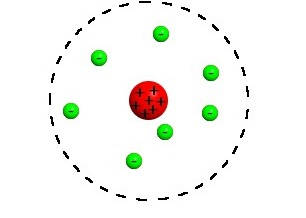
Whose model suggested that negative particles were mixed in with positively charged material - like seeds in a watermelon?

a)

J.J. Thomson

b)

Ernest Rutherford

c)

Niels Bohr

d)

Albert Einstein

2.

Who discovered that the atom had an small, dense, positively charged center?

a)

Ernest Rutherford

b)

J.J Thomson

c)

Robert Millikan

d)

John Dalton

3.

Place the following atomic models in order, from earliest to latest:


A) Rutherford B) Thomson C) Dalton

a)

B, C, A

b)

C, A, B

c)

A, C, B

d)

C, B, A

4.
What can you conclude from the fact that scientists continue to update the atomic model?
a)
New information about atoms continues to be discovered
b)
Old information about atoms is completely useless
c)
Scientists did not have any information about atoms until a few years ago
d)
Scientists still have no idea what atoms look like
5.

Who named the positive center of the atom the "nucleus?"

a)

Democritus

b)

Dalton

c)

Thomson

d)

Rutherford

6.

Which scientists believed an atom was indivisible? (Choose all correct responses.)

a)

Democritus

b)

Dalton

c)

Thomson

d)

Rutherford

7.

Which scientist believed that elements differed from one another because their atoms had different mass?

a)

Democritus

b)

Dalton

c)

Thomson

d)

Rutherford

8.

In the atomic model nicknamed the "plum pudding" model, what do the plums represent?

a)

the nucleus

b)

the atom

c)

the electrons

d)

the positive material

9.

Which scientist proposed a new atomic model after discovering the electron in 1897?

a)

Dalton

b)

Thomson

c)

Rutherford

d)

Bohr

10.

Who discovered that atoms are mostly empty space?

a)

Dalton

b)

Thomson

c)

Rutherford

d)

Bohr

11.

In the model nicknamed "the solar system model" what are the electrons like?

a)

the sun

b)

the nucleus

c)

the planets

d)

the moon

12.

Who proposed that electrons move around the nucleus in circular orbits?

a)

Dalton

b)

Thomson

c)

Rutherford

d)

Bohr

13.
This model this model was the first to show a nucleus, consisting of protons and neutron.  Electrons surround the nucleus but are not shown in distinct energy levels. 
a)
The "Rutherford Model" of the atom
b)
The "Plum Pudding Model" of the atom
c)
The "Quantum Mechanical Modell" of the atom
d)
Democritus's model of the atom
14.
This was the first model of the atom ever proposed. It was simple and described atoms as tiny spheres that could not be broken down into smaller pieces.
a)
Democritus's model of the atom
b)
The "Plum Pudding Model" of the atom
c)
The "Rutherford Model" of the atom
d)
The "Quantum Mechanical Model" of the atom
15.
This model added on to previous models by showing electrons existed at certain "energy levels". However it does not accurately show what those levels look like.
a)
The "Bohr Model" of the atom
b)
The "Rutherford Model" of the atom
c)
The "Plumb Pudding Model" of the atom
d)
The "Quantum Mechanical Model" of the atom
16.
This model was developed after J.J. Thompson discovered electrons, a particle smaller than an atom. Is shows electrons floating freely in a positive space.
a)
The "Plum Pudding Model" of the atom
b)
The "Rutherford Model" of the atom
c)
Democritus's model of the atom
d)
The "Quantum Mechanical Model" of the atom
17.
Ernest Rutherford discovered that atoms were mostly _________________. 
a)
negatively charged
b)
positively charged
c)
electrons
d)
empty space. 
18.
What does the nucleus of an atom contain?
a)
Electrons & Neutrons
b)
Protons & Neutrons
c)
Neutrinos & Positrons
19.
In the gold foil experiment, most of the positively charged alpha particles passed through the gold foil, but some were deflected or bounced back.  What did we conclude because of this?  
a)
Atoms are small indivisible spheres
b)
Atoms are mostly empty space with a small, dense, positive center
c)
Atoms have negatively charged particles which orbit the nucleus
d)
Light is a wave, not a particle
20.
Discovered the electron using cathode ray tube
a)
Joseph Thomson
b)
John Dalton
c)
Ernest Rutherford
d)
Robert Millikan
21.
His atomic model included a dense positive core in an atom, surrounded by negatively charged particles
a)
Joseph Thomson
b)
Niels Bohr
c)
Ernest Rutherford
22.
Idea was of an indivisible particle of matter he called "atomos"
a)
John Dalton
b)
Aristotle
c)
Democritus
d)
Plato
23.
What scientist is best known for his gold foil experiment?
a)
J.J. Tomson
b)
Ernest Rutherford
c)
John Dalton
d)
Democritus
24.

An atom is electrically neutral because

a)

the numbers of protons and neutrons are equal.

b)

the numbers of protons and electrons are equal.

c)

neutrons balance the protons and electrons.

25.

Which of the following does the nucleus contain?

a)

protons and electrons

b)

neutrons and electrons

c)

protons and neutrons

26.

Which of the following statements is correct?

a)

Protons are positively charged and neutrons are negatively charged.

b)

Protons are negatively charged and electrons are positively charged.

c)

Protons are positively charged and electrons are negatively charged.

27.

Which model of the atom is denoted as the "plum pudding" model?

a)

A

b)

B

c)

C

d)

D

e)

E

28.

Chadwick is credited with discovering which part of the atom?

a)

nucleus

b)

protons

c)

electrons

d)

neutrons

29.

Who is credited with developing model D?

a)

Thomson

b)

Dalton

c)

Bohr

d)

Rutherford

30.

What is the meaning of the greek word "atomos"?

a)

Invencible

b)

Invisible

c)

Indivisible

d)

Independent

31.

Which model of the atom is denoted as the "billiard ball" model?

a)

A

b)

B

c)

C

d)

D

e)

E

32.

Which model of the atom is denoted as the "electron cloud" model?

a)

A

b)

B

c)

C

d)

D

e)

E

33.

Which model of the atom is denoted as the "planetary" model?

a)

A

b)

B

c)

C

d)

D

e)

E

34.
The section labeled D is known as the?
a)
Electron cloud
b)
Neutron
c)
Nucleus
d)
Electron
35.
Letter A Is positively charged particle called?
a)
Neutron
b)
Proton
c)
Electron
d)
Atom
36.
How many electron shells does this atom have?
a)
1
b)
2
c)
3
d)
4
37.
How many protons does this element have?
a)
6
b)
4
c)
2
d)
3
38.
The smallest unit of matter is called?
a)
An electron
b)
An element
c)
An atom
d)
A solid
39.

What subatomic particles make up the nucleus of an atom?

a)

electrons

b)

protons

c)

neutrons

d)

leptons

e)

mesons

40.

Dalton's model of the atom is represented by which letter?

a)

A

b)

B

c)

C

d)

D

e)

E

41.

Where is number two pointing at?

a)

Nucleus

b)

Protons

c)

Neutrons

d)

Electron cloud