
 Worksheets
Unit IV AP Microeconomics
Total questions: 42
Worksheet time: 51mins
A monopoly can price discriminate between two groups of consumers if each group has
a large consumer surplus.
a different willingness to pay.
the same willingness to pay.
the ability to resell the good to the other group.
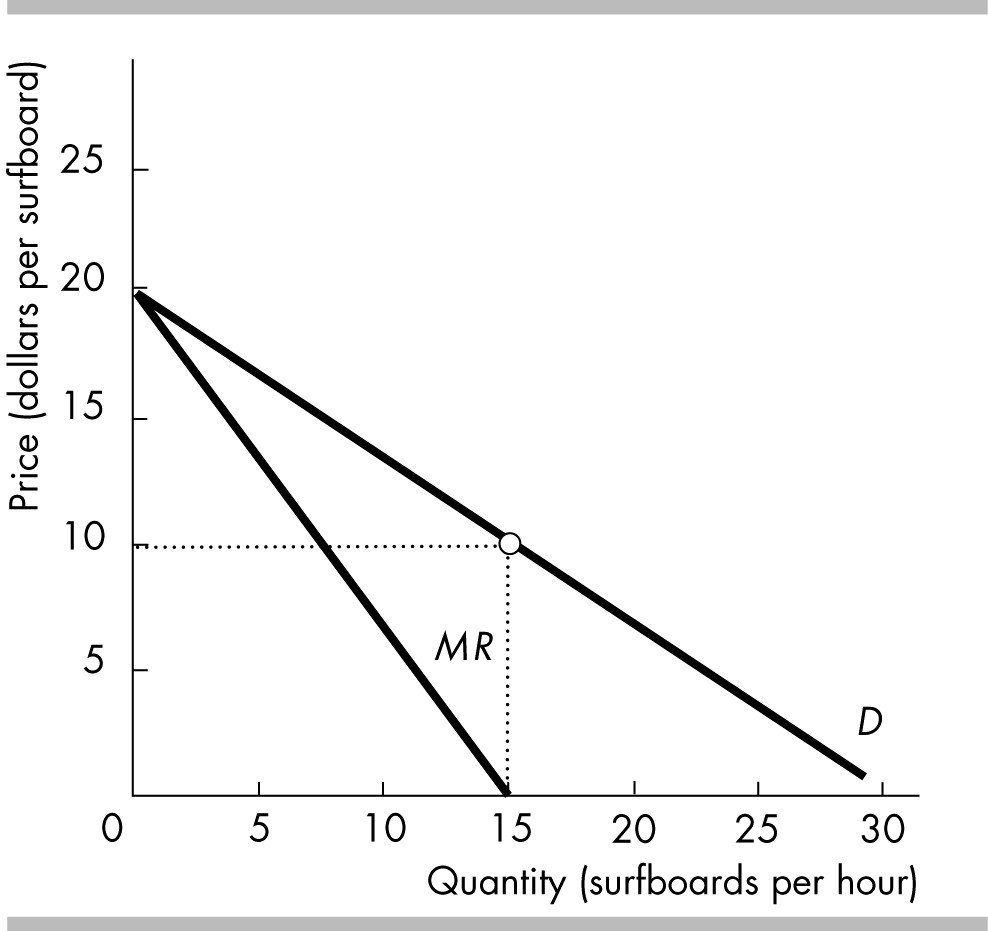
Sue's Surfboards is the sole renter of surfboards on Big Wave Island. Sues demand and marginal revenue curves are illustrated in the figure above. Sue's Surfboards currently rents 15 surfboards an hour. Sue's total revenue from the 15 surfboards is
$300
$220
$150
$100
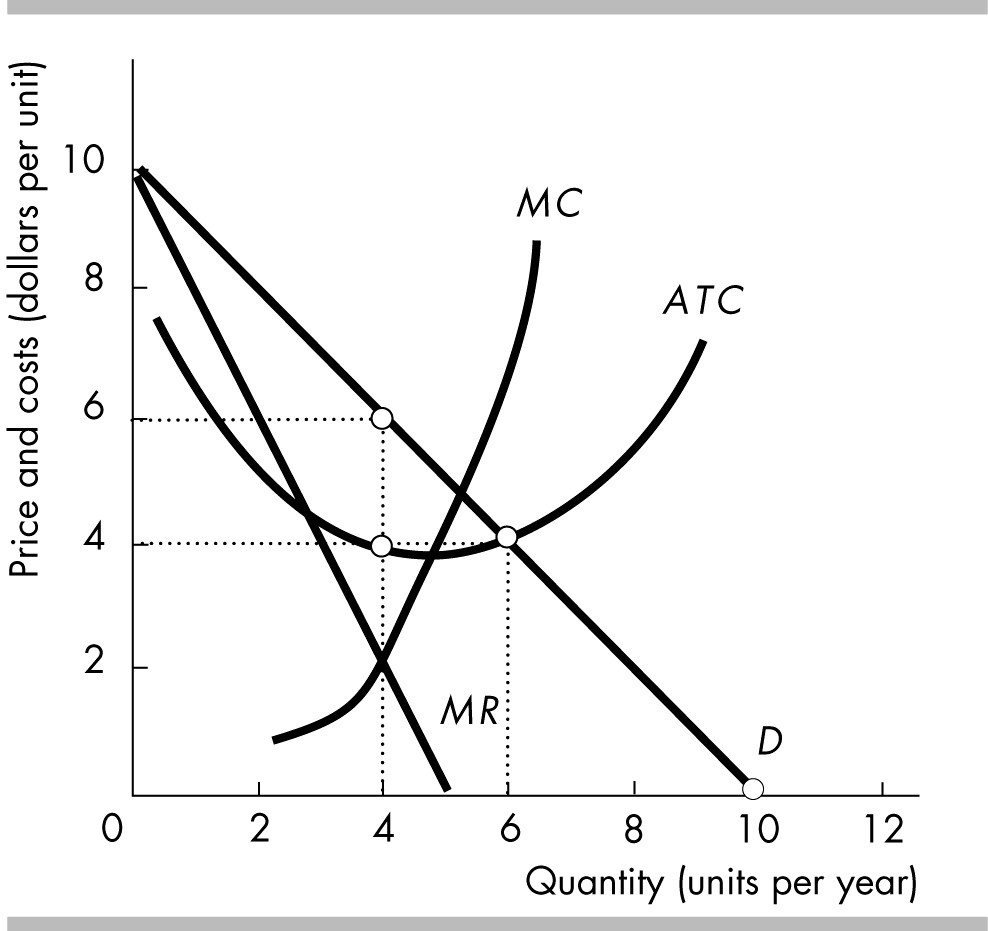
For the unregulated, single-price monopoly shown in the figure above, when its profit is maximized, output will be
4 units per year and the price will be $6.
4 units per year and the price will be $4.
6 units per year and the price will be $4.
None of the above answers is correct.
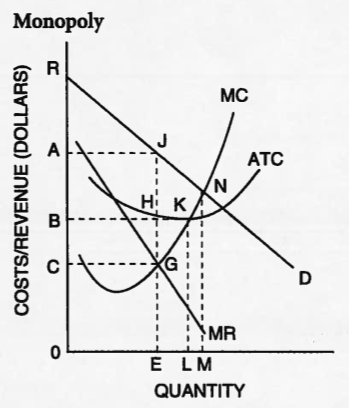
If this monopolist is given a lump-sum subsidy its output would
increase to M. A lump-sum subsidy shifts the firm's MC curve to the right.
increase to L. A lump-sum subsidy shifts the firm's MC curve to the left.
decrease by the amount of the subsidy.
remain at E. A lump-sum subsidy does not shift the firm's MC curve.
There is not enough information to answer the question.
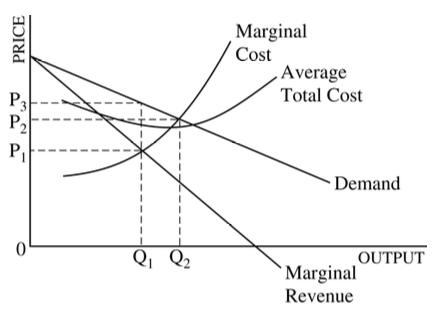
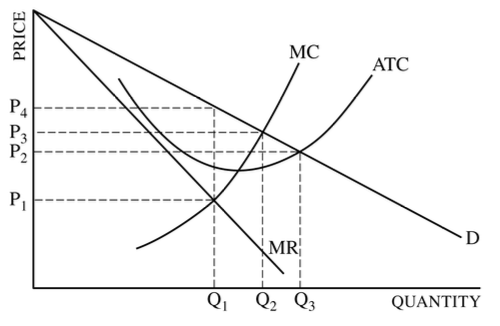
If the monopolist were to produce at the socially optimal output, quantity and price would be
Q1, P4
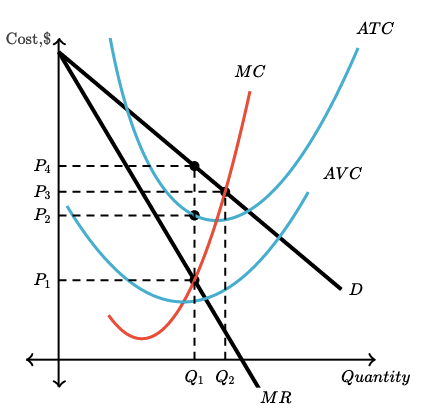
For the graph shown here, what quantity will this firm produce and what price will it charge?
Q2 ; P2
Q2 ; P3
Q1 ; P1
Q1 ; P2
Q1 ; P4
All of the following are imperfectly competitive markets EXCEPT:
monopolistic competition
pure competition
monopoly
oligopoly
monopsony
Priya’s Party Supplies sells cake toppers in a market with many other sellers, but each seller has their own version of cake toppers.
Which of the following statements is true based on this information?
Priya produces a socially optimal quantity.
Priya produces in a perfectly competitive industry.
Priya’s marginal revenue curve is less than her demand curve.
Priya can charge whatever price she wants to for her cake toppers.
Priya’s average total cost curve is below her average variable cost curve.
Which of the following is true about production in an imperfectly competitive market?
Choose 1 answer:
The amount produced minimizes marginal cost.
Less is produced than is socially optimal.
The amount produced minimizes average total cost.
More is produced than is socially optimal.
The amount produced is the same as in perfect competition.
Firms in monopolistic competition do not attain allocative efficiency because at the long-run equilibrium
output, which of the following is true?
Price is greater than marginal cost.
Marginal cost is greater than minimum average total cost.
Marginal revenue is greater than marginal cost.
Products are homogeneous.
There is an overallocation of resources to the market.
Which of the following is true about an imperfectly competitive firm’s marginal revenue (MR) curve if it has a linear and downward-sloping demand curve?
MR decreases at an increasing rate.
MR increases at first, then decreases.
MR is constant.
MR decreases and is less than demand.
MR is greater than demand.
Price leadership and collusion often occur in this type of market structure
Laws that are meant to stop monopolies from forming are called?
Anti-Monopoly Laws
Anti-Trust Laws
When there is only one seller of a good or service, they are said to have a?
Monopoly
Oligarchy
Monopolistic Competition
Perfect Competition
If every consumers needs are being met perfectly and every good that is being made is being sold, what type of efficiency is being achieved?
Productive Efficiency
Allocative Efficiency
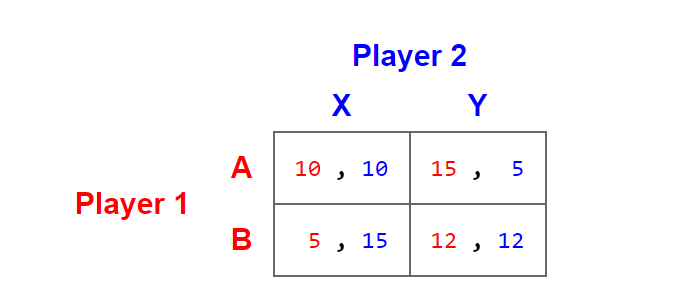
The amounts in the matrix represent potential profits to each player. What of the following correctly represents that game's nash equilibrium?
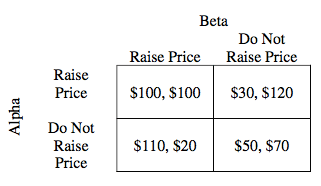
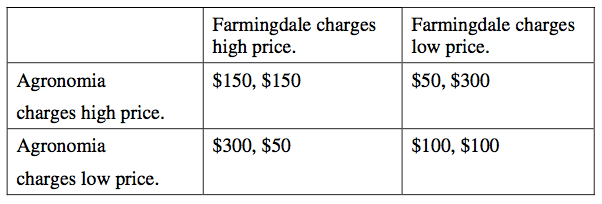
The cartel model of oligopoly predicts that
all firms in the industry act in unison to set monopoly price
each producer acts independently of others
firms follow the low-price firm in the industry
differences in cost of production discourage individual firms from cheating
the markup on marginal cost should be the same for all firms
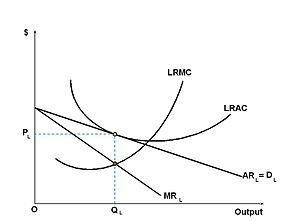
If this graph is for a monopolistically competitive firm, it best represents
short run economic loss.
short run extra-normal profit.
long run economic profit.
long run equilibrium at normal profit.
short run accounting loss.
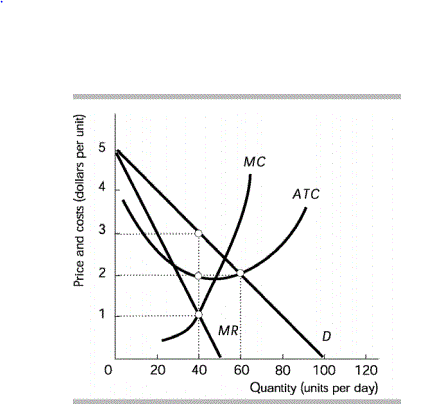
In the above figure, the monopolistically competitive will experience what change into the long run?
a right shift of it's demand curve.
a left shift of it's demand curve.
a right shift of it's supply curve.
a left shift of it's supply curve.
A monopolistically competitive firm maximizes profits or minimizes losses in the short run by
Setting price equal to marginal cost.
Producing at the output level where ATC is minimized.
Producing at the output level where MR equals MC.
Producing at the output level where MC equals ATC.
Which of the following characterizes monopolistic competition?
Price leadership.
Zero long-run profit.
Retaliation.
Marginal cost pricing.
If profits are negative in a monopolistically competitive market, then:
new firms will enter until profit returns to the optimal positive level.
new firms will enter the market until economic profits are zero.
firms will exit the market until economic profit returns to the optimal positive level.
firms will exit the market until economic profit returns to zero.
Game theory is used to explain
why firms price discriminate
how monopolies evolve into oligopolies
strategic behavior of firms in oligopoly
profit maximization in monopoly
price leadership of monopolistic competition
For the graph shown here, if the firm were regulated to the socially optimal / allocatively efficiency output and price the firm would produce at ___ and charge ___
Q2 ; P2
Q2 ; P3
Q1 ; P1
Q1 ; P2
Q1 ; P4
For the graph shown here, if this single price monopolist could now perfectly price discriminate the frim would produce at ___ and charge ___
Q2 ; P2
Q2 ; P3
Q1 ; P1
Q1 ; P2
Q1 ; P4
If this monopolist is given a per unit subsidy, what would happen to amount of consumer surplus?
increase due to MC shifting right and price falling
decrease due to MC shifting right and price rising
increase due to ATC shifting right and price falling
decrease due to ATC shifting right and price rising
not change
Assume the single price monopolist is producing at its profit maximizing output and price. If the monopolist raised its price, what would happen to its total revenues?
Total revenues would increase. The monopolist is producing in the inelastic portion of the demand curve.
Total revenues would increase. The monopolist is producing in the elastic portion of the demand curve.
Total revenues would decrease. The monopolist is producing in the elastic portion of the demand curve.
Total revenues would decrease. The monopolist is producing in the inelastic portion of the demand curve.
Total revenues would not change.
Firms in perfect and monopolistic competition will continue to produce in short run as long as
Price is greater than min ATC
Price is greater than min MC
Price is greater than min AVC
Price is greater than AVC
Price is greater than ATC

