Wayground logo

Free Printable Worksheets

Font size

S
M
L
XL
Worksheets

BSC Biology Year 9 Quiz

Total questions: 35

Worksheet time: 24mins

Name
Class
Date
1.

Which type of organisms depends DIRECTLY on light energy for its nutrition ?

a)

Carnivore

b)

Decomposer

c)

Herbivore

d)

Producer

2.
a)

A

b)

B

c)

C

d)

D

3.
a)

A

b)

B

c)

C

d)

D

4.

What converts nitrogen gas into a usable form for plants and animals?

a)

bacteria

b)

rain

c)

fungi

d)

car exhaust

5.

Organisms that need nitrogen to survive.

a)

only plants

b)

only animals

c)

only bacteria

d)

all living things

6.

How do animals get the nitrogen they need?

a)

From the air they breathe

b)

From the water they drink

c)

From the food they eat

d)

From the sun

7.

What is the process of combining nitrogen gas with other elements to make nitrogen into usable compounds?

a)

nitrogen composition

b)

nitrogen fixation

c)

ammonia

d)

denitrification

8.

What is the formula for atmospheric nitrogen?

a)

N

b)

N2

c)

NH3

d)

NO3

9.

Bacteria fix nitrogen from the atmosphere into a form plants can use.

a)

True

b)

False

10.

All plants have nitrogen fixing bacteria in their roots.

a)

True

b)

False

11.
Plants and animals need nitrogen to make __________.
a)
Protein
b)
Carbohydrates
c)
Lipids
d)
Minerals
12.
The process where excess nutrients enter a body of water causing overgrowth of aquatic plants and algae...
a)
Eutrophication
b)
Acid Precipitation
c)
Nitrogen Fixation
d)
Decomposition
13.
What does NOT produce carbon dioxide?
a)
Photosynthesis
b)
Burning Fossil Fuels
c)
Animal respiration
d)
Plants decaying
14.
Combustion is another word for __________.
a)
Transportation
b)
Respiration
c)
Fossil Fuels
d)
Burning
15.
Which of the following removes carbon from the atmosphere?
a)
Combustion
b)
Respiration
c)
Photosynthesis
d)
Death
16.
Respiration is the process by which animals take in _____ and release _____. 
a)
photosynthesis, air
b)
carbon, oxygen
c)
oxygen
d)
oxygen, carbon dioxide
17.
Pollution _________________________.
a)
is harmful materials put into the environment
b)
found in air, water, and land
c)
effects plants, animals, and people
d)
All of the above
18.
To reduce pollution in the environment, people should ______________ materials.
a)
recycle
b)
pollute
c)
throw away
d)
clean
19.
Which of the following does NOT cause water pollution?
a)
oil spills
b)
garbage
c)
fertilizers from farms
d)
smoke
20.
__________________ is using materials wisely to protect them.
a)
Pollution
b)
Conservation
c)
Recycling
d)
Smog
21.
What is one thing humans can do to positively impact the environment?
a)
They can throw their trash away anywhere. 
b)
They can recycle items if possible.
c)
They can empty their drinks into rivers and other water sources.
d)
They can work in factories that produce a lot of smoke.
22.
The car is creating ____________________.
a)
air pollution
b)
land pollution
c)
water pollution
d)
an oil spill
23.
Which of these problems can be caused by air pollution?
a)
Respiratory problems
b)
Reduced food sources for humans
c)
Increased disease for humans
d)
Decrease in global temperatures
24.
Which of the following is NOT a challenge to a growing population?
a)
Overcrowding
b)
Housing shortages
c)
Overuse of resources
d)
Increased food supplies
25.
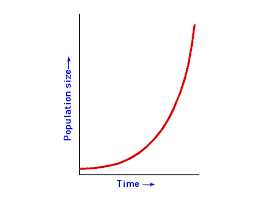
What type of growth is shown in the diagram?
a)
exponential growth
b)
logistic growth 
c)
predator-prey cycle
d)
boom-bust curve
26.
What is a producer?
a)
an organism that gets energy from eating other organisms
b)
an organisms that uses sunlight to make its own food
c)
an organism that gets energy from eating dead organisms, non-living material or waste
d)
an organism that uses chemical energy to make its own food
27.
What is a herbivore?
a)
an animal that gets energy from eating other animals
b)
an organism that gets energy from eating only plants
c)
an animal that gets energy by eating both plants and other animals
d)
an animal that eats only herbs
28.
What is this called?
a)
Food Web
b)
Food Chain
c)
Abiotic Factors
29.
What is the original source of almost all energy in most ecosystems?
a)
carbohydrates
b)
sunlight
c)
water
d)
carbon
30.
What does a food web represent?
a)
All connections of energy flow throughout all organisms in a habitat.
b)
The specific ways that mutualism is carried out.
c)
A single pathway or energy flow between organisms. 
d)
How carnivores get their food. 
31.
Members of a species in a defined area
a)
Ecosystem
b)
community
c)
biodiversity
d)
population
32.
Where an organism lives
a)
habitat
b)
niche 
c)
heterotrogh
d)
biosphere
33.
Non-living factor that affects an ecosystem
a)
biotic factor
b)
abiotic factor
c)
food chain 
d)
biome
34.
Organisms that breaks down and absorbs nutrients from dead organisms 
a)
consumer
b)
trophic level
c)
decomposer
d)
species
35.

Which is true of denitrification?

a)

It converts ammonia to nitrates

b)

It can occur due to lightning

c)

It converts nitrates to nitrogen gas

d)

It benefits the plant