wayground logo

Free Printable Worksheets

NEW

Font size

S
M
L
XL
Worksheets

Blood and Heart Review

Total questions: 36

Worksheet time: 32mins

Name
Class
Date
1.

Identify the correct function of white blood cells

a)

Transport oxygen to the working muscles

b)

Fight infection and disease

c)

Form scabs around the site of a wound

d)

Allows the blood to flow

2.
The main purpose of Red Blood Cells is to 
a)
carry gases, wastes, and nutrients
b)
attack and destroy pathogens
c)
clot the blood
d)
digest food
3.
Which of the following is not a primary function of blood?
a)
help fight disease
b)
transports nutrients, oxygen, wastes, and hormones
c)
to provide structure 
d)
distributes heat
4.

Blood type is determined by the antigens present on the surface of RBCs.

a)

True

b)

False

5.

Which blood type is the universal donor?

a)

A

b)

B

c)

AB

d)

O

6.

The thickest and strongest blood vessel is the

a)

vein

b)

artery

c)

capillary

d)

both veins and capillaries

7.

Valves in veins

a)

support them

b)

protect them

c)

prevent the backward movement inside them

d)

provide them elesticity

8.
Carry blood away from heart; mostly oxygen-rich
a)
Arteries
b)
Veins
c)
Capillaries
9.
Carry blood toward heart; mostly oxygen-poor
a)
Arteries
b)
Veins
c)
Capillaries
10.

These are one cell thick

a)

arteries

b)

capillaries

c)

veins

11.

The blood vessel that carries oxygenated blood back to the heart

a)

vena cava

b)

pulmonary vein

c)

pulmonary artery

d)

hepatic portal vein

12.
The term that means heart contraction is ________.
a)
diastole
b)
systole
c)
tachycardia
d)
fibrillation
13.
Tunica _______, the middle layer of a typical blood vessel, contains smooth muscle and elastic fibers.
a)
intima
b)
externa
c)
media
d)
adventitia
14.
Pulmonary circulation involves blood flow to and from the heart and the _______.
a)
body
b)
digestive organs
c)
brain
d)
lungs
15.
When the ventricles contract, the bicuspid (mitral) valve prevents blood from flowing from the ________.
a)
right ventricle to right atrium
b)
left ventricle to left atrium
c)
left atrium to the right atrium
d)
right atrium to the left atrium
16.
The sinoatrial node is located in the ________.
a)
aorta
b)
right atrium
c)
left atrium
d)
right ventricle
17.
Which one of the following represents the correct path for the transmission of an impulse in the intrinsic conduction system of the heart?
a)
AV node, Bundle of His, SA node, Purkinje fibers, bundle branches
b)
SA node, AV node, Bundle of His, bundle branches, Purkinje fibers
c)
SA node, Bundle of His, AV node, Purkinje fibers, bundle branches
d)
SA node, Bundle of His, bundle branches, Purkinje fibers, AV node
18.
In a fetus, the lungs are nonfunctional and can be
a)
bypassed.
b)
utilized.
c)
inflated.
19.
This is the opening in the fetal heart that allows blood to move directly from the right to the left atrium.
a)
foramen ovale
b)
umbilical artery
c)
umbilical vein
d)
pulmonary bypass
20.
The fetus receives all of its oxygen and nutrients from the mother through the 
a)
umbilical vein.
b)
umbilical artery.
c)
foramen ovale.
d)
pulmonary vein.
21.

what does an atrium do

a)

let blood in

b)

let blood out

c)

exchange gases

d)

remove waste

22.

what does a ventricle do

a)

force blood out

b)

let blood in

c)

exchange gases

d)

remove waste

23.
An electrocardiogram measures what?
a)
The amount of pressure exerted on blood vessels.
b)
The electrical activity of the heart.
c)
How many times the heart contracts over time.
d)
The body's temperature caused by friction of blood in vessel.
24.
The p-wave correlates with which event?
a)
atrium contraction /signals moving from SA node to AV node
b)
ventricle contraction
c)
ventricle repolarization
d)
both atrial and ventricle contraction
25.
The t-wave correlates with which event?
a)
atrium contraction /signals moving from SA node to AV node
b)
ventricle contraction
c)
ventricle repolarization
d)
both atrial and ventricle contraction
26.
The QRS-wave correlates with which event?
a)
atrium contraction /signals moving from SA node to AV node
b)
ventricle contraction
c)
ventricle repolarization
d)
both atrial and ventricle contraction
27.
name of the valve that separates right atrium from right ventricle.
a)
tricuspid
b)
aortic
c)
mitral
28.
Valve that blood is forced through from right ventricle into pulmonary arteries.
a)
pulmonary valve
b)
aortic valve
c)
mitral valve
29.

Your heart always pumps at the same rate.

a)

True

b)

False

30.

The main artery in the heart is the

a)

aorta

b)

vena cava

c)

pulmonary artery

d)

pulmonary flow

31.

When you go to the doctor and they want to see how hard your heart is pumping, they take your...

a)

blood pressure

b)

temperature

c)

pulse

d)

name and address

32.
What carries the oxygenated blood from the lungs to the left atrium of the heart?
a)
vena cava 
b)
aorta
c)
pulmonary vein
d)
pulmonary artery
33.
As the right ventricle contracts, the blood flows into the 
a)
Heart
b)
Pulmonary arteries 
c)
Atrium
d)
Ventricle 
34.

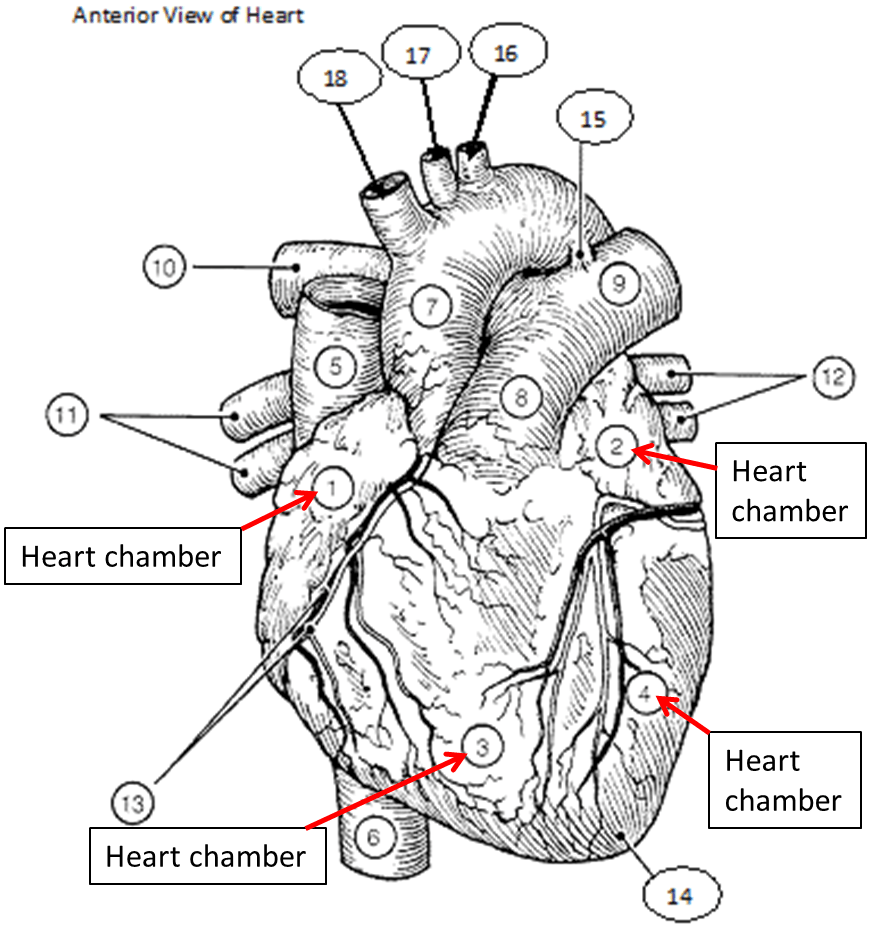
Name the structure labeled #2

a)

Right atrium

b)

Left atrium

c)

Right Ventricle

d)

Left Ventricle

e)

Aorta

35.

Name the structure labeled #13

a)

Coronary Circulation (coronary arteries and veins)

b)

apex of heart

c)

Ligamentum Arteriosum

d)

Left Subclavian artery

e)

Left Common Carotid artery

36.

Name the structure labeled #7

a)

tricuspid valve/right A.V. valve

b)

Pulmonary semilunar valve

c)

Inferior Vena Cava

d)

Right atrium

e)

right ventricle