Wayground logo

Free Printable Worksheets

Font size

S
M
L
XL
Worksheets

E-1 Review

Total questions: 79

Worksheet time: 2hrs 36mins

Name
Class
Date
1.
According to the Big Bang Theory, which graph best represents the relationship between time and the size of the universe from the beginning of the universe to the present?
a)
Size decreasing as time increases
b)
Size and time both increasing
c)
Size does not change as time increases
d)
Size increases, then decreases as time increases
2.
Which of the following is evidence of the Big Bang Theory?
a)
Cavemen heard a loud bang at the beginning of time.
b)
The universe isn't moving
c)
The universe is expanding
d)
The universe is getting smaller
3.
Which of the following is NOT evidence of the Big Bang Theory?
a)
Abundance of Hydrogen and Helium
b)
CMBR everywhere
c)
Stars that are blue shifted
d)
the universe is getting bigger
4.
What is the CMBR
a)
The shape of the universe
b)
The first primordial elements
c)
Red shifted galaxies
d)
Leftover heat from the Big Bang 
5.
How did the discovery of Cosmic Microwave Background Radiation support the Big Bang Theory?
a)
It suggests that Hydrogen and Helium were the first elements to form.
b)
It confirms the age of the Earth to be around 5 billion years old.
c)
It supports the idea that the universe used to be hotter.
d)
It demonstrates that the universe continues to expand.
6.
Which statement best describes the age of our solar system and universe?
a)
Our solar system and the universe are estimated to be 5 billion years old.
b)
Our solar system and the universe are estimated to be 10 billion years old.
c)
Our solar system is at least twice as old as the universe.
d)
The universe is roughly 13.7 billion years old.
7.
Which of the following is NOT true about the Big Bang Theory?
a)
It is the scientific explanation of how life began on Earth and evolved over time.
b)
It is the scientific explanation for the origin of the universe.
c)
It states that the universe expanded from a single point and is still expanding today.
d)
It states that the universe used to be much hotter and smaller.
8.
What can we conclude from the observation that nearly all galaxies are moving away from us?
a)
Massive black holes are drawing galaxies away from Earth.
b)
The Sun and Earth are located at the center of the universe.
c)
Everything in the universe is moving the same direction.
d)
The once-smaller universe is expanding in all directions.
9.
Which of the following best describes the expansion of the universe?
a)
As space expands, matter spreads out to fill up the empty space.
b)
Expansion involves the spreading of matter into infinite and empty space.
c)
As space expands the empty space between matter increases.
d)
As space expands, matter continually is created to fill that space.
10.
As part of the modern theory of the origins of the elements, it is hypothesized that before the formation of the stars, most of the matter in the universe consisted of what atoms?
a)
hydrogen and helium
b)
nitrogen and carbon
c)
silicon and lithium
d)
uranium and radium
11.
If a star is being observed from Earth and it's light has shifted towards the blue side of the electromagnetic spectrum it would be...
a)
Moving towards the Earth
b)
Moving away from the Earth
c)
This is a trick question that cannot be answered
d)
It isn't a star, it is a very large blueberry.
12.
The vast majority of galaxies in our universe are moving away from us.  We know this because we observe __________ in the galaxies absorption spectra.
a)
Redshift
b)
Blueshift
c)
Turbulance
d)
Superposition
13.

What characteristics are used to classify stars?

a)

Flammability, weight, and reactivity

b)

Temperature/color and brightness

c)

Conductivity, luster, and density

d)

Malleability, distance, and viscoscity

14.

Which star is hotter than Deneb

a)

Procyon

b)

Sun

c)

Regel

d)

Banard's Star

15.

Which star is brighter than the sun?

a)

Sirius B

b)

Procyon B

c)

Van Maanan's Star

d)

Aldebaran

16.

Which star is considered a supergiant?

a)

Sirius B

b)

Sun

c)

Betelgeuse

d)

Van Maanan's Star

17.

Which of the following lists the lifecycle of a star correctly?

a)

Supergiant, Giant, Dwarf, Nebula

b)

Supernova, Supergiant, Giant, Dwarf

c)

Dwarf, Main Sequence, Supergiant, Giant

d)

Main Sequence, Giant, Supergiant, Dwarf

18.

True or False: White dwarfs are warmer and dimmer than giants.

a)

True

b)

False

19.

What is the Hertzsprung-Russel Diagram?

a)

A map which tells the approximate location of stars in the Milky Way galaxy and their distance from Earth.

b)

A table that alphabetically lists stars by name and includes dates of when the star was first charted.

c)

A chart which organizes stars into categories based on the amount of Hydrogen they burn.

d)

A graph used to classify stars according to their luminosity, color, temperature, and stage.

20.

Knowing the color of a star also tells us its __________

a)

age

b)

location

c)

temperature

d)

name

21.

Which of the following statements is the most accurate statement for the element of Hydrogen?

a)

It is the most abundant element found in stars.

b)

It is a not found in many stars.

c)

It is only found in dwarf stars and supergiants.

d)

It causes stars to go supernova.

22.
A large cloud of gas and dust in interstellar space; the predecessor to stars...
a)
Constellation
b)
Black hole
c)
Nebula
d)
Galaxy
23.
As a whole, Giants are considered hotter than White Dwarfs.
a)
True
b)
False
24.
In the diagram given, what happens as we move to the left?
a)
Stars Get Larger
b)
Stars get Colder
c)
Stars get hotter
25.
Compared to the rest of the stars, our sun is considered...
a)
Extremely Large and Cold
b)
Small with a medium temperature
c)
Medium size with medium temperature
26.
Which category is our Sun located in?
a)
White Dwarfs
b)
Supergiants
c)
Main Sequence
d)
Giants
27.
The category that contains the most stars is...
a)
Main Sequence
b)
Supergiants
c)
Giants
28.
Stars are formed from big clouds of gas and dust is known as a ______. 
a)
clouds grande
b)
BCOG's
c)
neutron clouds
d)
nebulae
29.
The only force acting on the nebulae is ________.
a)
thermal
b)
singular
c)
gravity
d)
microscopic
30.
A star is born when ________________ begins to happen.
a)
nuclear fusion
b)
nuclear abrasion
c)
crying
d)
nuclear fission
31.
Larger, cooler stars are called ___________.
a)
Blue Giants
b)
White Dwarfs
c)
Red Giants
d)
Yellow Giants
32.
When a massive star begins to cool and expand it is known as a _______________.
a)
Blue Supergiant
b)
Red Giant
c)
Red Supergiant
d)
White Dwarf
33.
When the core of a Red Supergiant collapses, a bright event known as a ___________ occurs.
a)
superdupernova
b)
supernova
c)
big bang
d)
black hole
34.
After a supernova, the core can collapse into a neutron star, or if massive enough even a ___________.
a)
Black Hole
b)
White Dwarf
c)
Brown Dwarf
d)
Black Dwarf
35.
When a Red Giant's outer atmosphere drifts away it is now known as a ____________.
a)
planetary cloud
b)
White Dwarf cloud
c)
planetary nebula
d)
expanding nebula
36.
One possible outcome that is left after a supernova is a super dense core called a _____________.
a)
neutron star
b)
Yellow Star
c)
Red Giant
d)
Black Dwarf
37.
Everything you see around you was made inside ________.
a)
the earth
b)
factories
c)
stars
d)
an oven
38.
The stable period of a star’s life cycle is called... 
a)
The birth of a star
b)
Nebula 
c)
Neutron star
d)
Main Sequence 
39.
Hotter stars appear to be what color? 
a)
Red
b)
Blue
c)
Yellow
d)
Green
40.
Cooler stars appear to be what color? 
a)
Red
b)
Blue
c)
Yellow
d)
Green
41.
What fuel do stars use? 
a)
Oxygen
b)
Hydrogen
c)
Carbon
d)
Iron
42.
Larger stars (stars with more mass) have a longer life cycle. 
a)
True
b)
False
43.
The energy from the sun is created by a process called:
a)
nuclear fission
b)
nuclear fusion
c)
nuclear reaction
d)
nuclear core
44.

____________are areas of gas on the sun that are cooler than the gas around them.

a)

Solar Wind

b)

Solar Flares

c)

Sunspots

d)

Core

45.
Energy is created in the core when two _____________ atoms join together to form a ______________ atom.
a)
helium, hydrogen
b)
carbon, hydrogen
c)
nitrogen, helium
d)
hydrogen, helium
46.
In which area of the sun does gas rise as it heats up, then fall back down as it cools?
a)
the core
b)
the radiation zone
c)
the convection zone
d)
the corona
47.

When we look at the sun, what layer are we viewing? (Dropped for year 23-24)

a)
photosphere
b)
chromosphere
c)
corona
d)
convection zone
48.

What layer can be seen here? (Dropped for year 23-24)

a)
chromosphere
b)
corona
c)
photosphere
d)
core
49.
What is the sun mostly made up of
a)
Helium
b)
Core
c)
Carbon
d)
Hydrogen
50.

a brief burst of energy from the sun’s photosphere (dropped for 23-24)

a)
corona
b)
solar flare
c)
solar wind
d)
photosphere
51.

Label Part 3 (dropped for year 23-24)

a)
#3 Chromosphere
b)
#3 Radiation zone
c)
#3 Convection zone
d)
#3 Photosphere
52.

When prominences erupt into space releasing gas and energy we call this: (Dropped for year 23-24)

a)
solar winds
b)
coronal outburst
c)
solar flares
d)
auroras
53.

What are the Sun's layers of atmosphere from lowest to highest layer? (dropped for year 23-24)

a)

Core, Radiative Zone, Convection Zone

b)

Corona, Chromosphere, Photosphere

c)

Convection Zone, Radiative Zone, Core

d)

Photosphere, Chromosphere, Corona

54.

The Sun produces energy by fusing hydrogen atoms into helium atoms in the _____.

a)

Radiative Zone

b)

Convective Zone

c)

Core

55.
Mercury, Venus, Earth, and Mars are called.....?
a)
Jovian Planets
b)
Awesome Sauce Planets
c)
Gas Giants
d)
Inner Planets
56.

Which planet is the hottest? (Solar System Project)

a)
Earth
b)
Neptune
c)
Mercury
d)
Venus
57.
What do we call Jupiter, Saturn, Uranus and Neptune?
a)
Outer Planets
b)
Terrestrial Planets
c)
Inner Planets
d)
Oort Cloud
58.
What is the big bang theory?
a)
A movie
b)
A planet
c)
A theory of how Jupiter will crash into Saturn
d)
A theory of how the Universe began
59.
What is the only planet known to contain life?
a)
Mars
b)
Earth
c)
Neptune
d)
Uranus
60.

What characteristic is Jupiter known for? (Solar System Project)

a)
Rings of ice and dust
b)
Great Red Spot
c)
Olympus Mons
d)
Fire
61.

Which planet is known for having an extreme tilt on its axis causing extreme seasons? (Solar System Project)

a)
Neptune
b)
Mercury
c)
Venus
d)
Uranus
62.

What characteristics do Earth and Venus share? (Solar System Project)
a)
They rotate in the same direction
b)
They are both similar size and density
c)
They have the same gases in their atmospheres
d)
They were born at the same time
63.
What is one factor that makes life on Earth possible?
a)
Water
b)
High gravity
c)
Elliptical Orbit
d)
Hydrogen
64.
Which planet is now characterized as a dwarf planet?
a)
Neptune
b)
Pluto
c)
Miss Best
d)
Coca-cola
65.
Which is the largest object in our solar system?
a)
Sun
b)
Jupiter
c)
Earth
d)
Pluto
66.
Which planet is closest to the sun?
a)
Uranus
b)
Mercury
c)
Neptune
d)
Earth
67.
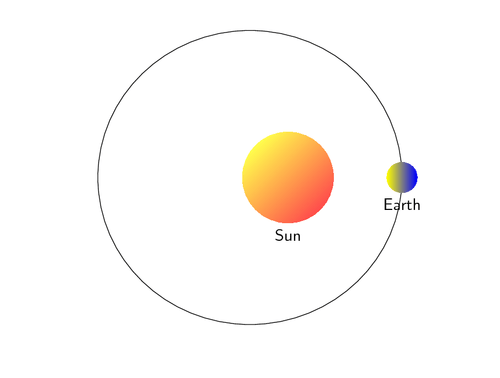
This picture shows the path Earth takes as it moves around the sun. What is the path called?
a)
a constellation
b)
a moon
c)
an orbit
d)
a planet
68.

Which planet is the largest? (Solar System Project)

a)
Earth
b)
Jupiter
c)
Neptune
d)
the Sun
69.
Which is not evidence for the geocentric model?
a)
The sun moves across the sky from east to west every day.
b)
The moon moves around the Earth every day.
c)
The stars move across the sky every night.
d)
The planets display retrograde movement in the sky. 
70.
A model of the solar system in which Earth and the other planets revolve around the SUN.
a)
Heliocentric
b)
Geocentric
71.
A model of the universe in which Earth is at the center of the revolving planets and stars. This includes the sun revolving around the Earth. This model is no longer supported.
a)
Geocentric
b)
Heliocentric
72.

What keeps the planets in their orbits around the sun?

a)

String

b)

Gravity

c)

The Milky Way.

73.
Planets that are closer to the sun
a)
take more time to orbit
b)
take less time to orbit
74.
What are the first four terrestrial planets made of?
a)
Gas
b)
Rock
c)
Metal
d)
Ice
75.
Which planet takes the LONGEST to revolve around the sun? What type of planet is this?
a)
Mars, Gas
b)
Neptune, Terrestrial
c)
Uranus, Gas
d)
Neptune, Gas
76.
The further the planet is from the sun, the ________
a)
Longer the year on that planet
b)
Fewer moons the planet will have
c)
Shorter the day on that planet
d)
Fewer rings the planet will have
77.
Identify the gas giant planets.
a)
Neptune, Mars, Venus, Jupiter
b)
Venus, Mercury, Mars, Earth
c)
Mars, Saturn, Sun, Earth
d)
Jupiter, Saturn, Uranus, Neptune
78.
What are the planets Jupiter, Saturn, Uranus and Neptune made of? 
a)
Gas
b)
Rock
c)
Ice
d)
Dust
79.
What are three characteristics the outer planets have in common?
a)
They are made of rock, close to the sun and have a short year.
b)
They are made of rock, have 1-2 moons and are made of metal.
c)
First four planets, have many moons and rings.
d)
Made of gas, many moons and rings.