
 Worksheets
Stellar Evolution
Total questions: 46
Worksheet time: 29mins


What is the first phase in the life cycle of a star?
molecular gas cloud
protostar
main sequence star
white dwarf
Once a star uses up all of the _________ in its core, the star will expand into a giant or supergiant
light
heat
energy
hydrogen

What determines if a star becomes a giant or a supergiant?
star mass
star temperature
star color
star luminosity

A hypothetical star cluster produces the HR diagram shown. This is known as:
Zero-age main sequence
A globular cluster
An open cluster
The CNO sequence

The image shown is an example of a(n) _____________
Open cluster
Globular cluster
Shockwave
Black hole

The image shown is an example of a(n) _________________
Globular cluster
Open cluster
Time dilation
Planetary nebula

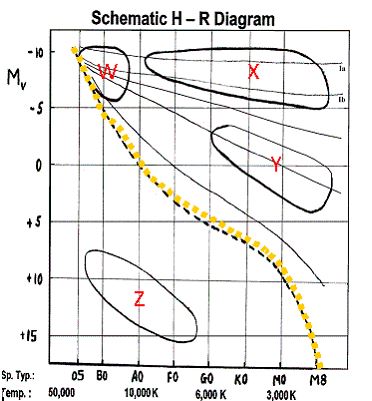
The line in yellow shows the life sequence of a
high mass star
low mass star
neutron star
globular cluster

After a low mass star sheds its outer layers into a planetary nebula, it leaves behind its core, called a
White Dwarf
Neutron Star
Protostar
Zero-age main sequence
When a large enough mass of instellar gas compresses, it begins to heat up and rotate. At this point, a __________ has formed.
giant molecular cloud
protostar
red giant
planetary nebulae


main sequence>
red giant >
white dwarf
main sequence>
white dwarf>
red giant
protostar>
white dwarf>
red giant
red giant >
main sequence>
white dwarf

Very massive stars continue to fuse elements in their cores all the way up to...
helium (He)
iron (Fe)
carbon (C)
plutonium (Pu)
Which of the following would NOT be useful information for helping to classify stars?
the constellation they are a part of
the mass of the star
the amount of light given off by a star
the color of the star

How do star clusters form?
by collapsing molecular clouds in interstellar space
by a congregation of mass through black holes
through massive shock waves
through worm holes in space/time

All stars in a cluster are about the same age. Why?
the big bang made all stars equal
because they're all made of hydrogen
they formed from the same material in the same region
because they all started out as protostars

"Open" star clusters are groups of ____ of stars that are gravitationally bound.
millions
billions
dozens
hundreds of thousands

The Pleiades - also known as the "Seven Sisters" are a good example of a nearby
stellar association.
open cluster.
emission nebula.
group of stars.

How do astronomers know that globular clusters are some of the oldest objects in the Universe?
because astronomers can predict stellar evolution
there are no young O, B, A & F stars present in the clusters
because globular clusters orbit every large galaxy
globular clusters are very rare since only 150 exist
What the last element to be produced before a low-mass star collapses?
Helium
Oxygen
Silicon
Iron
What the last element to be produced before a high-mass star collapses?
Helium
Oxygen
Silicon
Iron
What event causes heavier elements to scatter across the universe?
Nuclear Fusion
Supernova
Nucleosynthesis
Convection
What will the sun, a low-mass star, ultimately form?
A black hole
A neutron star
A white dwarf
A supernova

After the main sequence, a high mass star becomes a
black dwarf
protostar
red giant
supergiant

This HR Diagram overlays data from many star clusters. According to this diagram, which cluster is oldest?
M67
The Pleiades
NGC 2362
The Hyades
This HR Diagram overlays data from many star clusters. According to this diagram, which cluster is youngest?
M67
The Pleiades
NGC 2362
The Hyades
In which region of the H-R Diagram would you be likely to find the youngest stars?
W
X
Y
Z

Astronomers can age star clusters by
Examining an HR Diagram for the stars in the cluster to see where the stars depart the main sequence
Examining an HR Diagram for the stars in the cluster to count how many white dwarf stars are present
Examing the spectra of any star in the cluster
Examining the space around the cluster
A very old star cluster is expected to
Have many blue stars
Have an even distribution of stars
Have a lack of blue stars
Be extremely large

Some very old globular clusters have a handful of blue stars known as Blue Stragglers. These are probably present because
Old clusters tend to have more blue stars than red stars
Globular clusters are dense, and colliding stars sometimes combine and make new, young, hotter stars
Globular clusters are sparse, and there is nothing to disrupt the evolution of a blue star
Blue stars are short lived, and will have already died out

The image depicts the life route of a
Low mass star
High mass star
Blue star
White Dwarf
After a low-mass Red Giant loses its ability to fuse elements, it will shed it's outer layers and become a
Low mass star
High mass star
Blue star
White Dwarf

Low mass red giant stars participate in a fusion chain resulting in which products?
Carbon, Nitrogen, Oxygen
Helium, Carbon, Beryllium
Oxygen, Neon, Iron
Hydrogen, Helium, Carbon

