wayground logo

Free Printable Worksheets

NEW

Font size

S
M
L
XL
Worksheets

Enzymes

Total questions: 15

Worksheet time: 11mins
Name
Class
Date
1.
Some bacteria live in hot springs. Their cells contain enzymes that function best at temperatures of 70 °C or higher. At the temperature of 50 °C, how will the enzymes in these bacterial cells most likely be affected?
a)
The enzymes will be destroyed by lysosomes
b)
The enzymes will lose their bond structure and fall apart.
c)
The enzymes will require less energy to function than at 70 °C.
d)
The enzymes will not increase the rate of reactions as much as they would at 70 °C. 
2.
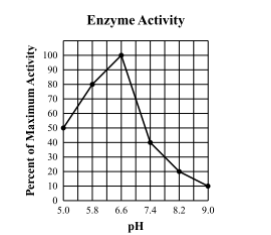
The graph below shows how the activity of an enzyme changes over a range of pH values. Which of the following conclusions can be drawn from this graph?
a)
The optimum pH of the enzyme is 6.6.
b)
The optimum pH of the enzyme is 5.8
c)
The enzyme’s activity continually increases as pH increases from 5.0 to 9.0
d)
The enzyme’s activity is greater around pH of 8.0 than around pH of 5.0.
3.
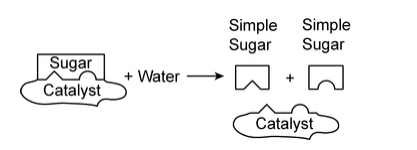
The diagram below illustrates a biochemical process that occurs in organisms. What is another name for the substance labeled "catalyst"?
a)
Enzyme
b)
inorganic compound
c)
Hormone
d)
Antibody
4.
Which of the following best explains why enzymes are necessary for many cellular reactions?
a)
Enzymes supply the oxygen necessary for the reactions
b)
 Enzymes change reactants from solid to liquids during the reactions.
c)
The reactions take up too much space in the cell if the enzymes are missing.
d)
The reactions are too slow to meet the needs of the cell if enzymes are missing. 
5.
What will most likely happen if an appropriate enzyme is added to a chemical reaction? 
a)
The reaction rate will increase.
b)
The equilibrium of the reaction will be maintained. 
c)
The reaction rate will decrease.
d)
The reaction will stop. 
6.

Enzymes speed up the rate of reaction by _________ the activation energy (EA).

a)

increasing

b)

decreasing

7.

Each enzyme only has 1 substrate that will fit its active site. What is this called?

a)

reusable

b)

reversible

c)

specificity

d)

denaturation

8.

With what 3 letters do enzymes typically end?

a)

-ose

b)

-ase

c)

-ate

d)

-ine

9.

Enzyme that catalyses the transfer of functional group of atoms from one molecule to another. This enzyme is __

a)

Isomerases

b)

Transferases

c)

Oxidoreductase

d)

Lyases

10.

Amylase

Lipase

Peptidase/Protease


These enzymes are example of

a)

Ligases

b)

Transferase

c)

Hydrolases

d)

Lyases

11.

Which class of enzyme catalyses the formation of bonds between two molecules using energy derived from the breakdown of ATP?

a)

Ligases

b)

Transferase

c)

Hydrolases

d)

Oxidoreductases

12.

It forms bonds by addition of the water component.

a)

Ligases

b)

Isomerases

c)

Hydrolases

d)

Oxidoreductases

13.

Which type of enzyme breaks bonds without the use of water?

a)

Ligases

b)

Transferase

c)

Hydrolases

d)

Lyases

14.

Kinases and aminases are examples of which class of enzyme?

a)

Isomerases

b)

Transferase

c)

Oxidoreductase

d)

Lyases

15.

The presence of an electron acceptor such as NAD+ indicates which type of enzyme?

a)

Isomerases

b)

Transferase

c)

Oxidoreductase

d)

Lyases