wayground logo

Free Printable Worksheets

Font size

S
M
L
XL
Worksheets

Science 6 Online Revision 8: SE 1

Total questions: 80

Worksheet time: 3600secs

Name
Class
Date
1.

How much did it rain in April?

a)

12 inches

b)

10 inches

c)

6 inches

d)

8 inches

2.

Sedimentary rocks form a thin layer on the Earth’s surface.

a)

True

b)

False

3.

Some living things have magnetic materials inside their bodies.

a)

True

b)

False

4.

The highest point on the Earth.

(a)  

5.
The layer of gases surrounding the Earth
a)
Hydrosphere
b)
Cryosphere
c)
Oxyosphere
d)
Atmosphere
6.
The outermost layer of the Earth that contains the continents and the oceans.
a)
mantle
b)
crust
c)
outer core
d)
inner core
7.
The layer of rock between the Earth's core and crust.
a)
outer core
b)
crust
c)
inner core
d)
mantle
8.
Solid metal layer at the center of the Earth.
a)
mantle
b)
outer core
c)
inner core
d)
crust
9.
The crust underneath the oceans.
a)
oceanic crust
b)
continental crust
c)
biosphere
d)
tectonic plates
10.
The plates that make up the Earth's crust that are responsible for continental drift.
a)
continental crust
b)
oceanic crust
c)
geologist
d)
tectonic plates
11.
Tectonic plates are still moving, causing continents to drift.
a)
True
b)
False
12.
What is the name of the Super-Continent that existed long ago?
a)
Wegener
b)
Pangaea
c)
Geocontinent
13.
Which layer is made up of iron and nickel?
a)
Crust
b)
Mantle
c)
Inner Core
d)
Lithosphere
14.
How would you describe our Earth's crust?
a)
brittle and rocky
b)
soft and rocky
c)
soft and sandy
d)
None of these
15.

The process of moving rocks and soil by water, wind, ice, and gravity.

a)

Erosion

b)

Weathering

c)

Metamorphic Rock

d)

Oil

16.

formed from the remains of once living things; includes oil, natural gas and coal.

a)

Fossil Fuel

b)

erosion

c)

weathering

d)

renweable resource

17.

A type of rock formed from melted rock that cools and hardens.

a)

igneous rock

b)

metamorphic rock

c)

sedimentary rock

d)

mineral

18.

Formed by high temperature & high pressure deep inside the Earth.

a)

metamorphic rock

b)

igneous rock

c)

sedimentary rock

d)

mineral

19.

formed when layers of sediment are pressed together over a long period of time.

a)

sedimentary rock

b)

metamorphic rock

c)

igneous rock

d)

mineral

20.

Which diagram shows compaction which leads to the formation of sedimentary rock?

a)
b)
c)
d)
21.

Erosion is major process in the formation of sedimentary rock. What is erosion?

a)

Rocks are broken into smaller pieces that remain the in same location.

b)

Pressure compacts layers of sediment and turns them into rock.

c)

Pieces of soil or rock are carried from one place to another.

d)

Sediment falls to the bottom of a lake to form sedimentary layers.

22.

Monahans Sandhills State Park in Texas has 4,000 acres of sand dunes. Some as tall as a 6 story building. Which is the most likely way that sand dunes were formed?

a)

rainstorms

b)

tornadoes

c)

earthquakes

d)

strong winds

23.
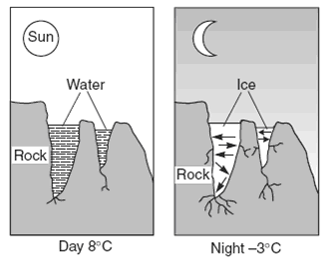
The diagrams  shows a natural process that weathers rock.
 Which statement best explains why this process results in weathering?
a)
frozen water acts as a solute
b)
water expands when it freezes
c)
the mass of water increases when it freezes
d)
frozen water dissolves most types of rock
24.
5. Which layer is the thickest?
a)
Core
b)
Crust
c)
Mantle
25.
What causes the waves that scientists have used to gain most of their understanding of the composition of Earth's interior?
a)
earthquakes
b)
magnetic fields
c)
meteor strikes
d)
winds
26.
This rock is made from tiny pieces of other rocks that settled to the bottom of a valley millions of years ago. What type of rock is this?
a)
Sedimentary
b)
Igneous
c)
Metamorphic
27.

Is magma below or above ground?

a)

above

b)

below

28.
Scientists use a(n) __________ to record vibrations in the ground and determines the location and strength of an earthquake. 
a)
seismograph
b)
seismogram
c)
S-P graph
d)
compass
29.
The _______ is the point along a fault at which the first motion of an earthquake occurs. 
a)
epicenter
b)
focus
30.
While learning about last night’s earthquake, Pat saw that the ________________ registered a 6.7 on the Richter Scale. 
a)
Epicenter
b)
Magnitude
c)
Seismic waves
d)
Focus
31.
Pat, a seismologist, was studying about last night’s earthquake. She read that the ___________, the point on Earth’s surface directly above where the earthquake began, was only 8 miles from her favorite historic museum.
a)
Epicenter
b)
Primary Wave
c)
Secondary wave
d)
Surface wave
32.
The second type of wave Skyler experienced from the earthquake was called a _____________________. It moves in a side to side “S” shaped motion like a rope. 
a)
Epicenter
b)
Primary wave
c)
Secondary wave
d)
Surface wave
33.
The first type of seismic wave Skyler experienced from the earthquake was called a ________________. It moves back and forth in compressions like a slinky. 
a)
Epicenter
b)
Primary wave
c)
Secondary wave
d)
Surface wave
34.
    ________________ are malleable and ductile.
a)
Metals
b)
    Non-metals
c)
  Carbon
d)
   Water
35.

Inner Planets are also called.

a)

Terrace Planets

b)

Terrestrial Planets

c)

Terminal Planets

d)

Treasure Planets

36.

Inner planets are most likely ____

a)

closer to the Sun and are smaller and made of gasses

b)

away from the sun and made up mostly of rocks

c)

closer to the Sun and are smaller and rockier

d)

away from the sun and made up mostly of gasses

37.

Which of the following is considered the 'Red Planet?

a)

Mars

b)

Earth

c)

Venus

d)

Mercury

38.

It is the center of the Solar System.

a)

Asteroids

b)

Jupiter

c)

Mars

d)

Sun

39.

It is sometimes referred to as the sister planet to Earth, because their size and mass are so similar.

a)

Mars

b)

Mercury

c)

Jupiter

d)

Venus

40.

Which from the following is an example of circular motion?

a)
b)
c)
d)
41.

Which of these material is opaque?

a)
b)
c)
d)
42.

Which from the following is a good conductor of heat?

a)
b)
c)
d)
43.
The solid outer layer of the Earth. 
a)
core
b)
mantle
c)
crust
d)
outer core
44.
The very, very hot inner part at the center of the Earth. It is made of solid metal. 
a)
core
b)
mantle
c)
crust
d)
mineral
45.
Which indicates that it is a physical change?
a)
Odor change
b)
Color change
c)
Rearranged atoms
d)
Change in size
46.

Fire can only burn if...

a)

If there is oxygen

b)

You use a match

c)

You're a wizard

d)

Nitrogen is in the air

47.
When gas is burned it becomes
a)
Water vapor
b)
Smoke
c)
Carbon dioxide
d)
Heat
48.

Water vapour ________ and forms clouds

a)

Condenses

b)

freezes

c)

explodes

d)

Soaks up

49.

How does the human body respond to hot temperature?

a)

hibernates

b)

migrates

c)

sweats

d)

shivers

50.

We feel the heat from the sun, even though we are not touching it. This is an example of _____.

a)

conduction

b)

convection

c)

radiation

51.

Warm air and steam will rise above a pot of boiling water. This is an example of _____.

a)

conduction

b)

convection

c)

radiation

52.

A metal spoon placed in a cup of hot cocoa will become hot to the touch. This is an example of _____.

a)

conduction

b)

convection

c)

radiation

53.
Gravity depends on ___________ and _________.
a)
orbit & moons
b)
rotation & revolution
c)
mass & distance
d)
color & shape
54.
Which planet is the largest of all the planets?
a)
Mercury
b)
Earth
c)
Jupiter
d)
Uranus
55.

A group of students carried out the experiment shown. Which question did the students MOST LIKELY try to answer?

a)

F. Which soil has the most nutrients?

b)

G. Which soil grows the tallest plants?

c)

H. Which soil holds the most water?

d)

J. Which soil has the most minerals?

56.
Which object do we not see at night?
a)
Sun
b)
Clouds
c)
Stars
57.
What part of the water cycle is called precipitation?
a)
Heat causing liquid to turn into gas
b)
Tiny water droplets form clouds
c)
Rain, snow, sleet, or hail that falls from the clouds
58.
If you bend a plastic ruler and a paper clip, what are you testing?
a)
Flexibility
b)
Texture
c)
Mass
59.
Which thermometer has the lowest temperature?
a)
Green
b)
Blue
c)
Red
60.
What does the C stand for?
a)
Cold
b)
Celsius
61.

The orbiting of the earth around the sun causing seasons to change takes one year and is called a

a)

revolution

b)

rotation

c)

spin

d)

trip

62.
An imaginary line which runs through both poles that the earth spins on:
a)
axis
b)
tilt
c)
north pole
d)
south pole
63.
How do igneous rocks form? 
a)
small particles of rocks are pressed and cemented together
b)
when a rock is changed by heat or pressure
c)
From the cooling of magma or lava 
64.
What do you call a million year old tooth found in the dirt?
a)
a fossil
b)
a fake
c)
a rock
d)
a skeleton
65.
What is the volume of liquid in this graduated cylinder?
a)
40.0 mL
b)
40.3 mL
c)
43.0 mL
d)
44.0 mL
66.
Sponge Bob's volume equals
a)
0.5 mL
b)
1.0 mL
c)
2.0 mL
d)
3.0 mL
67.

How many high tides are there per day?

a)

2

b)

4

c)

8

d)

12

68.

How much time is there between two high tides in a day?

a)

6 hours

b)

4 hours

c)

12 hours

d)

3 hours

69.

Where do we find coal?

a)

It is dug underground in mines.

b)

It is piped up from deep below the surface of the Earth.

c)

It is found in the forests.

d)

It is taken from the cocoons of moths.

70.

What is this?

a)

Balance

b)

Triple beam balance

c)

Mass

d)

Measuring cylinder

71.
This measures temperature.
a)
graduated cylinder
b)
thermometer
c)
pan balance
d)
matter
72.
What tool would you use to measure Ms. Jones' foot?
a)
a ruler
b)
a meter stick
c)
a graduated cylinder
d)
a stopwatch
73.

What is a high tide?

a)

Sea pulled TOWARD the moon where Earth is CLOSEST to the moon

b)

Sea pulled AWAY from the moon where Earth is FARTHEST to the moon

c)

Sea pulled AWAY from the moon where Earth is CLOSEST to the moon

74.

How can we separate an insoluble solid from a liquid?

a)

chromatography

b)

evaporation

c)

filtration

d)

condensation

75.
The clear liquid which passes through the filter paper is called
a)
filt
b)
filter
c)
filtrate
d)
filtration
76.

Which one of the following is the name for separation technique in the picture below

a)

distillation

b)

filtration

c)

evaporation

d)

chromatography

77.
Which one of the following would you use to separate sand from iron filings?
a)
a bar magnet
b)
 filter paper
c)
distillation apparatus
d)
chromatography paper
78.

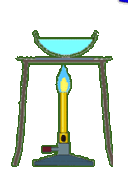
Which separation technique is shown below

a)

filtration

b)

crystallization

c)

sublimation

d)

evaporation

79.
Substances that do not dissolve are said to be ______________
a)
Soluble
b)
Insoluble
80.
Substances that dissolve in a liquid are said to be _____________
a)
Soluble
b)
Insoluble