
 Worksheets
Swahili and Great Zimbabwe
Total questions: 43
Worksheet time: 22mins
Africa is a...
Nation
Continent
Third-world country
Country
Africa is very diverse.
"Diverse" means that there are a lot of differences; it's NOT all the same.
If you learn about one town in Africa, will most towns be very similar to that one?
Yes, because it's all pretty much the same in Africa.
No, because Africa is very diverse.
Two reasons historians USED TO think that Africa had very little history of interest include:
(SELECT the TWO correct answers.)
Africa has a rich tradition of ORAL HISTORY (teaching the next generation by telling stories out loud, rather than in writing).
So, historians incorrectly THOUGHT there was no written records to study.
Few ruins of buildings have been found, so they incorrectly THOUGHT that Africans did not build with strong materials like stone.
There isn't much history in Africa. Nothing really happened until European nations colonized there.
It has been said that now would be an exciting time to be an archaeologist studying Africa.
Which of the statements below best stupports this idea?
Modern discoveries have only begun to shed light on a rich cultural history of Africa, especially sub-Saharan Africa.
Tomorrow's archaeologists are likely to
discover exciting new civilizations.
Egypt is the only ancient civilization of Africa.
To study Africa, one must focus on
uncovering more history of Egypt.
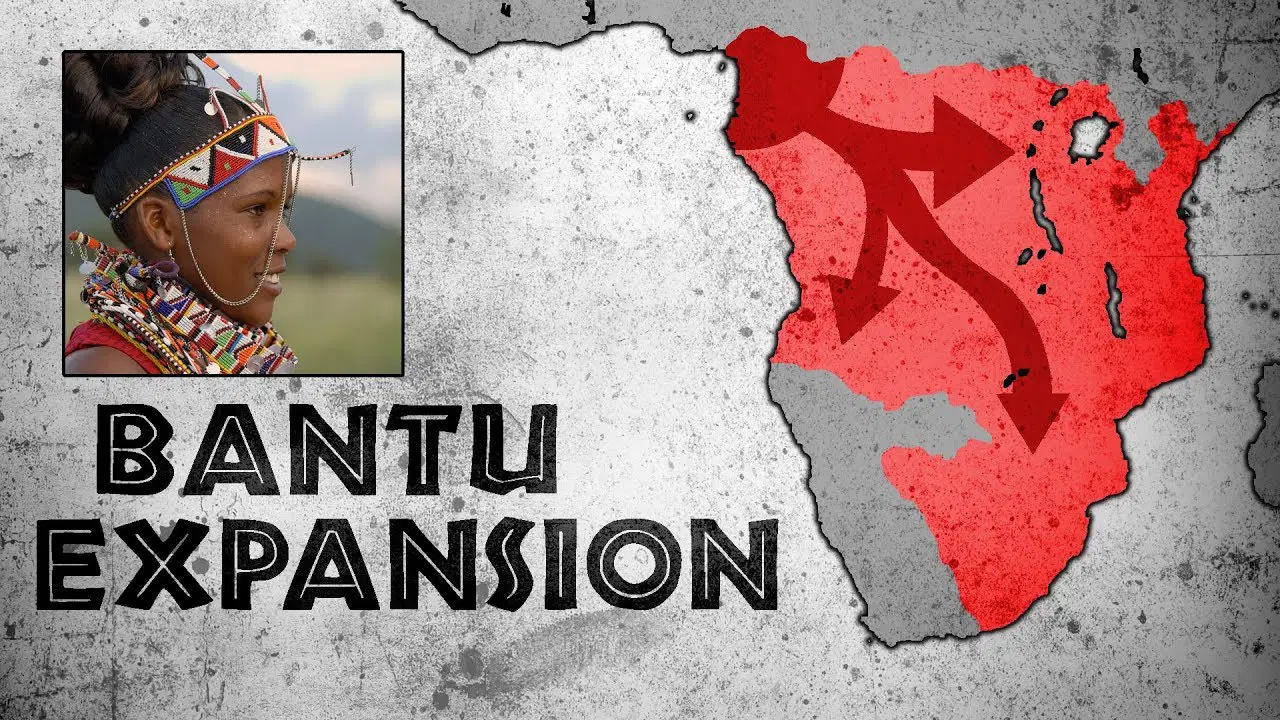
Europe was late in learning
about sub-Saharan Africa, for several reasons.
Among the reasons are (select TWO)
Crossing the Sahara desert would have been too hard. (The Sahara is 4 times the size of the Mediterranean Sea)
A disease called malaria discouraged exploration.
Marco Polo had returned, saying that there wasn't anything of interest there.
The monarchs of Europe agreed to leave Africa alone.

The continent of Africa has:
54 countries, More than 2,000 languages, and More than 3,000 ethnic groups.
There are arid deserts, but also savanas and rain forests.
There are areas of poverty, and areas of wealth.
These facts support the idea that Africa is very . . .
diverse
all pretty much the same
arid
verdant

How many different ethnic groups exist on the African continent?
500
30
3,000
4

Which of the following is method of passing on information
that was common
to early African civilizations?
Written History
Short Stories
Photographs
Oral Histories

The remains of a town farther south than the Swahili was discovered in modern times,
and studied by a lady archaeologist.
This town is where the Swahili got their gold.
This town's name means "Great Stone House", or
Great Nile
Great Sahara
Great Mt. Kilimanjaro
Great Zimbabwe
Great Horn

Along the coast of east Africa are the remains of hundreds of towns
with buildings made of stone and blocks of coral,
including elegant homes, and elaborate palaces.
For a long time, historians couldn't believe that Africans built these great towns.
They said that Arabs had come to Africa and built them.
Now, evidence makes clear that these towns were
built by Arabs who came to Africa and built them.
built by Africans, a group called the Swahili.
built by Africans, Egyptians who traveled to sub-Saharan Africa and built them.

What was unique about the walls of Great Zimbabwe?
There is no mortar holding the stones together!
Also, every wall is curved.
There are no straight lines or right angles.
The stones are held together with golden glue.
Also, every wall is made of ivory.
There are no stone walls.
Niether of the provided answers is correct.

What is remarkable about the process of constructing the buildings of Great Zimbabwe?
(Select TWO correct answers.)
There is nothing (No mortar or other substances) holding the blocks together.
There are no rocks in the area, so they "cut" granite rocks from the hillside, using heat and cold.
The rocks weighed at least a ton each, and we don't know how they were transported.
Egypt isn't the only place in Africa with an interesting history.
Africa had many civilizations, including these:
Nubia, Ethiopia, Mali, Songhai, Ghana, Zimbabwe, Swahili
Peloponnesian , Arabian, Iberian, Scandinavia, Berbers
Athens, Sparta, Olympia, Corinth,Atlas, Alps, Caucasus, Ural
Two civilizations of sub-Saharan Africa include:
Berbers and Normans
Swahili and Great Zimbabwe
Egypt and Morrocco
Lords and serfs

The buildings in Great Zimbabwe that had curved walls were used for
the royal family
market places
cattle pens
grain storage
Who built Great Zimbabwe?
Travelers from Arabia or Asia
Europeans
Africans

The people of Great Zimbabwe herded cattle, grew cotton, and
dug gold, which was sold to the Swahili
wove fabric, which was sold to Arabia
mined slabs of salt, which they transported to north Africa
The word "Swahili" gives a clue about where they live, as well as how they live.
"Swahili" means
coast dwellers.
interior dwellers.
rain forest harvesters.
sand caravan travelers.
The Swahili were expert
salt harvesters.
sailors and traders.
pyramid builders.
coal and oil miners.
Why are there many Arab influences in the Swahili culture?
Arabs took over much of East Africa and forced the Swahili to follow Arab culture. The Swahili were punished if they didn't practice Arabian cultural traits.
East Africans (including the Swahili) and Arabs sailed back and forth to each other's lands, trading goods. During these interactions, many Arabian cultural traits were picked up by East Africans.

What religion
became prevalent (common) among the Swahili and other East Africans,
due to trade with Arabia?
Christianity
Indigenous religions
Judaism
Islam

Dhow are expertly made ______ used by the Swahili.
palaces
horse pulled carts
sail boats
gold mining machines

Gold provided Great Zimbabwe with income. However, what was even more valuable to them than gold?
granite
cows
salt
lumber

Any part of Africa that is located
SOUTH of the Sahara Desert.
sub-Saharan
rift
plateau
sub-African

An example of artistic beauty apparently valued by Great Zimbabwe:
statues of birds, carved in a stone called soapstone
statues of great leaders, carved in a stone called granite
elaborately carved doors on every building

What happened
to the civilization
that lived at Great Zimbabwe?
They were taken captive by other African nations.
Their fate is unknown. Perhaps you or one of your classmates will become an archaeologist and discover the answer!
Dhow demonstrate that the Swahili people were
good builders
good farmers and good salt miners
good boat builders and good sailors

The Swahili appreciated this art form:
decorated clay pots
detailed carvings on the buildings
brightly colored fabrics

The Swahili became rich, by exporting _____ and _____ to Arabia.
salt and timber
Ivory and gold
blocks of coral and stone
woven fabric and beautiful pottery

The Swahili got the gold and ivory that they sold to Arabs
from their own lands
from the Ethiopian Highlands
from the cities of Timbuktu and Tripoli
from Great Zimbabwe
What happened to the ancient cities of the Swahili?
They were burned by the Portuguese.
They were destroyed by Arabs.
Similar to the cities of the Swahili,
historians didn't at first believe that Great Zimbabwe was built by Africans.
Great Zimbabwe got rich from mining salt to Europe to Asia.

This picture shows
Great Zimbabwe
a dhow of the Swahili

Which civilization made this art? (Hint: It is carved in a stone called soapstone. And notice the bird.)
Swahili
Timbuktu
Egypt
Great Zimbabwe

This picture shows (Hint: Which civilization had intricate carvings on their buildings?)
an artistic expression of the Swahili
an artistic expression of Great Zimbabwe.

Where is this? (Hint: notice the shape of the walls.)
Egypt
a Swahili town
Great Zimbabwe

What clue on this flag tells us that it is for the country of Zimbabwe?
the colors of the stripes
the white triangle and the red star
the bird

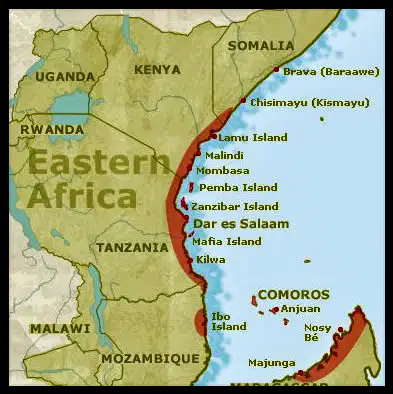
The area shaded in red on this map roughly shows the location of
ancient Swahili cities
Great Zimbabwe
Great Rift Valley
Congo River Basin
What desired goods did Great Zimbabwe control?
Gold, slaves, silk
Copper, lumber, textiles
Gold, ivory, copper
Tea, cotton, citrus fruits
European colonial leaders actually _____ the idea
of Africans building Great Zimbabwe
because it threatened European rule.
discouraged
encouraged
what is the national emblem of the Great Zimbabwe?


do not have one
This question is not part of your score. It is a survey only.
Which topics are most interesting to you?
(Select all that apply. )
the Swahili people of east Africa
Great Zimbabwe
the interaction between east Africa and Arabia
the history of gold in Africa
art of ancient Africa

