
NEW
Font size
 Worksheets
Electrostatics Review
Total questions: 29
Worksheet time: 32mins

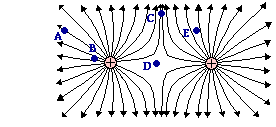
which is the field for opposite charges


A charge of 9.88*10-6 C exerts a repelling force of 1645 N on a second charge of 2.30*10-6 C. Calculate the distance between the two charges.
0.204 m
1.24*10-4 m
0.011 m
1.38*10-14

What it the unit of charge?
Coulomb
Ampere
Volt
Ohm

Which of the following equations represents Coulomb's Law?
F= kQ/d2
F = kQ1Q2/d2
F = Q1Q2/d2
F = kQ1Q2/d

If you increase the magnitude of two charges, what happens to the force between them?
The force is less than before
The force is more than before
The force remains unchanged

What is the force between 10 C and 5 C charges placed 1 m apart?
4.5 x 10¹⁰ N
1.24 x 10⁸ N
4.5 x 10⁹ N
4.5 x 10¹¹ N
If you double both charges and double the distance between them, what happens to the force?
The force is less than before
The force is more than before
The force remains unchanged
The electrical force between the charges is weakest when ______
They are closest
When they are farthest
Force is constant everywhere
Distance is not a factor in determining force

What is the charge on the picture?
Neutral
Positive
Negative
Zero
Why did the tin plates jump off the Vaan de Graaf when it was turned.
The plates become positive (+) like the sphere and were repulsed by the similar charge.
The plates become positive (+) like the sphere and were repulsed by the opposite charge.
The plates become negative (-) like the sphere and were repulsed by the similar charge.
The plates become negative (-) like the sphere and were repulsed by the opposite charge.

Which Force diagram is correct for the two charges shown?
A
B
C
D

Which Force diagram is correct for the two charges shown?
A
B
C
D

Which Force diagram is correct?
A
B
C
D

What is the force exerted on the spheres if the distance between the charges is 100 m?
-.0002 N
-.02 N
-1.8 x 10^8 N
-1.8 x 10^6

What would happen to the force exerted on the spheres if you double the +2Q charge
1/2 the original force
2x the original force
4x the original force
No change

What would happen to the force exerted on the spheres if you double the +2Q charge and double the -1Q charge?
1/2 the original force
2x the original force
4x the original force
No change

What would happen to the force exerted on the spheres if you change the distance to 1/2d?
1/2 the original force
2x the original force
4x the original force
no change

Which diagram represents opposite charges?
A
B

Which picture is correct about the force on point charge c?
A
B
C

Which statement about electric fields is correct?
The electric field lines move out of positive and into negative charges
The electric field lines move out of negative and into positive charges
The closer the field lines are, the less strength in the field
The test charges a, b, c in the pictures are negative charges

Which diagram is accurate for the point charge b located inside the cylinder?
A
B
C

What will happen when the negatively charged rubber rod comes near the neutral electroscope?
The leaves will open because the electrons will move away from the rod. Like charges repel.
The leaves will open because the protons will move toward the rod. Opposite charges attract.
The leaves will open because the protons will move away from the rod. Opposite charges repel.
The leaves will open because the electrons will move toward the rod. Like charges attract.

After the negatively charged rubber rod makes contact with the electroscope, what will happen?
The leaves stay open because electrons transferred to the electroscope and it is now negatively charged.
The leaves stay open because protons transferred to the electroscope and it is now negatively charged.
The electroscope goes back to what the neutral electroscope looks like.

