

wayground logo

Free Printable Worksheets

Font size

S
M
L
XL
Worksheets

UNIT-5 Population Explosion

Total questions: 25

Worksheet time: 11mins
Name
Class
Date
1.
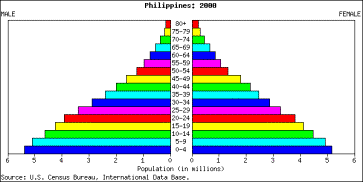
According to the population pyramid of this country, its population is most likely...
a)
growing slowly.
b)
growing rapidly.
c)
decreasing.
d)
not changing.
2.
The number of live births per 1000 people is called the...
a)
growth rate.
b)
infant rate.
c)
baby total.
d)
birth rate.
3.
Deserts are usually....
a)
densely populated.
b)
sparsely populated.
c)
evenly populated.
d)
None of the above
4.
If a country has a death rate of 30 and a birth rate of 45 the natural rate of increase would show the population is ______.
a)
Increasing
b)
Decreasing
c)
Staying the same
d)
Fluctuating too much
5.
The movement by people from one place to another with the intention of settling temporarily or permanently in a new location. 
a)
pull factor
b)
push factor
c)
distribution
d)
migration
6.
The average number of people living in a square kilometer is called...
a)
urbanization. 
b)
internal migration. 
c)
population density. 
d)
pull factors. 
7.
One reason for a rapid population growth is...
a)
an increase in pull factors.
b)
declining death rates. 
c)
a sparse population density. 
d)
internal migration.
8.
What is a population pyramid?
a)
A type of graph showing the number of males and females in different age groups.
b)
A type of graph showing the number of males in different age groups.
c)
A type of graph showing the number of females  in different age groups.
d)
A type of graph showing the number of males and females in only one age group.
9.
Areas close to rivers tend to be...
a)
Densely populated
b)
Sparsely populated
c)
Fairly populated.
d)
None of the above
10.
What is a population?
a)
set of individuals of the same species living in a given place and at a given time 
b)
set of individuals of the different species living in a given place and at a given time
c)
a species
d)
the entire ecosystem
11.

One reason the world is growing so quickly is because...

a)

The world has infinite resources for everyone

b)

There are more and more places for people to live

c)

Birth rate is higher than death rate

d)

Death rate is higher than birth rate

12.

Birth rates tend to be higher in

a)

Developed countries

b)

Developing countries

13.

If the world’s population continues at its current rate of growth, approximately how long will it take to double?

a)

9 years

b)

22 years

c)

64 years

d)

95 years

e)

148 years

14.

VOCAB: The average number of children a female member of a population has during her lifetime

a)

total fertility rate

b)

replacement fertility rate

c)

growth rate

d)

death rate

15.
Population growth and fertility rates are lowest in
a)
upper-income countries
b)
upper- and middle-income countries
c)
middle- and low-income countries
d)
lower-income countries
16.
The number of babies out of 1,000 that die during their first year of life is called
a)
infant mortality
b)
growth rate
c)
demography
17.

On a global scale, rapid population growth can harm the environment.

a)

True

b)

False

18.

Things that attract people to a new place ...

a)

Push factors

b)

Pull factors

19.

Number of births each year per 1,000 people

a)

migration

b)

population growth

c)

death rate

d)

birth rate

20.
In recent years, the human population has 
a)
increased exponentially
b)
decreased exponentially
c)
decreased slowly
d)
increased slowy
21.

Formula for doubling time?

(a)  

22.

Expand NIMBY syndrome.

(a)  

23.

What are viruses, bacteria, and organisms in the environment that causes human health classified as?

a)

social hazards

b)

biological hazards

c)

chemical hazards

d)

physical hazards

24.

Which statement about the effects of natural events and human activities is true?

a)

The environment is not usually affected by natural events.

b)

All human activities change the environment in a negative way.

c)

Natural events always have a positive impact on the environment.

d)

Human activities and natural events can damage the environment.

25.
Any amount of CO2 (Carbon Dioxide) in the atmosphere is bad for our planet.
a)
True
b)
False