
 Worksheets
APHG, Units 1-5
Total questions: 87
Worksheet time: 57mins
Which of the following is an example of an intrafaith boundary?
Northern Ireland Protestants vs. Catholics
Christianity vs. Islam in Former Yugoslavia
Tibetan Buddhism vs. Atheist China
Hinduism vs. Sikhism in India
An area that people believe exists as part of their cultural identity is an example of this type of region
Formal Region
Vernacular Region
Functional Region
Nodal Region
In the U.S.A., what crop is most frequently planted in the mixed crop & livestock region because it generates higher yields per area than any other crop?
Corn
Wheat
Soybeans
Apples
A related set of cultural traits or a combination of cultural traits is known as this
Cultural Adaptation
Cultural Norm
Cultural Complex
Cultural Ecology
Delayed degenerative diseases is what stage of the ETM?
Stage 2
Stage 3
Stage 4
Stage 5
A rapid increase in the value of houses followed by a sharp decline in their value is known as this
Housing Balloon
Housing Crunch
Housing Tide
Housing Bubble
Most of these farms are in the business of market-gardening products and are farms where nobody resides
Horseshoe Farms
Subsistence Farms
Suitcase Farms
Roaming Farms
According to possibilism
the physical environment is directly responsible for a group's development
the physical environment sets limits on humans that they can overcome by choices
human beings are responsible for caring for their physical environment
humans only live in places where life is possible
The clustering or dispersal of something within a given unit of area is
concentration
density
pattern
location
Which of the following best defines Carl Sauer’s concept of cultural landscape?
It is the outcome of interactions between humans and their natural environment
It is the way people landscape their yards in different parts of the world
It is a shared set of meanings and symbolic practices
It is the human adaptation to Earth’s physical environment
Hinduism first spread to the United States by
stimulus diffusion
relocation diffusion
contagious diffusion
hierarchical diffusion
Geographers might characterize as overpopulated a country where
there are too many people according to a standard economic measure of poverty.
the population numbers less than one million, but there is concern that the country's natural resources are adequate for only half that number.
the population numbers more than 100 million and there is concern about the finite limits of natural resources, although the resources available in the country seem adequate to that population.
the population numbers more than one million, and there is an average distribution of population to resources.
All of these answer choices are correct.
We can calculate that a country would raise, or increase, its agricultural density if it...
decreased the amount of agricultural land
decreased the number of farmers
increased the areas of its urban centers
increased the size of its population
decreased the number of farm animals
The average number of births women bear in their lifetimes is...
total birth rate
crude birth rate
total fertility rate
total increase rate
crude fertility rate
The fertility rate based on the number of live births per 1,000 residents is the...
crude birth rate
crude fertility rate
infant birth rate
natural increase rate
life expectancy at birth
The shape of a country's population pyramid...
is determined primarily by its crude birth rate
has no correlation to its crude death rate
cannot be used to estimate the country's dependency rate
cannot be used to estimate the country's sex ratio
is determined primarily by the combination of its crude birth rate and its crude growth rate
The highest natural increase rates are found in countries in which stage of the demographic transition?
stage 1
stage 2
stage 3
stage 4
stage 5
Thomas Malthus concluded that...
population increased arithmetically while food production increased linguistically
the world's rate of population increase was higher than the development of food supplies
so-called "moral restraint" was producing lower crude birth rates
population growth was outpacing available resources in every country, according to algebraic calculations
crude birth rates must balance crude death rates
Wilbur Zelinsky's model of migration predicted...
women are more likely to migrate than men
long migration distances are more likely than short
migration characteristics vary with the demographic transition
intraregional migration is more important than interregional migration in terms of political and economic resources
migrants move most frequently for economic reasons
A boy migrated from Honduras through Guatemala and Mexico, then entered the United States without immigration documents, because members of his ethnic group were being targeted for torture or assassination in his home country. Although the U.S. government does not grant the boy refugee status, his case is an example of international and ________ migration.
forced
human rights
voluntary
economic
transitional
Which statement most accurately describes the motivations of the historic European and current Latin American immigrants to the United States?
Both were and are motivated primarily by economic factors
Migrants from Europe were fleeing religious persecution while migrants from Latin America are motivated by economic factors
Both were and are motivated by a desire to join family members already in the United States
Migrants from Europe mostly spoke English while migrants from Latin American mostly speak Spanish
Both were and are motivated by famine in their home countries
Suburbanization of more developed countries is due to...
expanding urban territory
increasing employment opportunities
desire to change lifestyle
regional development
global investment
You might propose a(n) ________ program for your country if you wanted to hire a large number of manual laborers from neighboring countries to build a large dam or canal, with the understanding that they would not be granted any other privileges or legal status in your country, after the project is finished.
guest worker
unauthorized worker
unauthorized hiring
engineering obstacle
chain migration
An example of ________ is the migration of doctors and engineers to the United States after they have received years of government-financed schooling and training in Colombia.
brain drain
chain drain
chain migration
net migration
cohort migration
Replacement level, the number of births needed to keep a population at a stable level without immigration, requires a total fertility of _________
10
2.1
3.5
5.0
Not all countries with aging populations resort to immigration to offset economic problems. An example is:
Germany.
Japan.
the United States.
Norway.
Almost everywhere on Earth, Total Fertility Rates (TFRs) are
Rising
Falling
Staying about the same
Influenced by precipitation levels
A pilgrim to Varanasi (Benares) in India is most likely to be a
Muslim
Hindu
Jewish
Christian


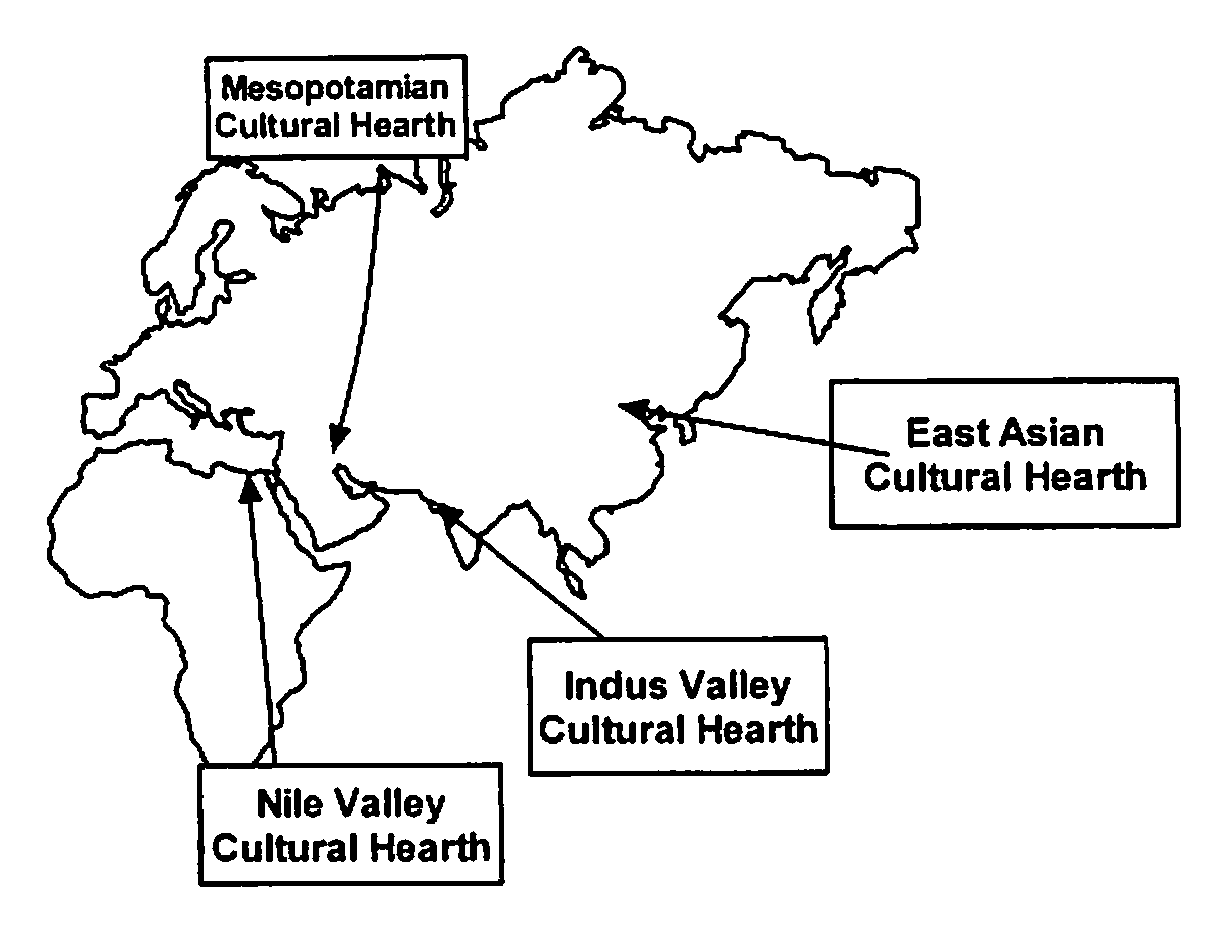

Hint: The trunk of the tree


A word-usage boundary is known as an _______________,
Look at all the names for soft-drink in the USA
standard language
dialect
isogloss
language family

Which of the following religions are considered to be universalizing religions?
Buddhism, Christianity, & Islam
Islam, Hinduism, & Buddhism
Hinduism, Judaism, & Christianity
Judaism, Islam, Buddhism
What religion is most associated with keeping Kosher?
Judaism
Hinduism
Buddhism
Christianity
Area that occupies a defined territory with a permanent population and is ruled by an established government that has control over its internal/external affairs.
State
Autonomous region
nation-state
city-state
The political authority of a state to govern itself is called
Democracy
Sovereignty
Government
International trade
The redrawing of congressional districts for political gain is termed
Reapportionment
Core-periphery federalism
Gerrymandering
Electoral regions
The border between the US and Canada along the 49th parallel is an example of what type of boundary?
Subsequent
Geometric
Superimposed
Relic
The majority of African states entered the United Nations after 1960 because
Political differences with the US did not allow them to join before then
Creation of the Organization for African Unity took precedence
The majority of the states didn't become independent until the 1960s
Most African states were autarkies before the 1960s
After 1990, the United Nations saw a large influx of new members. This was because
The former Soviet Union fragmented into many smaller nation-states
The Ottoman Empire collapsed after WW1
South Asia fragmented into smaller states after the Bangladesh Liberation War.
Colonies in Africa and Asia gained independence
Which of the following is an example of a centrifugal force within a nation-state?
Strong sense of nationalism
Strong national economy
Separatist movement demanding independence
Economic equality among regions
"Shatter belts" are geographic zones where tensions explode based on
Economic boundaries
Cultural boundaries
Physical boundaries
Functional boundaries
Group of people bound together by some sense of common culture, ethnicity, language, shared history, and attachment to a homeland.
Nation
State
This stateless nation is located in northern Spain and parts of southern France.
Hmong
Kurds
Basque
Thai
Which country is the closest in the world today to being a true nation-state.
Peru
Rwanda
Finland
Japan
State in which the cultural borders of a nation correspond with the state borders of a country.
Nation-state
State-nation
City-state
Compact State

