
 Worksheets
Physics Form 4_Chap 4.3 Specific Latent Heat
Total questions: 30
Worksheet time: 27mins

It's the amount of heat required to change the state (gas,liquid, solid) of a unit of material
Latent Heat
Specific Heat
Temperature
Q

This symbol represents latent heat
Q
c
ΔT
L

This formula is used to find the amount of heat (energy) neccesary when there's a phase change
Q= (h)(ΔT)
Q=(m)(l)
Q=(m)(c)(ΔT)
Q=(k)(A)(dT)

How much energy is required to freeze 150 g of water? ( LVapourisation=2260 and LFusion=334)
50 100 cal
339 000 J
339 000 cal
50 100 J
There are four main processes in changing of phase, and they are
Melting
Boiling
Condensation
All the above
Latent heat is
the heat absorbed or released at a boiling process during a change of phase
the heat absorbed or released at a constant temperature during a change of phase
the heat absorbed or released at a constant temperature during a change of phase of 1 kg object
the heat absorbed or released by an object to increase or decrease its temperature by 1 degree Celcius
The heat absorbed by melting a solid is known as
latent heat of fusion
latent heat of solid
latent heat of liquid
latent heat of vaporisation
specific latent heat of vaporisation is
the amount of heat required to change 1 kg of the substance from the solid to liquid phase without change in temperature
the amount of heat required to change 1 kg of the substance from the liquid to gaseous phase without change in temperature
the amount of heat required to change the temperature 1 kg of the substance by 1 degree Celcius
the symbol for specific latent heat is
c
l
Q
m
Water molecules have the greatest kinetic energy in
Ice at 0 ⁰C
Water at 90 ⁰C
Water at 373 K
Steam at 150 ⁰C

The graph shows the cooling curve of a substance. At which stages the specific latent heat released?
AB and CD
BC and DE
AB and EF
BC and CD
Calculate the energy absorbed by 30 g of 100 ⁰C water that is turned into 100 ⁰C.
67 800 J
6 7800 J
678 J
67.8 J
How much energy is required to change 5 kg of ice at 0 ° C into water at the same temperature? (latent heat of fusion is 3.36 X 10⁶ J/kg )
16.1 X 10⁶ J
16.8 X 10⁶ J
15.1 X 10⁶ cal
16.8 X 10⁶ cal
How much energy is required to melt down a 2000 g of mercury?(latent heat of fusion is 1.14 x 10⁴ J/kg)
2.55 x 10⁴ J
2.28 x 10⁴ J
2,280 x 104 J
3.28 x 10⁴ J
Calculate the amount of heat added to 15 kg gold to change phase from solid to liquid. (The heat of fusion for gold is 64500 J/kg)
967,500 calories
976, 500 Joules
967,500 Joules
976, 500 calories
How much energy is required to change 2600 g of water at 100 ° C into steam temperature? (latent heat of vaporization is 2.26 x 10⁶ )
Q = 5.9 X 10⁶ J
M = 5.9 X 10⁶ J
C = 5.9 X 10⁶ J
Δ T = 5.9 X 10⁶ J

The specific latent heat released at stages?

After 4 minutes, the mass of the water in beaker A is 15 g. What is the mass of the water in beaker B?
[Specific latent heat of fusion of ice = 3.36 × 10⁵ J kg−1]


What is the temperature of the metal cube when thermal equilibrium is achieved between the cube and the liquid?

Which of the following statements is correct if there are no heat losses to the surrounding?

It's the SI unit for Heat
Watts
Celsius
Joules
Nm

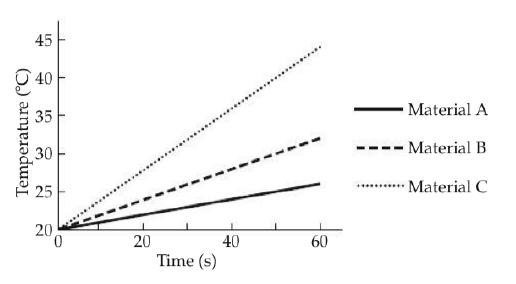
The graph shows the temperature of 1kg samples of three materials, A, B, and C, as they are heated. Heating occurs at a constant rate.
If material A starts to melt at 60 oC. At that point, the line on the graph will __________.
continue on as before
begin to curve upward
become steeper
become horizontal
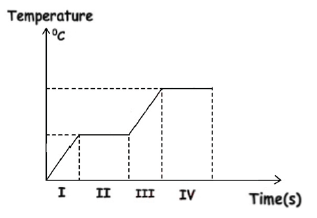
Consider the following temperature-time graph when a solid is heated. which part of the graph involves latent heat of vaporization?
Part I
Part II
Part III
Part IV
The temperature at which a liquid turns to a gas is called the _____ point.
boiling
freezing
amorphous
crystalline
The latent heat of fusion is used to
increase the kinetic energy of molecules.
do work to break the binding force among the molecules.
increase the kinetic energy of electrons in the molecules.
do work against the atmospheric pressure.
Water is a suitable cooling agent used in the cooling system of a car engine. This is because water
evaporates rapidly
is rust-resistant
has a high density
can absorb a lot of heat

