wayground logo

Free Printable Worksheets

Font size

S
M
L
XL
Worksheets

10 Follow the Flow Review

Total questions: 35

Worksheet time: 22mins

Name
Class
Date
1.
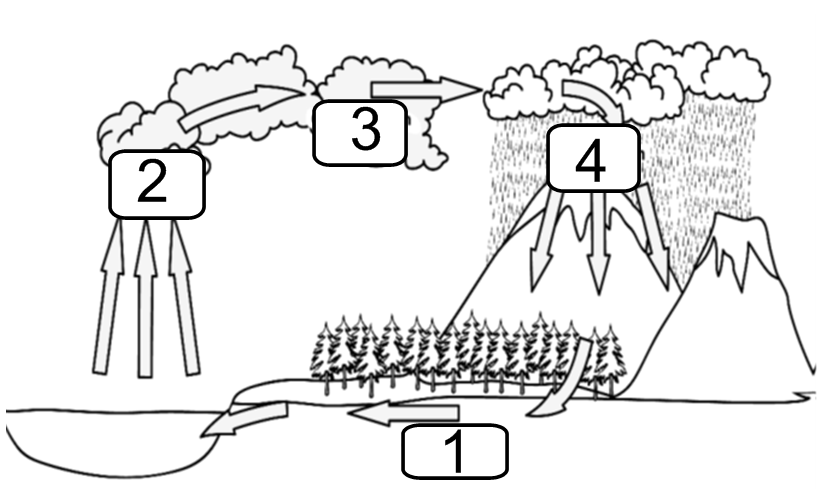
What part of the water cycle does this picture show?
a)
condensation
b)
precipitation
c)
evaporation
2.
Which is the opposite of condensation?
a)
runoff
b)
evaporation
c)
precipitation
d)
transpiration
3.

What is is called when water rises from the ocean as a gas?

a)

EVAPORATION

b)

PRECIPITATION

c)

TRANSPIRATION

d)

condensation

4.
What is it called when plants give off water vapor as a waste product?
a)
condensation
b)
evaporation
c)
sublimation
d)
transpiration
5.

Precipitation occurs because

a)

Water reaches its dew point

b)

infiltration at the surface is facilitated by porus rock

c)

Condensation in the clouds are too heavy for the air to hold

d)

water evaporates to form clouds

6.

When tiny droplets of water form in the air its called-

a)

precipitation forming snow

b)

evaporation forming gas

c)

condensation forming clouds

d)

transpiration forming gas

7.

The ________is the driving force of the earth's water . cycle.

a)

sun

b)

convection

c)

weather

d)

plate tectonics

8.
Which stage does the #2 show in the diagram?
a)
condensation
b)
evaporation
c)
precipitation
d)
run off
9.

Which stage does the #3 show in the diagram?

a)

condensation

b)

evaporation

c)

precipitation

d)

run off

10.
what does the #4 show in the diagram?
a)
condensation
b)
evaporation
c)
precipitation
d)
run off
11.
The first step in the water cycle 
a)
evaporation
b)
condensation 
c)
precipitation
d)
there is no first step 
12.
The water cycle is also known as ..........
a)
Hypertonic Solution
b)
Hydrological Cycle
c)
Hyperlogical Cycle
d)
None of these
13.

After precipitation occurs, what will the water do?

a)

It will infiltrate the ground or runoff.

b)

become groundwater

c)

It will evaporate

d)

become part of a river

e)

become snow or sleet

14.
Acid rain is an example of chemical weathering because
a)
pollution is in the sky
b)
rain connected to dust falls and hits rocks so hard they break.
c)
there is friction between rain and rocks.
d)
pollution gets dissolved in water and falls as rain dissolving rocks over time.
15.
The diagrams  shows a natural process that weathers rock.
 Which statement best explains why this process results in weathering?
a)
frozen water acts as a solute
b)
water expands when it freezes
c)
the mass of water increases when it freezes
d)
frozen water dissolves most types of rock
16.
The process of breaking up rocks on Earth's surface is called...
a)
sediment
b)
erosion
c)
weathering
d)
deposition 
17.
The process by which small pieces of rocks and soil are carried away to new locations is called...
a)
deposition
b)
erosion
c)
weathering
d)
faults
18.
What happens when glaciers slowly move down a mountain?
a)
the glaciers melt and refreeze
b)
the glaciers cause erosion by taking sediment and moving it somewhere else
c)
the glaciers melt and form giant lakes
d)
nothing happens
19.
What is sediment?
a)
the process of rocks being broken down and carried away
b)
bits of rock, sand, and silt caused by the weathering of rocks
c)
the top layer of the soil
d)
decaying plant or animal material 
20.
All of the following are causes of physical weathering except...
a)
plant growth
b)
wind
c)
acid rain
d)
running water
21.
Two streams begin at the same elevation and have equal volumes. Which statement best explains why one stream could be flowing faster than the other stream? 
a)
The faster stream contains more dissolved minerals
b)
The faster stream has a much steeper gradient (slope)
c)
The streams are flowing in different directions
d)
The faster stream has a lower temperature than the slower stream
22.
Rocks being made smooth by tumbling across a streambed
a)
Weathering
b)
Erosion
c)
Deposition
23.
Wind blowing sand from one location to another
a)
Weathering
b)
Erosion
c)
Deposition
24.
Which of the following is an example of chemical weathering?
a)
Acid rain dissolving limestone
b)
roots breaking into concrete
c)
paper being ripped
25.

The land area that supplies water to a river system is called a

a)

water table

b)

Drainage basin

c)

Water cycle

d)

watershed

26.

Which LOCAL watershed do we live in?

a)

York River

b)

James River

c)

Roanoke River

d)

Chesapeake Bay

27.

Where do the Potomac and Shenandoah drain/flow into?

a)

Chesapeake Bay

b)

Atlantic Ocean

c)

North Carolina Sounds

d)

Gulf of Mexico

28.
Our local watershed is part of a larger watershed called - 
a)
Gulf of Mexico
b)
Mississippi Valley Watershed
c)
 Chesapeake Bay Watershed
d)
Albemarle Sound
29.
Which states are part of the Chesapeake Bay Watershed?
a)
DE, MD, NY, PA, OH (and DC).
b)
PA, OH, VA, WV, NC, SC.
c)
DE, MD, NY, PA, VA, WV, (and DC).
d)
NY, VA, NC, PA, OH, DE.
30.
Where does the Chesapeake Bay empty in to?
a)
Gulf of Mexico
b)
North Carolina Sounds
c)
Atlantic Ocean
d)
Pacific Ocean
31.
The Chesapeake Bay is a mixture of saltwater and freshwater, this means that the Bay is an _______________________.
a)
ocean
b)
estuary
c)
river
d)
tributary
32.
An underground layer of rock or sediment that holds water is called what?
a)
Reservoir
b)
Aquifer
c)
Groundwater
d)
Watershed
33.
What is all the water that runs off the surface of the land and washes into rivers, streams, and other waterways called?
a)
Runoff
b)
Storm Drain
c)
Surface Water
d)
Tributary
34.
A ___________ is a smaller stream or river that "feeds" a larger stream or river.
a)
rill
b)
gully
c)
watershed
d)
tributary
35.
What is an area of higher elevation that separates watersheds?
a)
Estuary
b)
Divide
c)
Wetland
d)
Transition zones