

wayground logo

Free Printable Worksheets

NEW

Font size

S
M
L
XL
Worksheets

Electrostatics

Total questions: 25

Worksheet time: 52mins

Name
Class
Date
1.
During a physics lab, a plastic strip was rubbed with cotton and became positively charged. The correct explanation for why the plastic strip becomes positively charged is that ...
a)
the plastic strip acquired extra protons from the cotton.
b)
the plastic strip acquired extra protons from the charging process 
c)
protons were created as the result of the charging process
d)
the plastic strip lost electrons to the cotton during the charging process 
2.
Insulators are different than conductors in that insulators ____.
a)
do not contain electrons or protons 
b)
 do not contain any charge
c)
have a weaker affinity for electrons 
d)
do not allow charge to freely move 
3.
A negatively charged plastic comb is brought close to, but does not touch, a small piece of paper. If the comb and the paper are attracted to each other, the charge on the paper
a)
must be positive
b)
must be negative
c)
may be neutral or negative
d)
may be neutral or positive 
4.
When a plastic rod is rubbed with wool, the wool acquires a positive charge because
a)
protons are transferred from the wool to the rod
b)
protons are transferred from the rod to the wool
c)
electrons are transferred from the rod to the wool
d)
electrons are transferred from the wool to the rod
5.
Two electrically neutral metal spheres, A and B, on insulating stands are placed in contact with each other. A negatively charged rod is brought near, but does not touch the spheres, as shown in the diagram below. How are the spheres now charged?
a)
A is positive and B is positive.
b)
A is negative and B is positive.
c)
A is positive and B is negative.
d)
A is negative and B is negative.
6.
Metal sphere A has a charge of +12 elementary charges and identical sphere B has a charge of +16 elementary charges. After the two spheres are brought into contact and separated, the charge on sphere A is
a)
+14 elementary charges
b)
+28 elementary charges
c)
+2 elementary charges
d)
-2 elementary charges
7.
A metal sphere having an excess of +5 elementary charges has a net electric charge of
a)
8.0 x 10⁻¹⁹ C
b)
8.0 x 10¹⁹ C
c)
1.6 x 10⁻¹⁹ C
d)
5.0 x 10⁻¹⁹ C
8.
Two like charges
a)
 neutralize each other.
b)
repel each other. 
c)
must be neutrons. 
d)
attract each other.
9.

What direction are the electric field lines around an electron?

a)

towards the charge

b)

away from the charge

c)

In a circle around the electron

d)

toward the electron on one side, and away on the other
10.
What does it mean when the electric field lines are close together?
a)
the field is positive
b)
the field is negative
c)
The field is strong
d)
the field is weak
11.
Which of the following is not a good conductor of electricity?
a)
copper
b)
silver
c)
Glass
d)
aluminum
12.

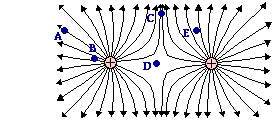
Which of the following labeled points is in the region with the strongest electric field?

a)

A

b)

B

c)

C

d)

D

13.

What is the electric force on a 5 coulomb charge in an electric field of 20 N/C?

a)

4 N

b)

100 N

c)

40 N

d)

10 N

14.
Which of the following statements is false about electric field lines
a)
electric field lines cannot cross
b)
electric field lines point away from positive charge
c)
electric field lines are always straight lines
d)
electric field lines show how a proton would move in an electric field
15.
An electrostatic force of 2 X 10². newtons is exerted on a charge of 4 coulomb at point P in an electric field. The magnitude of the electric field intensity at P is
a)
8 X 10² N/C
b)
5 N/C
c)
2 X 10⁻² N/C
d)
50 N/C
16.
Qand Qare two charges creating an electric field. Based on the electric field lines, we can conclude
a)
Qand Qare both positive
b)
Qand Qare both negative
c)
Qis positive and Qis negative
d)
Qis negative and Qis positive
17.
What is the magnitude of the electric field intensity at a point where a proton experiences an electrostatic force of magnitude 2.30 x 10⁻²⁵ newton?
a)
1.44 x 10⁻⁶ N/C
b)
3.68 x 10⁶ N/C
c)
1.44 x 1044 N/C
d)
3.68 x 10-44 N/C
18.

What is the definition of electric current?

a)

The ratio of potential difference across a component to the resistance of the component

b)

The power delivered by a battery per unit potential difference

c)

The rate of flow of electric charge

d)

The energy per unit charge dissipated in a power supply

19.

Which diagram represents the pattern of electric field lines of two small positive point charges held at the positions shown?

a)
b)
c)
d)
20.

What is the electric force between an electron and a proton that are separated by a distance of 1.0 x 10⁻¹⁰ m? is the force attractive or repulsive?

a)

attractive; 3.8 x 10⁻⁸N

b)

repulsive; 3.5 x 10⁻¹⁰N

c)

attractive ; 2.3 x 10⁻⁸N

d)

repulsive; 2.0 x 10⁻¹⁰N

21.

Which net charge could not be found on an object?

a)

4.8 x 10⁻¹⁹ C

b)

1.6 x 10⁻¹⁹ C

c)

3.2 x 10⁻¹⁹ C

d)

2.8 x 10⁻¹⁹ C

22.

How many volts are needed to do 50 joules of work on a 2.0 Coulomb charge?

a)

100V

b)

25V

c)

0.04V

d)

52V

23.

Two parallel plates are 0.002 meters apart. If the plates are connected to a 8.0 volt battery, what will be the electric field strength between them?

a)

4000 V/m

b)

0.016 Vm

c)

2.5 x 10⁻⁴ m/V

d)

8.002 NC

24.

The electric field between two oppositely charged parallel plates is directed from:

a)

the negative plate to the positive plate and strongest near the positive plate.

b)

the positive plate to the negative plate and strongest near the positive plate.

c)

the negative plate to the positive plate and the same strength everywhere between the plates.

d)

the positive plate to the negative plate and the same strength everywhere.

25.

Which of the following labeled points is in the region where the electric field is zero?

a)

A

b)

B

c)

C

d)

D
