
 Worksheets
Introduction to plate tectonics
Total questions: 20
Worksheet time: 9mins
How far do tectonic plates move each year?
~10 Millimeters per year
~10 Centimeters per year
~ 10 Meters per year
~10 Kilometers per year
Which of the following causes Earth's tectonic plates to move?
Energy from the Sun
Magnetic Pole Reversal
Convection currents in the mantle
Faults in Mountain Ranges

Label the layers.
A is the ...
(a)
Label the layers.
B is the ...
(a)
Label the layers.
C is the ...
(a)
Label the layers.
D is the ...
(a)
Label the layers.
E is the ...
(a)

What type of boundary is shown at A?
Transform
Destructive
Constructive
Convergent

What might be happening at point B? Select all that apply.
Subduction
Creation of a volcano
Slab-pull force
An earthquake
At this boundary plates slide past one and other and earthquakes are created
Transform
Continental-Continental Convergent
Divergent
Oceanic-Continental Convergent
How do the plates move along a constructive boundary?
They move towards one another
They move away from one another
They move past one another
One move up the other moves down
How do the plates move along destructive boundaries?
They move towards one another
They move away from one another
They move past one another
One moves up and one moves down
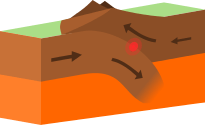
What type of plate boundary is this?
Constructive
Destructive
Strike-slip
Transform
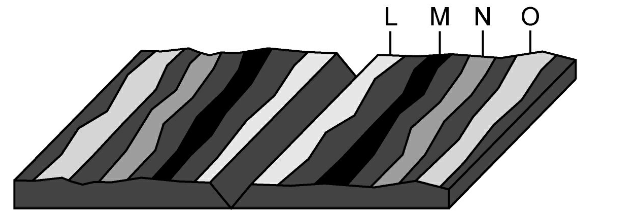
What are some data that a seismologist might study/track?
(Check all that apply)
Vibrations produced by plate interactions in the Earth's crust
The source (location and depth) and magnitude of an earthquake
The carbon content in the atmosphere
The effects of earthquakes and volcanoes

What is plate C?
(a)

What is plate A?
African
North American
Eurasian
Pacific
What is plate G?
North American
South American
Cocos
Caribbean
What is plate H?
Juan de Fuca
Nazca
Cocos
Caribbean
Scotia

