
Font size
 Worksheets
Lenses & Images
Total questions: 17
Worksheet time: 16mins

In this photograph, the water droplet is acting like a lens. Lenses work because of _________.
reflection
refraction
diffraction
interference

What type of lens is the droplet acting like?
bi-convex
bi-concave
plano-convex
meniscus

The lens pictured is exhibiting _______ behavior and is ______ in shape.
converging, convex
converging, concave
diverging, convex
diverging, concave
Which of the following correctly labels points A, B, and C?
focal point, focal length, principal axis
focal point, principal axis, focal length
principal axis, focal length, focal point
focal length, focal point, principal axis
The focal length of this lens is _______.
negative because it can form real images
positive because it can form real images
negative because it can form virtual images
could be positive or negative depending on the image formed

The focal length of this lens is _______.
negative because it can form real images
positive because it can form real images
negative because it can form virtual images
could be positive or negative depending on the image formed

The lens pictured is exhibiting _______ behavior and is ______ in shape.
converging, convex
converging, concave
diverging, convex
diverging, concave

Classify the image formed in the droplet. Check two.
real
virtual
inverted
upright

Classify the image produced by the projector lens. Check two.
real
virtual
larger than original
smaller than original

Classify the image in the viewfinder lens of the camera.
real
virtual
inverted
upright

Classify the image formed in the magnifying glass.
real
virtual
larger than original
smaller than original

The lens used in this scenario is
converging
diverging
bi-convex
bi-concave
The focal length in this scenario is
-1.5 units
1.5 units
2.5 units
4.0 units
Classify the image formed in this scenario.
real, inverted, larger than original
real, inverted, smaller than original
virtual, upright, larger than original
virtual, upright, smaller than original

A person standing in front of a lens creates an image that is both smaller than the original and closer to the lens. Classify the image formed in this scenario.
real, inverted
real, upright
virtual, inverted
virtual, upright
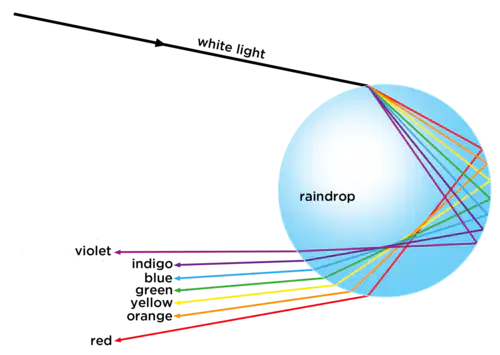
Rainbows occur because each color of light has a slightly different index of refraction. This causes each color to separate out into different colors. What is the cause of this effect?
Diffraction
Diverging
Dispersion
Differential

Because each color has a slightly different focal length, dispersion in lenses causes blurry color separation at the edge of images. Dispersion is caused by ___________.
refraction
reflection
diffraction
interference

