
NEW
Font size
 Worksheets
TE21 #2 Review
Total questions: 45
Worksheet time: 32mins

The diagram shows the location of a region labeled X. How does the presence of the mountain influence the climate of region X?
by bringing wet conditions
by causing dry conditions
by causing extremely cold conditions
by bringing stormy winds

A student labels two beakers 1 and 2, fills each beaker with 200 mL of water at 26°C, and places Beaker 1 on a table in a room with no windows and Beaker 2 in sunlight. The student places a thermometer in each beaker and records the final temperature of the water in each beaker after one hour, as shown in the table. Which statement accurately explains how thermal energy impacts water particles in the beakers?
Thermal energy causes the particles in both Beaker 1 and Beaker 2 to slow down.
Thermal energy causes the particles in both Beaker 1 and Beaker 2 to speed up.
Thermal energy causes the particles in Beaker 1 to slow down and in Beaker 2 to speed up.
Thermal energy causes the particles in Beaker 1 to speed up and in Beaker 2 to slow down.
What occurs when energy is transformed from kinetic to potential energy?
The energy is higher.
The energy is destroyed.
Energy is created.
Energy is conserved.

A student marks the Gulf Stream on a map, as shown. Which climate condition does the Gulf Stream cause?
It causes droughts along the eastern shoreline of North America.
It causes heat waves along the eastern shoreline of North America throughout the year.
It influences the climate of the eastern shoreline of North America by bringing in warm, moist air.
It influences the climate of the eastern shoreline of North America by bringing in cold, dry air.
At which position does a string on a bow have the least elastic potential energy?


A student places a thermometer 20 cm away from a lamp, as shown. If the room temperature is 25°C, why is the reading on the thermometer 29°C?
Thermal energy from the room moves to the thermometer as heat from radiation.
Thermal energy from the lamp moves to the thermometer as heat from radiation.
Thermal energy from the room moves to the thermometer as heat from conduction.
Thermal energy from the lamp moves to the thermometer as heat from conduction.

A 300 g ball is thrown upward. The diagram shows the path of the ball and four positions along its path. Which graph represents the relationship between gravitational potential energy (GPE) and kinetic energy (KE) at position 3?


If a ball weighing 150 g follows the same path with the same speed, how would its kinetic energy compare to the kinetic energy of the 300 g ball at position 4?
The 150 g ball would have more kinetic energy at position 4.
The 150 g ball would have less kinetic energy at position 4.
The 150 g ball would have the same kinetic energy at position 4.
The 150 g ball would have zero kinetic energy at position 4.

A student places a metal spoon, a wooden stick, and a plastic ruler in separate glasses of water at 70°C. After 30 minutes, the student carefully touches each object and records any observations in a table. Based on the student’s observations, which statement is true?
Heat can easily travel through metals.
Metals are good conductors of electricity.
Heat can easily travel through nonmetals.
Nonmetals are good insulators of electricity.

The arrows represent the movement of air above a road on a sunny day. What is happening at arrow X?
Warm air is rising because warm air is more dense than cooler air.
Cold air is rising because cold air is more dense than warmer air.
Warm air is rising because warm air is less dense than cooler air.
Cold air is rising because cold air is less dense than warmer air.

A student sees a book on a bookshelf. What can the student do to change the energy of the book?
Decrease the electrical energy by repeatedly rubbing the cover of the book.
Decrease the kinetic energy by moving the book to the bottom shelf
Increase the gravitational potential energy by moving the book to the top shelf.
Increase the thermal energy by opening the book.

The table shows four moving objects with different masses and speeds. Which object has the most kinetic energy?
Object 1
Object 2
Object 3
Object 4

A teacher prepares a demonstration to show the transfer of heat using the setup shown in the diagram. Which statement correctly describes how heat moves in the demonstration?
Heat moves from the lamp to the water by conduction, travels through the water by convection, and warms the boat by conduction.
B Heat moves from the lamp to the water by conduction, travels through the water by radiation, and warms the boat by convection.
Heat moves from the lamp to the water by radiation, travels through the water by radiation and convection, and warms the boat by convection.
D Heat moves from the lamp to the water by radiation, travels through the water by conduction and convection, and warms the boat by conduction.

A student drops a solid piece of foam in boiling water. The piece of foam rises to the top of the container, gets pushed to the side, sinks to the bottom, and then rises again repeatedly. What causes the foam to move in a circular motion?
conduction
convection
evaporation
radiation

A student conducts an experiment by dropping three balls with the same size but different masses from a height of two meters into a box of flour. The table shows the recorded measurements of the indentation each ball makes in the flour. What can the student conclude from the experiment?
The ball with the greatest mass has the most kinetic energy as it lands in the flour.
The ball with the lowest mass has the greatest velocity as it lands in the flour.
As the height from which the ball is dropped increases, the kinetic energy increases
As the size of the ball decreases, the velocity increases.

Locations X, Y, and Z are marked on a map of North America. Which location will most likely have the coldest average temperature in December, and why?
Location X; it is located near the ocean.
Location Y; it is not located near a large body of water.
Location Z; it is at the highest latitude.
Location Z; it is at the highest longitude.
Gasoline is the source of the energy used by a car to move. What type of energy is stored in the gasoline before it is released in a burning reaction in the engine?
chemical potential energy
elastic potential energy
gravitational potential energy
kinetic energy

A child pulls back a knob to compress a spring. When the child releases the knob, a pinball shoots forward to start the game, as shown. How does the child’s action move the pinball?
Compressing the spring creates kinetic energy, which when released, transforms into elastic energy of the ball.
Compressing the spring stores elastic energy, which when released, transforms into kinetic energy of the ball.
Compressing the spring stores elastic energy, and when released, the elastic energy transfers to the ball.
Compressing the spring creates kinetic energy, and when released, the kinetic energy transfers to the ball.
What is the main cause of convection currents forming in Earth’s atmosphere?
increase in global temperatures
movement of clouds at high altitudes
revolution of Earth around the Sun
unequal heating of Earth’s surfaces

A teacher has two jars, one with freshwater and one with salt water. Each type of water is dyed a different color and then carefully mixed by adding drops of salt water to the freshwater. The diagram shows the results of the activity. How can the activity help demonstrate the formation of ocean currents?
The salt in water makes water more dense, causing salt water to sink.
The salt in water makes water less dense, causing salt water to sink.
The salt in water makes water warmer, causing salt water to sink.
The salt in water makes water colder, causing salt water to sink.

A student rolls a 20-gram ball at different speeds. The table shows the kinetic energy of the ball at each speed. Based on the data, which statement describes the relationship between the speed and the kinetic energy of the ball?
When the speed of the ball is halved, the kinetic energy doubles.
When the speed of the ball is doubled, the kinetic energy doubles.
When the speed of the ball is doubled, the kinetic energy quadruples.
When the speed of the ball is quadrupled, the kinetic energy is halved.

How are northeast trade winds created?
Moist air at 30°N creates large amounts of clouds that block the flow of air from the equator, causing the air to sink and create northeast trade winds.
The Sun’s radiation warms the air at the equator, causing the air to rise, and the rotation of Earth on its axis creates northeast trade winds.
Ships traveling across the ocean between the equator and 30°N change the flow of water, and the wind is cooled by frequent rain to create northeast trade winds.
The oceans at the equator store the Sun’s radiation, generating a flow of cooler winds from the north, creating northeast trade winds.

Why are deserts commonly found at 30°S?
Warm, moist air near the equator rises and falls as rain, leaving cool, dry air that cycles and sinks at 30°S.
Warm air from the equator and 60°S combine at 30°S, creating very warm conditions.
The Sun’s radiation strikes most directly at 30°S, causing warm air to sink toward the surface.
The force of southeast trade winds and westerlies combining generates strong wind gusts, limiting the formation of clouds at 30°S.

A student sets up a model to show convection patterns in the ocean by placing a glass tray filled with water on a stand with a candle positioned below the tray. The student adds drops of food coloring in two positions, A and B, as shown. Initially, the drops in position A rise, while in position B, the drops sink to the bottom. Which statement is an accurate interpretation of the model?
Position A shows the convection process in polar regions.
Position B shows the convection process in tropical regions.
Position B shows the convection process in equatorial regions.
Position A shows the convection process in tropical regions.

A student who lives in Miami, Florida, travels to Helena, Montana, for summer vacation. The student notices that Montana is cooler than Florida and lists several ideas to explain why in the chart. Which ideas most likely contribute to the difference in the climate?
3 and 4
2 and 5
1, 2, and 3
1, 4, and 5
Which scenario shows the least amount of kinetic energy?


Which factor contributes to the formation of deep ocean currents?
Earth’s rotation
Moon’s gravity
surface wind
temperature differences

A child swings back and forth from point A to point B on a tree swing, as shown. Which statement best describes what happens to the energy as the child swings back and forth on the tree swing?
The energy is used up.
The energy continuously increases.
The energy continuously decreases.
The energy changes forms.
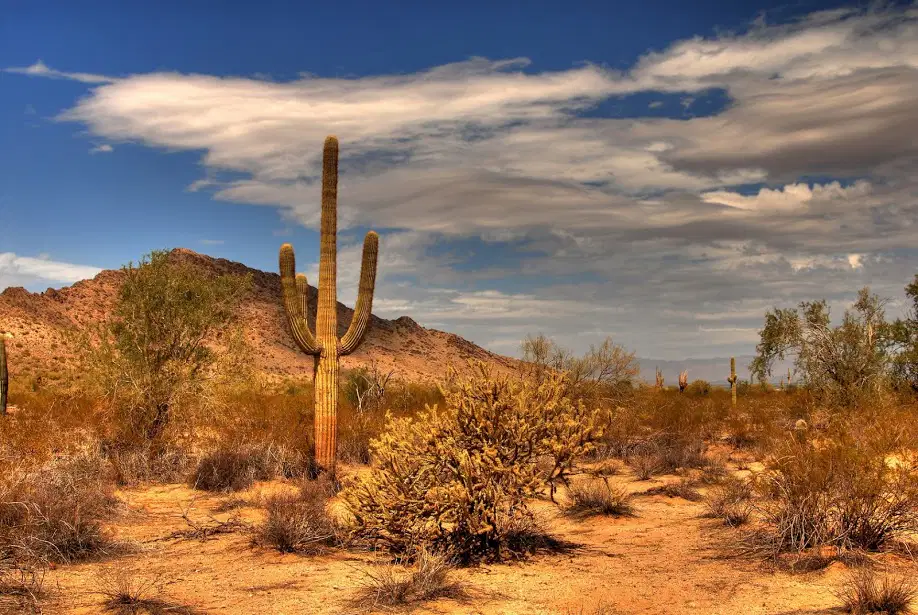
Which animal is most likely found in this biome?
Bear
Deer
Parrot
Rattlesnake
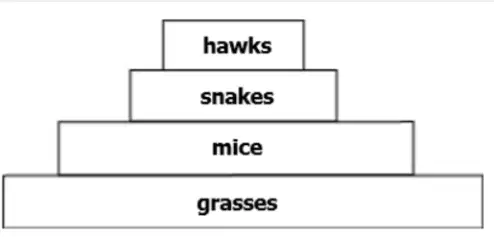
The diagram shows an energy pyramid for an ecosystem. Based on the diagram, what can be concluded about the amount of available energy at each level?
The amount of energy increases moving up the energy pyramid.
The amount of energy decreases moving up the energy pyramid
The amount of energy is at its lowest at the bottom and top levels.
The amount of energy is at its greatest at the top two levels.
In general, how does latitude affect the climate of a region?
A region at a higher latitude is closer to the equator and has a cooler climate.
A region at a higher latitude is farther from the equator and has a cooler climate.
A region at a higher latitude is closer to the coast and has a cooler climate.
A region at a higher latitude is farther from the coast and has a cooler climate
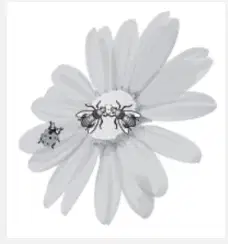
The image shows a ladybug and two honeybees on the same flower. Which statement explains the type of ecological interaction the image shows?
Parasitism; the insects benefit from the flower, and the flower acts as the host to protect the insects.
Mutualism; all three insects are equally feeding on the nectar of the flower.
Competition; all three insects are competing for the same food source.
Commensalism; the honeybees feed on flower nectar, and the ladybug protects them from predators.
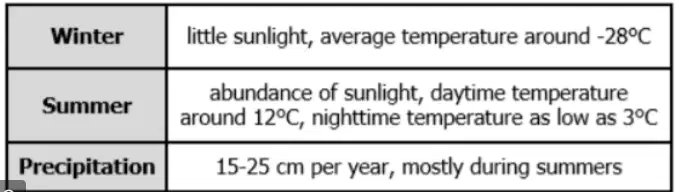
Based on the data, what can be inferred about the biotic factors of this region?
The region has large populations of birds in the winter when they migrate.
The region supports the growth of tropical flowers.
The region does not have mammals as they cannot adapt to the climate.
The region does not support the growth of trees as the land remains frozen most of the year.
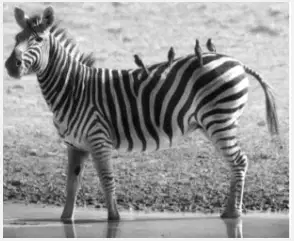
Oxpecker birds are named after their feeding habits. They sit on a large mammal’s back and peck their beaks into the hair to eat ticks and other larvae attached to the mammal’s skin. Since an oxpecker’s food of choice is blood, they also feed directly on the mammal’s blood using their strong beaks. Which combination of symbiotic relationships does the oxpecker have with large mammals?
commensalism and mutualism
commensalism and parasitism
parasitism and mutualism
commensalism, mutualism, and parasitism
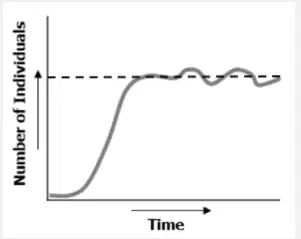
What is represented by the dashed line on the graph?
birth rate
carrying capacity
death rate
emigration maximum
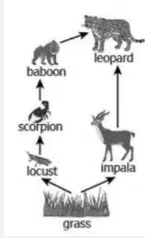
A herd of zebra enter the grassland ecosystem. Zebra feed solely on grasses and are eaten by leopards. What effect will the introduction of the zebra have on the grassland ecosystem?
The number of leopards will decrease, and the number of locusts and impalas will increase.
The number of scorpions and leopards will increase, and the number of impalas will decrease.
The number of impalas and locusts will decrease, and the number of leopards will increase
The number of baboons will increase, and the number of scorpions and locusts will increase.
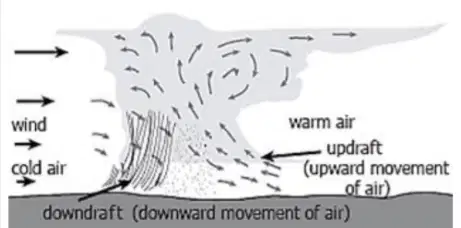
Which statement best explains the basic cause for a thunderstorm?
A thunderstorm is caused by the convergence of any two air masses with different altitudes.
A thunderstorm is caused by the convergence of air masses with different temperatures.
A thunderstorm is caused by the convergence of air masses having different speeds due to their accompanying wind directions.
A thunderstorm is caused by the convergence of any two air masses moving in opposite directions.
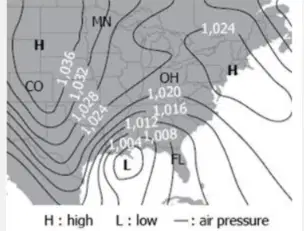
The map shows regions of low and high pressures across the United States. In which state will it most likely rain?
Colorado (CO)
Florida (FL)
Minnesota (MN)
Ohio (OH)
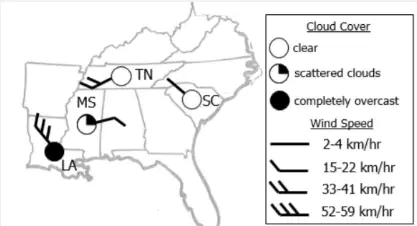
Examine the weather map that provides information about four state capitals in the southeast United States. Which city will have the highest reading on an anemometer?
Baton Rouge, LA
Columbia, SC
Jackson, MS
Nashville, TN
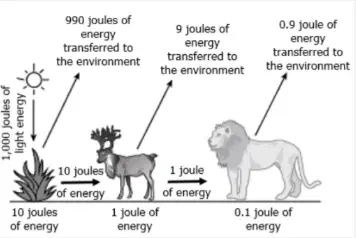
Energy is measured in units of joules. The model shows the energy transfer in a simple food chain. Which statement is supported by the model?
Animals use the Sun’s energy directly to perform body functions.
Energy is not conserved in the food chain.
Most of the energy on Earth originally comes from plants.
Energy available for organisms decreases as it passes through the food chain.
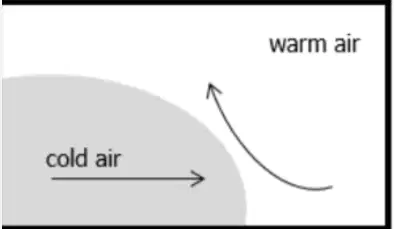
The model shows how a cold air mass slides under a warm air mass in a region. What weather condition will most likely occur in the region?
cooler temperatures
warmer temperatures
extremely hot weather
extremely humid weather

A student reads the features of a biome listed in the chart. Which type of plant is best suited to grow in this biome?
cactus with spines instead of leaves to reduce water loss by transpiration
fan palm with large, segmented leaves that catch sunlight and drain excess water
pine tree with waxy needles to prevent water loss and accumulation of snow
kelp with multiple leaf-like blades that work well submerged underwater
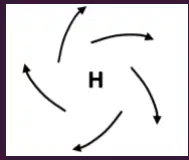
A student observes the symbol H on a weather map along with arrows indicating the direction of wind, as shown. Which weather condition is often associated with this symbol?
rainy weather
fair weather
above average temperatures
below average temperatures
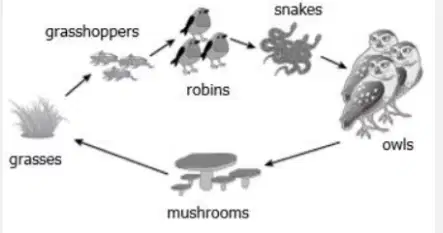
Which organisms can be labeled as decomposers?
grasses
mushrooms
owls
snakes
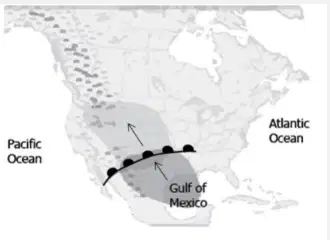
Two air masses interact to form a warm front, as shown in the diagram. Which statement correctly describes the interaction of the two air masses and the weather generated?
A warm air mass combines with another warm air mass, generating extremely hot temperatures and strong winds
A warm air mass pushes into a second warm air mass, creating short periods of precipitation and cooler temperatures.
The warm air mass rises up and rolls over a cold air mass, creating long periods of precipitation and warmer temperatures.
The warm air mass sinks below the cold air mass, generating extremely cold temperatures and strong winds.

