
NEW
Font size
S
M
L
XL
 Worksheets
Chemistry Unit 2 Test
Total questions: 42
Worksheet time: 14mins
Name
Class
Date
1.
Carbon dioxide goes from a solid to a gas without becoming a liquid. This is a (chemical/ physical) change.
a)
chemical
b)
physical
2.
Shape is a (chemical/ physical) property.
a)
chemical
b)
physical
3.
Bleach is an example of a (base/ acid).
a)
base
b)
acid
4.
When substances react, their mass remains the (same/ different) after the reaction.
a)
same
b)
different
5.
In a physical change, the substance (does/ does not) change its identity.
a)
does
b)
does not
6.
A description of an object based on what you observe with your senses includes (physical/ chemical) properties.
a)
physical
b)
chemical
7.
The ability to react with oxygen is a (physical/ chemical) property.
a)
physical
b)
chemical
8.
(Mass/ Weight) is due to gravitational pull.
a)
Mass
b)
Weight
9.
The ability for a substance to dissolve in another is (solubility/ flammability).
a)
solubility
b)
flammability
10.
(Acids/ Bases) are associated with the number greater than 7 on the pH scale.
a)
Acids
b)
Bases
11.
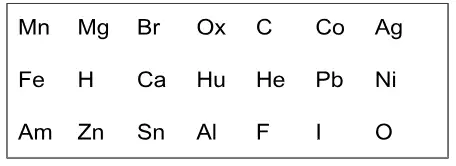
Directions: Write the symbol of the element or the name of the element in the space provided.
Magnesium:
a)
Mn
b)
Mg
c)
Br
d)
Ox
12.
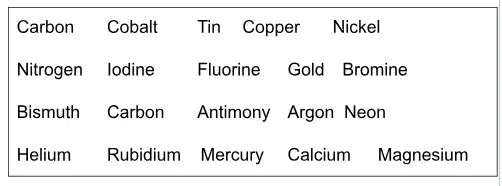
Directions: Write the symbol of the element or the name of the element in the space provided.
N:
a)
Nickel
b)
Nitrogen
c)
Neon
d)
Carbon
13.

Directions: Write the symbol of the element or the name of the element in the space provided.
Helium:
a)
H
b)
He
c)
Hu
d)
Pb
14.
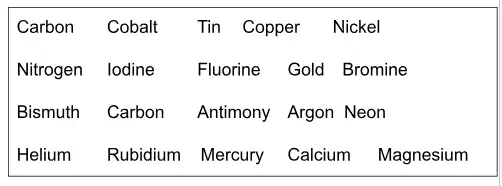
Directions: Write the symbol of the element or the name of the element in the space provided.
Co:
a)
Carbon
b)
Copper
c)
Cobalt
d)
Calcium
15.
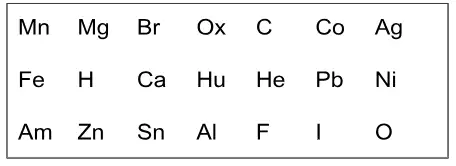
Directions: Write the symbol of the element or the name of the element in the space provided.
Nickel:
a)
Ni
b)
Fe
c)
Zn
d)
O
16.
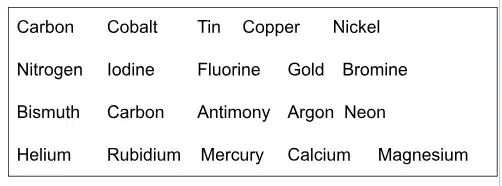
Directions: Write the symbol of the element or the name of the element in the space provided.
Au:
a)
Iodine
b)
Fluorine
c)
Neon
d)
Gold
17.
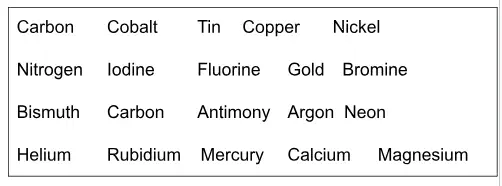
Directions: Write the symbol of the element or the name of the element in the space provided.
Rb
a)
Rubidium
b)
Bismuth
c)
Mercury
d)
Neon
18.
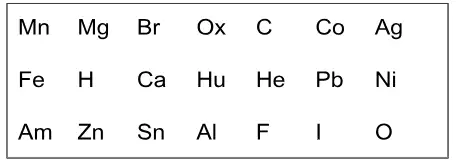
Directions: Write the symbol of the element or the name of the element in the space provided.
Bromine:
a)
Br
b)
Ox
c)
I
d)
F
19.

Directions: Write the symbol of the element or the name of the element in the space provided.
Hg:
a)
Helium
b)
Rubidium
c)
Mercury
d)
Magnesium
20.
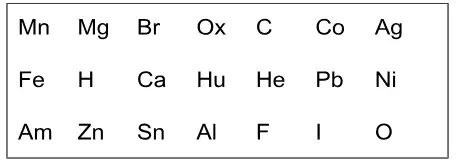
Directions: Write the symbol of the element or the name of the element in the space provided.
Oxygen:
a)
Fe
b)
H
c)
F
d)
O
21.
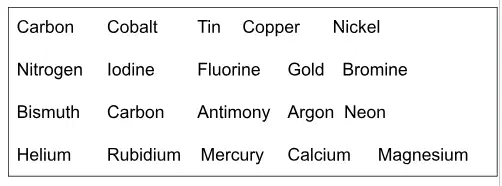
Directions: Write the symbol of the element or the name of the element in the space provided.
Ca:
a)
Carbon
b)
Cobalt
c)
Calcium
d)
Copper
22.
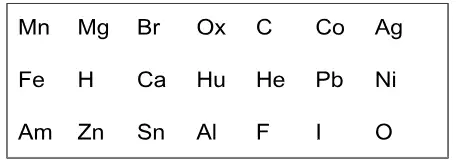
Directions: Write the symbol of the element or the name of the element in the space provided.
Iron:
a)
Fe
b)
F
c)
He
d)
Pb
23.
The following are examples of physical properties EXCEPT :
a)
Density
b)
Ability to react with oxygen
c)
Shape
d)
Color
24.
Which formula listed below correctly finds density:
a)
D= m/V
b)
D= g/V3
c)
D=V/m
d)
D= g3/V
25.
A bicycle was left outside for several days. What most likely happened to the bicycle?
a)
Physical changes colored it green
b)
Chemical changes colored it reddish-brown
c)
Physical changes made it shiny
d)
No changes occurred
26.
Which of the following is the law that states that matter cannot be created or destroyed?
a)
The Law of Conservation of Mass
b)
The Law of Conservation of Density
c)
The Law of Gravity
d)
The Law of Motion
27.
An example of a chemical change is ___
a)
A magnet sticking to a fridge
b)
Baking bread
c)
Breaking glass
d)
Water boiling
28.
The temperature at which a liquid becomes a gas is the ___ point.
a)
Boiling
b)
Freezing
c)
Melting
d)
Condensation
29.
The amount of matter in an object is called the
a)
Weight
b)
Volume
c)
Mass
d)
Precipitate
30.

Using the picture, which liquid has the highest density?
a)
Liquid A
b)
Liquid B
c)
Liquid C
d)
Liquid D
31.

Using the picture, which what must be true about Liquid A when compared to liquid C?
a)
Liquid A is denser than Liquid C
b)
Liquid C is denser than Liquid A
c)
Liquid C is less dense than Liquid A
d)
They have the same density
32.
The mass of the products of a chemical reaction ____ the mass of the reactants
a)
is greater than
b)
is the same as
c)
is less than
d)
none of the above
33.
When we added steel wool to the hydrogen peroxide we observed a….
a)
physical change
b)
chemical change
c)
homogenous mixture
d)
solution
34.
Which of the following is an example of a chemical reaction?
a)
Lighting a match
b)
Freezing water
c)
Breaking a glass
d)
Dissolving salt into water
35.
Which of the following is an example of a physical change?
a)
Slicing bread
b)
Rusting chairs
c)
Burning fire
d)
Exploding fireworks
36.
In an experiment, a student adds baking soda (sodium bicarbonate) to vinegar (acetic acid) and observes a large amount of gaseous carbon dioxide is released. What is the scientific reason for this change?
a)
Baking soda chemically changes into a new substance
b)
Baking soda evaporates
c)
Baking soda condenses
d)
Baking soda's atoms are destroyed
37.
Which of these observations is an indication that a chemical reaction has occurred?
a)
Steam forms above boiling water
b)
A solid forms when a clear solution is frozen
c)
A solid forms when two clear solutions are mixed
d)
Sugar crystals form on the sides of a boiling pot of sugar water
38.

What are the reactants?
a)
35g Cl2 + 15g 2KI
b)
25 g KCL + __ g I2
39.
What are the products?
a)
35g Cl2 + 15g 2KI
b)
25 g KCL + __ g I2
40.

Which product is an element?
a)
KCl
b)
I2
41.
Which product is a compound?
a)
KCl
b)
I2
42.

How many grams of iodine is produced?
a)
10
b)
15
c)
25
d)
30
Reset

