
 Worksheets
Ecology
Total questions: 46
Worksheet time: 54mins

All organisms of a species that live in the same place at the same time is called
species
predation
population
habitat

Living parts of an ecosystem are called...
species
abiotic factors
biotic factors
population
Examples of autotrophs are...


What percentage of energy is passed from one trophic level to the next trophic level?
About 25% of the energy is passed to the next trophic level.
Only about 10% of the energy at one level is passed to the next.
About 50% of the energy is passed
50% of energy is passed from one trophic level to the next


The meanings of the terms habitat and niche are often confused or are intertwined. Which of the following describes the difference between these two terms?
A niche is the place where an organism lives. A habitat is the job or role of an organism.
A habitat has to do with how the organism interacts with its environment. A niche is the job or role of an organism.
A habitat is a place where an organism lives. A niche is the job or role of an organism.
A niche involves the food, water, and shelter that an organism has access to. A habitat is a place where an organism lives.
Mushrooms and bacteria are considered _____________, which are organisms that break down decaying organisms.
consumers
decomposers
producers
herbivores

An energy pyramid represents what?
How much energy a particular organism needs.
How much sunlight is available for the ecosystem to use.
How much energy is needed to build a pyramid.
The amount of energy available to the next 'feeder' in a food web.


According to the graph, what is causing the deer population to decrease
They got sick
The wolf population is decreasing
The wolf population increased
They ran out of food


Which pattern is found in the graph?
The populations do not show a similar pattern
The populations cycle opposite of each other about every 10 years. When one increases, the other decreases
The populations cycle with each other about every 10 years. When one increases, the other also increases

90% of the energy that gets lost as you move up a food pyramid or chain gets lost as
pollution to the environment
heat to the environment
energy for decomposers
gets recycled
When two or more organisms depend upon one another
mutualism
commensalism
interdependent
parasitism
An organism that is being hunted or eaten
organism
abiotic
predation
prey


Small openings on a leaf- O2, oxygen and CO2 carbon dioxide can move
product
stomata
roota
glucose
What are the two products of photosynthesis?
Glucose
Oxygen
Carbon Dioxide
Water
Light

A species that plays a critical role in the health, maintenance, growth, or definition of an ecosystem.
keystone
invasive
engineer
predator

Which of the following would be the most likely effect, if there were a sudden increase in the cricket population?
There would be a decrease in the small bird population.
There would be a decrease in the grass/flowers population.
There would be a decrease in the mice population.
There would be an increase in the grass/flowers population.

When there is higher biodiversity...
more organisms are likely to die because they can't adapt to environmental changes.
there is more diversity and higher sustainability of life.
there is less diversity.
there is more diversity and lower sustainability of life
Biodiversity is affected by pollution.
True
False

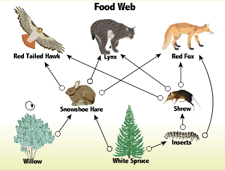
Who are the primary consumers in this food web?

A scientist was studying a population of fish in a pond over a period of 10 years. He observed that the population increased each year for 3 years, and then remained nearly constant for the rest of the study. The best explanation for this observation is that the population had
stopped reproducing
reached carrying capacity
mutated into a different species
run out of food and all died
Predator population lags behind prey population because:
Increase in predators leads to decrease in prey
Increase in predators leads to increase in prey
Increase in predators leads to decrease in producers
Read the following statement and choose which characteristic of living things it describes. A caterpillar eats the leaves of a plant.
Obtain and use energy
Respond to a Stimulus
Grow and Develop
Reproduce

This refers to the total disappearance of all the members of a particular group of species.
Extinction
Biodiversity
Natural Selection
Disappearance
Why are mushrooms important to the food chain?
They recycle nutrients into the ecosystem.
They produce food energy for other living things.
They recycle oxygen into the atmosphere.
They consume excess herbivores in the ecosystem.
What happens if an animals moves to a new habitat, and cannot get its basic needs of food, water, shelter, and space?
Nothing
Extinction
The animal will adapt no matter what

