wayground logo

Free Printable Worksheets

Font size

S
M
L
XL
Worksheets

RNA & Protein Synthesis

Total questions: 65

Worksheet time: 38mins

Name
Class
Date
1.

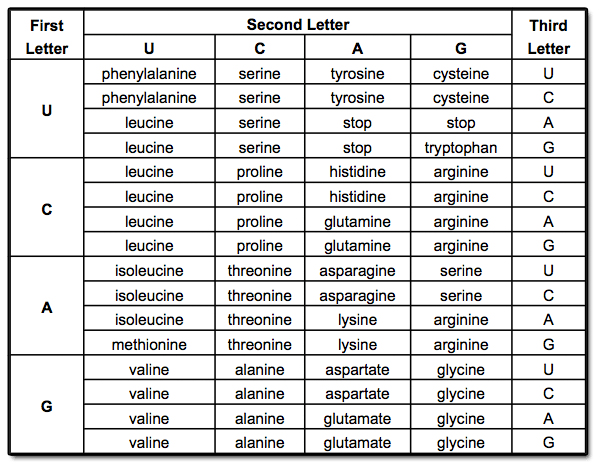
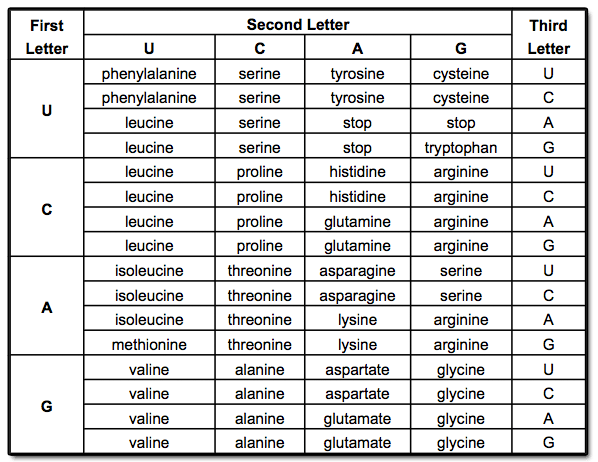
When using your codon chart, what sequence can you use to find the correct amino acid?

a)

DNA

b)

mRNA

c)

tRNA

d)

Any of these will do

2.

How many nucleotides make up a codon?

a)

1

b)

3

c)

5

d)

15

3.
What amino acid is represented by the codon UUA?
a)
Phenylalanine
b)
Tyrosine
c)
Leucine
d)
Stop codon
4.

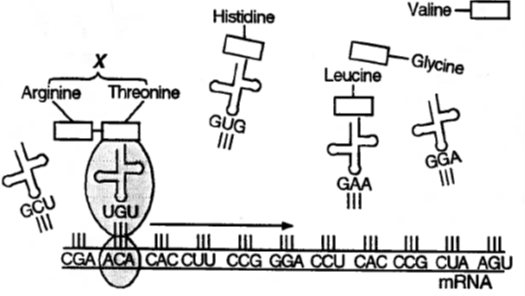
Which of the following answer choices correctly identifies each molecule in the above diagram?

a)

1 - mRNA, 2 - tRNA, 3 - ribosome

b)

1 - tRNA, 2 - mRNA, 3 - ribosome

c)

1 - tRNA, 2 - ribosome, 3 - mRNA

d)

1 - ribosome, 2 - tRNA, 3 - mRNA

5.

Use the CODON CHART to answer the following question.


CCG UUG ACC GCG


What is the sequence of amino acids that will be translated from the mRNA above?

a)

proline - threonine - alanine - luecine

b)

proline - leucine - threonine - alanine

c)

proline - phenylalanine - tyrosine - arginine

d)

arginine - leucine - threoinine - alanine

6.
Which of the following describes RNA?
a)
RNA is usually double-stranded and contains the base thymine
b)
RNA is usually single-stranded and contains the base uracil
c)
RNA is longer than DNA and uses five bases to encode information
d)
RNA is made in the nucleus of eukaryotic cells and stays there to carry out its functions
7.
How would the DNA sequence GCTATA be transcribed to mRNA?
a)
GCUAUA
b)
CGATAT
c)
CGAUAU
d)
GCUTUT
8.
The process by which the genetic code of DNA is copied into a strand of RNA is called
a)
translation
b)
transcription
c)
transformation
d)
replication
9.
Which of the following describes RNA?
a)
RNA is usually double-stranded and contains the base thymine
b)
RNA is usually single-stranded and contains the base uracil
c)
RNA is longer than DNA and uses five bases to encode information
d)
RNA is made in the nucleus of eukaryotic cells and stays there to carry out its functions
10.
In messenger RNA, each codon specifies a particular
a)
nucleotide
b)
enzyme
c)
amino acid
d)
promoter
11.
The number of codons in the genetic code is
a)
3
b)
4
c)
20
d)
64
12.
Which of the following statements about the genetic code is true?
a)
A codon can specify more than one amino acid
b)
Every codon specifies a different amino acid
c)
Some codons specify the same amino acid
d)
Some codons have no function at all
13.
The process of making proteins on the ribosome based on instructions from messenger RNA is called
a)
transcription
b)
transformation
c)
translation
d)
molecular biology
14.
The process of making proteins on the ribosome based on instructions from messenger RNA is called
a)
transcription
b)
transformation
c)
translation
d)
molecular biology
15.
Changes is DNA sequences that affect genetic information are known as
a)
replications
b)
mutations
c)
transformations
d)
translations
16.
A single-base mutation in a messenger RNA molecule could transcribe the DNA sequence CAGTAT into
a)
GTCATA
b)
GUCAUA
c)
GTCUTU
d)
GUAAUA
17.
A group of genes that are regulated together is called a(n)
a)
promoter
b)
operon
c)
intron
d)
allele
18.
Blocking gene expression in eukaryotes with microRNA strands is called RNA
a)
transcription
b)
translation
c)
interference
d)
digestion
19.

What organelle reads the mRNA and finds the correct amino acid?

a)

DNA

b)

Nucleus

c)

Ribosome

d)

Chloroplast

20.

When using your codon chart, what sequence can you use to find the correct amino acid?

a)

DNA

b)

mRNA

c)

tRNA

d)

Any of these will do

21.

How many nucleotides make up a codon?

a)

1

b)

3

c)

5

d)

15

22.

How many codons: AAU GCG AUG

a)

9

b)

1

c)

3

d)

15

23.

How many nucleotides? AAU GCG AUG

a)

9

b)

3

c)

1

d)

15

24.
ATCAGTGAT A codon is a sequence of three nucleotides that code for an amino acid. If the DNA sequence shown here goes through transcription and translation, how many amino acids will result from this sequence?
a)
5
b)
4
c)
2
d)
3
25.
RNA is read in sections called:
a)
Triplets
b)
Genes
c)
Codons
d)
Genes
26.
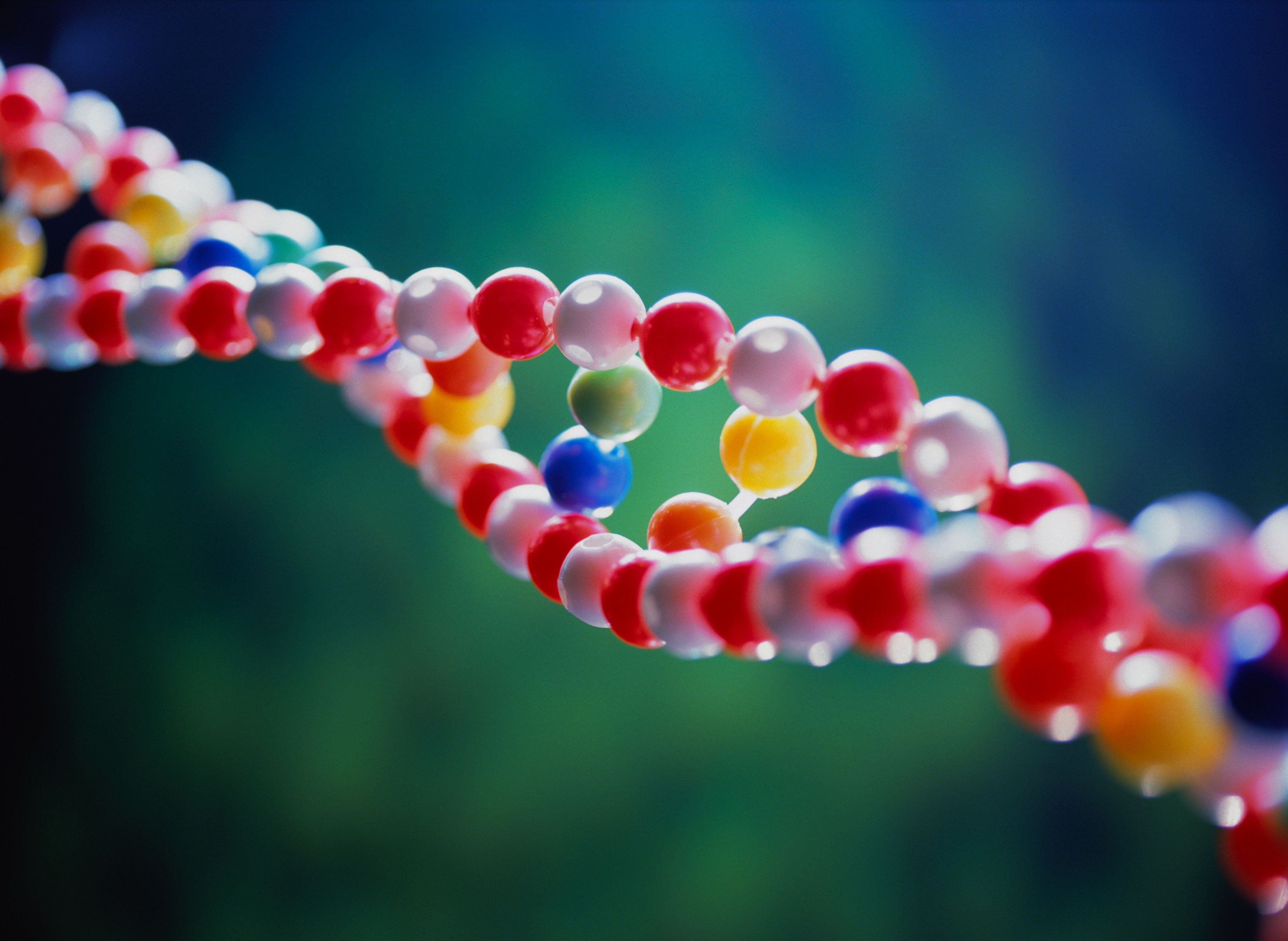
What process is going on in this photo? 
a)
Transcription 
b)
Translation 
c)
Replication 
d)
All the above 
27.

What is the order for Protein Synthesis?

a)

Transcription -> Translation -> Protein

b)

Translation - > Transcription -> Protein

c)

Protein -> Transcription -> Translation

d)

Translation -> Protein -> Transcription
28.
tRNA is involved in
a)
carrying amino acids 
b)
carrying ribosomes
c)
carrying glucose
d)
carrying lipids
29.
What is the location in the cell for translation?
a)
nucleus
b)
mitochondria
c)
ribosome
d)
chloroplast
30.
Amino acids are joined together in order to form
a)
DNA
b)
ribosomes
c)
proteins 
d)
RNA
31.
What is the correct amino acid sequence for the mRNA code AUGCCAGUAUGA
a)
Met-Pro-Ala-Val
b)
Met-Pro-Val
c)
Tyr-Gly-His
d)
Tyr-Gly-Arg-His
32.
What amino acid is represented by the codon UUA?
a)
Phenylalanine
b)
Tyrosine
c)
Leucine
d)
Stop codon
33.

What is the correct amino acid sequence for the mRNA code AUGCCAGUAUGA

a)

Met-Pro-Ala-Val

b)

Met-Pro-Val

c)

Tyr-Gly-His

d)

Tyr-Gly-Arg-His

34.

Which of the following are differences in the structure between RNA and DNA

a)

DNA uses deoxyribose sugar, RNA uses sugar ribose

b)

DNA pairs Adenine with Uracil, RNA pairs Adenine with Thymine

c)

DNA is a double helix, RNA is a single helix

d)

DNA pairs Adenine with Thymine, RNA pairs Adenine with Uracil

35.

Which organelle is the location where protein is made?

a)

Ribosome

b)

Nucleus

c)

Cytoplasm

d)

Nucleotide

36.

Insertion, deletion, and substitution are all examples of a change in a genetic sequence which is also referred to as (a)

a)

Gene

b)

Amino Acid

c)

Ribose

d)

Mutation

37.

During transcription, this type of ribonucleic acid is responsible for copying the DNA and brining it out of the nucleus.

a)

tRNA

b)

mRNA

c)

rRNA

d)

dRNA

38.

When these bond together, they form a protein

a)

Amino Acids

b)

Peptide Bonds

c)

Ribose

d)

Nucleotides

39.

These building blocks consist of a sugar, phosphate, and nitrogen base.

a)

Ribose

b)

Nucleotide

c)

Gene

d)

Protein

40.

During translation, this type of ribonucleic acid is responsible for delivering amino acids to help make a protein.

a)

mRNA

b)

rRNA

c)

tRNA

d)

dRNA

41.

There are a total of ____ different amino acids

a)

20

b)

1

c)

4

d)

unlimited

42.

mRNA occurs during this process

a)

Translation

b)

Transcription

c)

Replication

d)

Delivery

43.

How many amino acids are found on one tRNA?

a)

20

b)

4

c)

1

d)

3

44.

Which of the following is the complementary mRNA sequence to this DNA strand: AACTGAA

a)

UUGACUU

b)

TTGACTT

c)

AACTGAA

d)

AACUGAA

45.

Which of the following is the tRNA that will be used to decode to this DNA strand: AACTGA

a)

AAC and TGA

b)

TTG and ACT

c)

UUG and ACU

d)

AAC and UGA

46.

A copy of a gene

a)

Gene

b)

mRNA

c)

tRNA

d)

RNA Polymerase

47.

The molecule that tells the ribosome in which sequence to connect the amino acid

a)

Gene

b)

mRNA

c)

tRNA

d)

RNA Polymerase

e)

codon

48.

An enzyme that makes RNA

a)

DNA Polymerase

b)

Helicase

c)

Ligase

d)

RNA Polymerase

e)

Primase

49.

Three consecutive nucleotides on a mRNA molecule

a)

Translation

b)

Transcription

c)

anticodon

d)

codon

50.

Three consecutive nucleotides on a tRNA molecule

a)

Translation

b)

Transcription

c)

anticodon

d)

codon

51.

Where does TRANSCRIPTION occur?

a)

Nucleus

b)

Ribosome

c)

Cytoplasm

d)

Mitochondria

52.

Why must transcription occur where DNA can be found?

a)

because DNA can't leave

b)

because ribosomes are in the nucleus

c)

because DNA polymerase is found there

d)

because helicase unzips the DNA

53.

On which molecule can an anticodon be found?

a)

mRNA

b)

DNA

c)

tRNA

d)

rRNA

54.

What is the purpose for anti-codons?

a)

to ensure the correct amino acid is dropped off

b)

to match the strand of DNA

c)

to decode a sequence of 4 nucleotides into an amino acid

d)

to make me hate biology

55.
DNA molecule segment is : TTACGCAAG
The mutated DNA segment is TTCGCAAG. This is an example of ___ mutation.
a)
Substitution
b)
Deletion
c)
Insertion
d)
Inversion
56.
Normal-
GAG-CTC-GAC-AGA
Mutant
GAG CTC-CAC-AGA
a)
no mutation
b)
substitution
c)
insertion
d)
deletion
57.
Are all mutations bad?
a)
Yes
b)
No
58.
What are the three types of mutation? 
a)
Insertion, Deletion, Subsitution
b)
Deletion, Newstion, Subsitution 
c)
Newstion, Deletion, Insertion 
d)
Insertion, Newstion, Substitution 
59.
Why is DNA important?
a)
it is very small and very complicated
b)
it's in everything
c)
it serves as the blueprint for traits of all living things
d)
because we eat it every day for energy
60.
What do helpful mutations do? 
a)
Increases chances of survival 
b)
Decreases changes of survival 
c)
Increases chances of developing cancer
d)
Decreases skills
61.

What mutation has occurred here?

T-G-A-C-C-A

T-G-A-G-C-A

a)

Substitution

b)

Deletion

c)

Insertion

d)

Frameshift

62.

DNA molecule segment is : TTACGCAAG

The mutated DNA segment is TTACGCAAC. This is an example of ___ mutation.

a)

Substitution

b)

Insertion

c)

Inversion

d)

Translocation

63.

ATT-TGA-GCC- Original

ATT-GAG-CC - Mutated

The example above is an example of a

a)

Insertion- Frameshift

b)

Deletion- Substitution

c)

Deletion -Frameshift

d)

All of the above

64.

DNA molecule segment is : TTA-CGC-AAG

The mutated DNA segment is TTC-GCA-AG. This is an example of ___ mutation.

a)

Substitution

b)

Deletion

c)

Insertion

d)

Inversion

65.
Original: ATC CAT
Mutation: ATC GCAT
What mutation occurred?

a)
deletion
b)
insertion
c)
silent
d)
transverse