
 Worksheets
Unit 7: Light, Color, Optics - Most missed on Quizzes
Total questions: 46
Worksheet time: 36mins

What particles make up light?
Photons
Neutrons
Protons
Matter
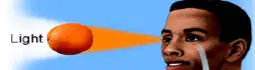
Why do we see the fruit ORGANGE as the COLOR ORANGE?
It is equal parts Red and Green
It is transparent + colorless
It is made of ALL colors BUT orange
It has an imbalance of RED (more Red) than Green


Number 2 on the list is:
radio
UV
visible Light
microwaves

EM waves have the same speed but different:
frequency & medium
wavelength & frequency
medium & wavelength
color & medium


Which images are opaque?
A & C
A,C,E, & F
D, E, & F
A & E

In this diagram, which is the angle of incidence?
Angle A
Angle B
Angle C
Angle D
Which of the following IS NOT a behavior that light waves can undergo when they reach a boundary between two media?
stopping at the edge of the boundary
reflection off of the boundary
transmission into the boundary
refraction through the boundary

Reflection is to bouncing as refraction is to:
bending.
breaking.
dissipating.
halting.

This drawing illustrates the ________________________ of a light wave.
refraction
reflection
diffraction
dispersion

A concave mirror is shaped like the inner surface of a sphere. How do you think light rays will reflect off a concave mirror?
Reflected rays converge toward the center line of a concave mirror.
Reflected rays diverge away from the center line of a concave mirror.
Reflected rays reflect straight back at the angle that they came in.
Reflected rays are absorbed by a concave mirror.
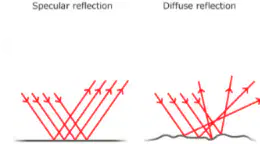
The way that a surface reflects light depends on its texture. Rough surfaces such as cloth and wood tend to scatter light, reflecting it in many different directions. This type of reflection is called:
diffuse reflection.
specular reflection.
incident reflection.
distorted reflection.

A ray of light is incident towards a plane mirror at an angle of 30-degrees with the mirror surface. What will be the angle of reflection?
60o
30o
90o
45o

What is the speed of light in air?
As fast as it would be in a vacuum
Slightly slower than the speed in a vacuum
Slightly faster than the speed in a vacuum
Light is unable to travel through air

flint glass n=1.70
barium glass n=1.60
crown glass n=1.523
water n=1.33
diamond n=2.45
flint glass n=1.70
barium glass n=1.60
crown glass n=1.523
water n=1.33
diamond n=2.45
A ray of light traveling from air into crown glass strikes the surface at an angle of 30 degrees. What is the angle of refraction? (air n=1, crown glass n=1.532)
exactly 30 degrees
less than 30 degrees
greater than 30 degrees
there is not enough information to answer this question


How does light behave as it enters these media?
Light travels at 1.76 x 10⁸ m/s through an optical medium. What is the medium?
diamond n=2.45
flint glass n=1.70
barium glass n=1.60
crown glass n=1.523
Crown Glass
Barium Glass
Flint Glass
Diamond

If I were to write out the expanded form of 2.3 x 10⁸?
2.3
2.300000000
230,000,000
00000002.3
2,300,000

According to the data, which media does light travel fastest through?
Air because it has the highest refractive index which means it is the most dense. The denser a medium is the faster the light wave will travel.
Air because it has the lowest refractive index which means it is the least dense. The less dense a medium, the faster the light wave will travel.
Diamond because it has the lowest refractive index which means it is the least dense, which means the wave will move the fastest.
Diamond because it has the highest refractive index which means it is the most dense. The denser a medium is the faster the light wave will travel.

The speed of light through water is 230,000,000 m/s per second. Refer to the data table to see the speed of a sound wave through water. What conclusion can I draw from the information?
Waves move at the same speed regardless of the type of wave
Mechanical waves (sound) move faster than Electromagnetic waves (liquid)
Electromagnetic waves (light) move faster than Mechanical waves (sound)
There is not enough data to answer the question

Why is the process of sunlight being broken into its constituent colors from water droplets forming a rainbow called (like a glass prism)?
scattering
dispersion
reflection
diffraction

Why is the spectrum of light separated into its components of color when white light is directed to a prism?
Because light reflects off the prism's surface
The incident white light refracts and separates into its constituent colors
The white light is dispersed by the prism, separating its colors through refraction
The light speeds up as it moves from air into the denser plastic material

Which of these is NOT an example of scattering of light?
Sky appears blue at midday
Sky appears reddish in the evening
Rainbow after rain

Which of the following is example light scattering ?
( There CAN be more than 1 answer)


Which of the following natural phenomenons occur due to light dispersion.


ALWAYS USD/Inverted
Magnified (larger) or Diminished (smaller)
Dan be projected and/or obtained on screen
All the above
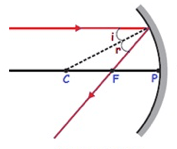
This ray diagram is for which mirror?
concave
convex
plane
window
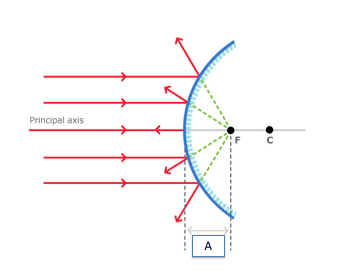
In the image, all the rays meet at F, What is F
focal length
focal point
center of curvature
reflection
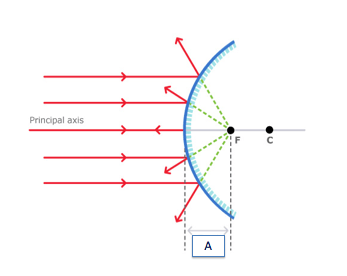
This image is showing a convex mirror because the image is (choose 2 answers)
real light rays meet behind the mirror
real light rays don't meet
the focal point is in front of the mirror
the focal point is behind the mirror
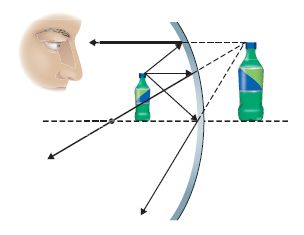
If the object is between C and f, the image is ...
image is real, smaller, and inverted
image is real, smaller, and upright
image is virtual, smaller, and inverted
image is real, bigger, and inverted
If the object is between C and f, the image is ...
image is real, smaller, and inverted
image is real, smaller, and upright
image is virtual, smaller, and inverted
image is real, bigger, and inverted
If the object is between f and the mirror, the image is ...
image is real, smaller, and inverted
image is virtual, larger, and upright
image is virtual, smaller, and inverted
image is real, bigger, and inverted

