wayground logo

Free Printable Worksheets

Font size

S
M
L
XL
Worksheets

Shang & Zhou Ancient China

Total questions: 84

Worksheet time: 55mins

Name
Class
Date
1.
What was the oldest Dynasty in China
a)
Tang
b)
Shang
c)
Xi
d)
Ki to
2.
What metal was the Shang Dynasty known for using?
a)
Steel
b)
Bronze
c)
Jade
d)
Gold
3.

What dynasty came up with the first system of Writing?

a)

Shang

b)

Tang

c)

Xia

d)

Xio

4.
How did scholars learn that the Shang Dynasty was real and not just a myth?
a)
They read old books
b)
They found artifacts
c)
They learned the language
d)
They asked Chinese elders
5.
In the Shang Dynasty, Anyang was
a)
chief ruler
b)
capital city
c)
royal army
d)
state religion
6.
Shang weapons were strong because artisans made them from
a)
iron
b)
stone
c)
bones
d)
bronze
7.
For what purpose would a Shang leader most likely use an oracle bone made from a turtle shell?
a)
to serve a ceremonial meal
b)
to make music for his family
c)
to send messages to nobles
d)
to ask advice from his ancestors
8.
What were the time periods in ancient China broken up into?
a)
Dynasties
b)
Decades
c)
Cycles
d)
Kingdoms
9.
The right of a Chinese Dynasty to rule with the blessings of the Gods is called...?
a)
The Mandate of Heaven
b)
The Dynastic Cycle
c)
The Heavenly Commandments
d)
The Oracle Bones
10.
The Mandate of Heaven
a)
justified the changing of dynasties
b)
justified rebelling against the ruling family
c)
justified waging war against neighboring societies
d)
justified putting down rebellions with swift violence
11.
Along what river did China's earliest civilizations develop?
a)
Huang He (Yellow)
b)
Indus
c)
Yangtze
d)
Nile
12.

What occurred during the end of the Zhou dynasty?

a)

Warlords fought throughout China.

b)

Crop production decreased.

c)

Cities declined in importance.

d)

Weak states conquered stronger ones.

13.
The Warring States Period was a time when China's states were fighting with each other for control.
TRUE or False
a)
True
b)
False
14.
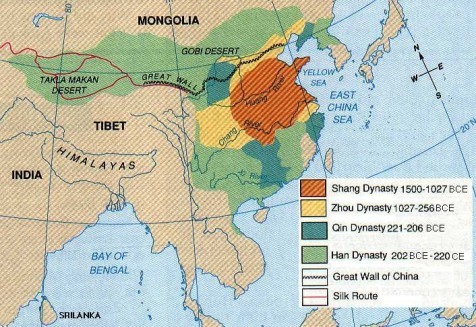
Which sea is located South of China?
a)
Yellow Sea
b)
Sea of Japan
c)
South China Sea
d)
East China Sea
15.
What sea is located East of China
a)
West China Sea
b)
Sea of Japan
c)
East China Sea
d)
South China Sea
16.
The major plateau in western China is called the Plateau of _______.
a)
Nepal
b)
Tibet
c)
Bhutan
d)
Yangzi
17.

Which physical feature covers much of the north of China?

a)

Gobi Desert

b)

Taklimakan Desert

c)

Plateau of Tibet

d)

Himalayas

18.

Many of the towns in ancient China were surrounded by walls to protect against:

a)

Floods

b)

Hostile Neighbors

c)

Wild Horses

d)

Earthquakes

19.

Stories of the Xia dynasty are important because:

a)

They're entertaining

b)

They show the relationship between the ruler and the people

c)

They help explain China's geography

d)

They describe the creation of the Gobi Desert

20.

A DYNASTY is a series of rulers from the same __________________.

a)

Town

b)

Family

c)

Political party

d)

Gym

21.

Dynasties utilize which form of government:

a)

Monarchy

b)

Democracy

c)

Dictatorship

d)

Republic

22.

What is the Mandate of Heaven?

a)

The divine right to rule China

b)

A system of relationships

c)

China's geography

d)

The Xia Dynasty

23.

The Warring States Period lased for about _________ years.

a)

250

b)

800

c)

2,000

d)

500

24.

Which of the following was NOT a belief of Confucius?

a)

Moral leadership over laws

b)

Importance of the family

c)

Leaders should set a good example

d)

Need for harsh laws

25.

According to Confucius, strength of the _________ lead to strength of the nation.

a)

Family

b)

Goverment

c)

King

d)

Army

26.

Living in harmony with 'the Way,' universe is a balance of opposites, rulers should be less involved

a)

Confucianism

b)

Daoism

c)

Legalism

27.

People are bad and need to be controlled, society needs strict laws and punishments

a)

Confucianism

b)

Daoism

c)

Legalism

28.

What hemisphere(s) is China located in?

a)

Northern

b)

Southern

c)

Eastern

d)

Western

29.

What is the Yellow River also known as?

a)

Huang He River

b)

Mother River

c)

China’s Sorrow

d)

all of the above

30.

Who did the authority of the family in Chinese culture belong to?

a)

The Mother

b)

The Father

c)

The Children

d)

The Grandparents

31.

What was religion like during this time period?

a)

Very strict Hinduism

b)

Divination with oracle bones

c)

Buddhism

d)

Ancestor worship

e)

Brahmanism

32.

How were oracle bones used?

a)

to predict the future

b)

to teach students how to write

c)

to record laws and official decrees

d)

to pass down dynastic history

33.

Which geographic features that isolated China complete the diagram? Choose the TWO correct answers.

a)

North China Plain

b)

Taklimakan Desert

c)

Plateau of Tibet

d)

Gobi Desert

34.

Why did the first settlements in China begin along the Huang River?

a)

They had no where else to go

b)

Crops grew in the area because of the river

c)

Flooding trapped them in the area

d)

They were safe from invaders there

35.
On which continent is China located? 
a)
Africa
b)
Asia
c)
Europe
d)
Australia 
36.
Early civilizations like Mesopotamia, Egypt, India and China have one thing in common.....
a)
each civilization flourished despite harsh desert conditions
b)
we know little about them due to catastrophic natural disasters
c)
they were founded along rivers and fertile valleys
d)
their coastal locations allowed them to trade with the Roman Empire
37.
What was the name of China's FIRST dynasty?
a)
Shang
b)
Zhou
c)
Hanfeizi
d)
Huang He
38.
How did the mountains and deserts affect China's civilization?
a)
providing rich soil for Chinese farmers
b)
made it difficult for invaders to enter
c)
made it easier to trade with other countries
39.
How was Chinese civilization affected by mountains and deserts?
a)
They became wealthy.
b)
They were isolated from other civilizations.
c)
They made it easier to travel.
d)
They made China easy to be attacked.
40.
The Shang were the first people in China to
a)
develop a writing system
b)
use advanced metal tools
c)
hunt with bows and arrows
d)
domesticate pigs and sheep
41.
How was the writing system of the Shang similar to that of Sumer?
a)
Both used letters to represent sounds
b)
Both began writing as a way to predict the future
c)
Both used pictographs
d)
Both began writing as a way to keep track of trade
42.
Why is the Huang He/Yellow River also known as "China's Sorrow."
a)
Hurricane force winds
b)
Tsunami's
c)
Catastrophic Flooding
43.

What is a social class?

a)

line of rulers in the same family

b)

people with a similar position in society

c)

heavenly law giving the king the right to command

44.

The teachings of Laozi are the basis of __________.

a)

Daoism

b)

Buddhism

c)

Confucianism

d)

Legalism

45.

The ideas of _______ included a duty to participate in government.

a)

Daoism

b)

Buddhism

c)

Confucianism

d)

Legalism

46.

The philosophy that traveled along the silk road to become China's largest religion

a)

Daoism

b)

Buddhism

c)

Confucianism

d)

Legalism

47.

Which dynasty was the longest lasting?

a)

Shang

b)

Zhou

c)

Qin

d)

Han

e)

Xia

48.

Which dynasty was the 1st but many say is just a myth?

a)

Shang

b)

Zhou

c)

Qin

d)

Han

e)

Xia

49.

Which Chinese philosopher (thinker who seeks wisdom and questions about life) said people should put the needs of the family and community first?

a)

Hanfeizi

b)

Laozi (Lao Tzu)

c)

Confucius

50.

Which Chinese philosopher (thinker who seeks wisdom and questions about life) said people should look to nature for examples of how to live, to protect nature and people? The Yin and Yang symbol represents how opposites are needed like winter and summer.

a)

Hanfeizi

b)

Laozi (Lao Tzu)

c)

Confucius

51.

Which of the following are innovations by the Ancient Chinese?

a)

Paper, Silk, Wheelbarrow

b)

Planned cities, papyrus, wheel

c)

Sailboat, Mummification, Sanskrit

d)

Hieroglyphs, gunpowder, number 0

52.

Confucianism focused on

a)

Following the vedas of hinduism

b)

The yin and yang

c)

worshipping more than one god

d)

Respecting rulers and elders

53.

The ancient Chinese were able to flourish independently, and without much interference from outsiders due to...

a)

their reputation and strength as a military power

b)

the outsiders not wanting what the Chinese had

c)

their geography providing many natural barriers

d)

their rivers being very difficult to navigate

54.
Confucius a very famous ____________, in Ancient China
a)
emperor
b)
philosopher
c)
army leader
d)
god
55.
For what purpose would a Shang leader most likely use an oracle bone made from a turtle shell?
a)
to serve as a ceremonial meal
b)
to make music for his family
c)
to send messages to the nobles
d)
to ask for advice from ancestors
56.
A symbol in a writing system based on pictures
a)
ideograph
b)
pictograph
c)
bureaucracy
d)
currency
57.
Which river is in China?
a)
Green
b)
Mississippi
c)
Yellow
d)
Himilaya
58.
What is the central idea of Daoism
a)
Duty to community
b)
Living in harmony with nature
c)
Enforcing laws with harsh punishments
d)
Humans are naturally evil
59.

What two things do the analects of Confucius teach?

a)

People should follow the path and be one with nature.

b)

People should have good conduct and moral judgement.

c)

There are opposing forces of light and dark.

d)

The government had a duty to set an example of right conduct.

60.

Confucius also teaches that each person is owed _________ and ____________.

a)

Money and glory.

b)

success and a nice house.

c)

respect and obedience.

d)

a job and family.

61.
This belief stressed that people were bad by nature, and needed to be controlled and punished.
a)
Confucianism
b)
Daoism
c)
Legalism
62.
Buddhism spreading from India along the Silk Road is an example of
a)
Christianity
b)
cultural diffusion
c)
Legalism
d)
filial piety
63.
The Silk Road refers to...
a)
A giant factory where silk is made
b)
A road made of a stringy material
c)
A religious path
d)
A series of trade routes between Asia and Europe
64.
How long did the Zhou Dynasty last for?
a)
50 years
b)
800 years
c)
1000 years
d)
300 years
65.
What was the main idea of Legalism? 
a)
Harsh rules and consequences for the people who do not follow the laws.
b)
A persons character is more important than wealth.
c)
“Go with the flow” kind of of view for living life
d)
Don't steal from your family or friends
66.
According to the Mandate of Heaven, a ruler would stay in power as long as he...?
a)
Obeys the priests
b)
controlled an army
c)
governed justly and truly
d)
conquered new territories
67.

Animal bones carved with written characters which were used for telling the future.

a)

Crystal Ball Bones

b)

Oracle Bones

c)

T - Bones

d)

Dynasty

68.

What is the time of civil war after the fall of the Zhou dynasty called?

a)

Warring States Period

b)

Feudal System

c)

Legalism

d)

Confucianism

69.
The rivers' floods deposited fertile 
a)
sand
b)
gold
c)
kilt
d)
silt
70.

Which dynasty was a period of intellectual awakening with philosophers such as Confucius and Laozi?

a)

Xia

b)

Shang

c)

zhou

d)

Qin

71.

A Chinese philosophy that emphasizes proper behavior.

a)

Confucianism

b)

Civil Servant

c)

Daoism

d)

Legalism

72.

A Chinese philosophy that emphasizes strict obedience to laws.

a)

Confucianism

b)

Civil Servant

c)

Daoism

d)

Legalism

73.
Individuals who believe in the supremacy of their own ethnic group. 
a)
Ethnocentric
b)
Prejudice
c)
Stereotype
d)
Acculturation
74.
process of scattering
a)
susceptible
b)
sabotage
c)
elusive
d)
diffusion
75.
leaderships by fathers
a)
recourse
b)
diffusion
c)
patriarchal
d)
icon
76.

location where ruins were found from the Shang dynasty, China’s first civilization

a)

Shang Dynasty

b)

Anyang

c)

bronze

d)

clans

77.

a strong metal alloy made from copper.

a)

bronze

b)

aluminum

c)

titanium

d)

gold

78.

honoring of ancestors through rituals, such as offering food and wine to the spirits of the dead

a)

ancestor worship

b)

funeral

c)

relative worship

d)

oracle bones

79.

highest ranking social class. fought in kings armies. supplied armies with weapons.

a)

farmers

b)

traders

c)

artisans

d)

nobles

80.

a piece of bone or shell heated and cracked by holy men to seek advice from a king’s ancestors

a)

ancestor bones

b)

deity bones

c)

prophet bones

d)

oracle bones

81.

Referred to as the "Roof of the World"

a)

Himalayas

b)

Tibetan Plateau

c)

Huang He

d)

Chang Jiang

82.

What is the biggest desert in Asia?

a)

Taklimakan

b)

Gobi

c)

Sahara

d)

Mojave

83.

What fabric was ancient China famous for?

a)

Cotton

b)

Polyester

c)

Wool

d)

Silk

84.

Why was it so difficult for monarchs to rule all of China?

a)

It was too large of an empire.

b)

The rulers were too weak.

c)

They had differing religious beliefs around the empire.

d)

They had too many rebellions.