wayground logo

Free Printable Worksheets

NEW

Font size

S
M
L
XL
Worksheets

Envirothon- Soils

Total questions: 46

Worksheet time: 2hrs 22mins

Name
Class
Date
1.
What is the layer of soil just below the topsoil?
a)
soil
b)
subsoil
c)
topsoil
d)
terrace farming
2.
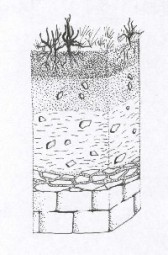
Which layer of soil are these roots growing in?
a)
subsoil
b)
topsoil
3.
When plants, animals, and other organisms die, they break down and become part of the soil. What is this part of the soil called?
a)
sand
b)
silt
c)
clay
d)
humus
4.
What is the layer of soil that contains humus, leaf litter, and other organic matter?
a)
O - Organic
b)
A - Topsoil
c)
B - Subsoil
d)
R - Bedrock
5.
Which layer is the bottom of the soil profile?
a)
C - Partially Weathered Parent Material
b)
D - Separated rock
c)
R - Bedrock
d)
A - Topsoil
6.
Layers of soil are also known as:
a)
Soil Profiles
b)
Soil Horizons
c)
Soil sheets
d)
Soil cores
7.
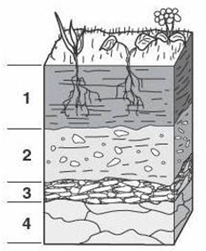
In which layer of the soil profile contains the MOST humus?
a)
Layer 1 (A)
b)
Layer 2 (B)
c)
Layer 3 (C)
d)
Layer 4 (R)
8.
In which layer of the soil profile contains a solid layer of rock?
a)
Layer 1 (A)
b)
Layer 2 (B)
c)
Layer 3 (C)
d)
Layer 4 (R)
9.
Which soil layer consists of clay, iron oxides, and other components that came form the zone of leaching?
a)
O horizon
b)
A Horizon
c)
B Horizon
d)
Bedrock
10.
Soil is made of
a)
weathered rocks and minerals
b)
dead plants and animals
c)
air and water
d)
all of the above
11.

Any particle larger than ____________ is not considered soil but is called rock.

a)

1 mm

b)

2 mm

c)

3 mm

d)

4 mm

12.

Organic material makes up between 0 and ____ of most soils.

a)

9%

b)

12%

c)

18%

d)

21%

13.
The breakdown of rock into smaller pieces by physical means; common causes are ice, wind, water, gravity, plants, and animals
a)
Physical (Mechanical) Weathering 
b)
Chemical Weathering
14.
Which of the following is NOT a major soil forming factor?
a)
Time, Topography
b)
Climate, Parent Material
c)
Organics (organisms)
d)
Deposition
15.
Which of the following is the largest particle in soil?
a)
sand
b)
silt
c)
humus
d)
clay
16.
Which ones does not represent soil texture:
a)
Silt
b)
Clay
c)
Humus
d)
Sand
17.
Which soil particles have the largest pore spaces between sediments?
a)
Clay
b)
Silt
c)
Sand
18.
If you have yellow or red soil, it is an indication of ______________ in your soil
a)
calcium
b)
water
c)
iron oxides
d)
sand
19.
What are the three components of soil?
a)
insects, sand, topsoil
b)
clay, sand, humus
c)
topsoil, subsoil, bedrock
d)
earthworms, sand, silt
20.
Which of the following is NOT one of the three layers of soil?
a)
topsoil
b)
undersoil
c)
subsoil
d)
bedrock
21.
Which of the following is NOT one of the three types of soil?
a)
clay
b)
sand
c)
silt
d)
mud
22.
_______ is the type of soil used most often with plants. It is a mixture of clay, sand, and silt.
a)
loam
b)
humus
c)
mud
d)
dirt
23.
Humus is.....
a)
the dead parts of plants and animals in soil.
b)
A food we eat with pretzels.
c)
The tiny particles inside of soil
d)
The roots that come off of a plant and live in soil.
24.
Ellen grabs a topsoil sample in her hand. She rolls it into a ball. The soil feels gritty and the ball falls apart. What part of the topsoil most likely made the topsoil feel gritty?
a)
clay
b)
sand
c)
silt
d)
humus
25.
When there are not enough plants to hold topsoil in place, water and  _______ carry the topsoil away, leaving the subsoil exposed
a)
sunlight
b)
birds
c)
magnetic fields
d)
wind
26.
Which of the following is the largest particle in soil?
a)
sand
b)
silt
c)
humus
d)
clay
27.
Many plants cannot grow in clay soil. Why is this true?
a)
Clay soil does not have many nutrients.
b)
Roots cannot easily push through clay soil.
c)
Water doesn't drain well through clay.
d)
All of these choices.
28.
You dig a small hole in the soil and the next day it rains. The hole fills with water, but does not empty even after several days of dry weather. What is the soil mostly made of?
a)
clay
b)
sand
c)
humus
d)
silt
29.
Many plants cannot grow in sandy soil. Why is this true?
a)
Sandy soil does not hold enough water.
b)
Oxygen cannot pass through sandy soil.
c)
Roots cannot easily push through clay soil.
d)
Sandy soil has too many nutrients.
30.
Which layer of soil are these roots growing in?
a)
subsoil
b)
topsoil
31.
What is a soil problem all farmers face?
a)
soil hardening
b)
soil erosion
c)
soil spoiling
d)
soil pollution
32.
How would you describe the texture of "sandy" soil?
a)
sticky
b)
gritty
c)
smooth
d)
slimy
33.
According to the settling tube experiment, which soil is the heaviest and fell to the bottom of the tube?
a)
clay
b)
humus
c)
sand
d)
silt
34.

Soil formation begins with the weathering of_______.

a)

Humas

b)

Subsoil

c)

Litter

d)

Bedock

35.
The layer of soil which the topsoil is found.
a)
Horizon A
b)
Horizon B
c)
Horizon C
d)
Horizon D or R
36.

Which soil horizon is contains decomposed plants and animals?

a)

A Horizon

b)

B Horizon

c)

C Horizon

d)

O Horizon

37.

Soil sample that is 60% clay, 30% silt, and 10% sand has which texture?

a)

clay

b)

clay loam

c)

sandy loam

d)

silt

38.

Soil sample that is 10% clay, 20% silt, and 70% sand has which texture?

a)

clay

b)

clay loam

c)

sandy loam

d)

silt

39.

What type of soil is in our area (New York)?

a)

Andisoils

b)

Alfisols

c)

Gelisols

d)

Entisols

40.

What soil conservation method refers to forming steps in a hill to prevent water erosion?

a)

windbreaks

b)

contour plowing

c)

terrace farming

d)

strip cropping

41.
The two main factors that determine the rate of weathering are the TYPE of rock and_____.
a)
Music
b)
Climate
c)
Size of rock
d)
Weight of rock
42.

Soil is formed by the breaking down of rocks by the action of wind, water and climate. This process is called

a)

Humification

b)

Weathering

c)

Soil erosion

d)

None of the above

43.

Soil erosion is the process by which the

a)

the land surface(top soil) is removed by wind, water or ice

b)

formation of soil form rocks

c)

rusting of soil

d)

None of the above

44.
Which of the following is the correct order of soil particles in order of increasing particle size?
a)
clay-sand-silt
b)
sand-clay-silt
c)
silt-clay-sand
d)
clay-silt-sand
45.

The ___________ soil is in the Alfisols soil order and is classified as fine-loamy. To honor this natural resource, New York unofficially named ________ as the State soil.

a)

Cecil

b)

Marlow

c)

Sunnyside

d)

Honeyoye

46.

A tool used to easily and quickly evaluate the type of soil that is present within a given area.

a)

Clinometer

b)

Biltmore Stick

c)

Munsell Color Chart

d)

Soil Map