
 Worksheets
refraction of waves
Total questions: 35
Worksheet time: 35mins


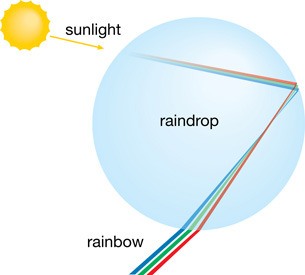


What is it called when light bends as it moves from one substance to another?
Absorption
Reflection
Refraction
Incidence
Light bends as it passes through a lens. This is called what?
Reflection
Diffraction
Refraction
Dilation
When light waves move from passing through air to passing through a glass lens when happens to them?
They slow down and change direction
They speed up and change direction
They maintain the same speed and change direction
They maintain their same speed and direction
When light waves move from passing through air to passing through a glass lens when happens to them?
They slow down and change direction
They speed up and change direction
They maintain the same speed and change direction
They maintain their same speed and direction

On the diagram A is :
The angle of incidence
The reflection ray
The incidence ray
The refraction ray

On the diagram, B is:
The refraction ray
The normal
The angle of incidence
The incidence ray

On the diagram, D is:
The reflected ray
The incidence ray
The normal
The refracted ray

What would you call this?
Reflection
Diffraction
Refraction
Friction

What would you call this?
Refraction
Diffraction
Bends
Reflection

The bouncing back of light waves off of a surface is...
Reflection
Refraction
Light
Lens

Light travels...
around corners
in a straight line

A mirror _________ light.
absorbs
reflects
refracts

1) Refraction happens when light______
bends as it enters a new medium
bounces back when it hits a surface
by a substance
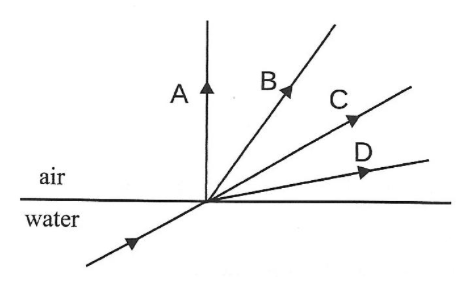
A light ray is incident from water to air. Which of the refracted rays is correct?
A
B
C
D
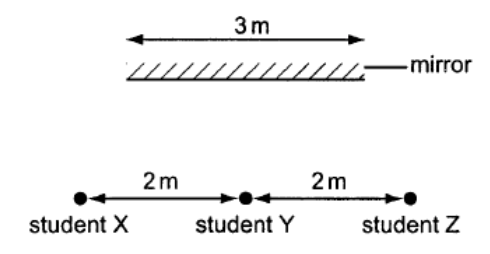
Three students stand 2 m apart in front of a plane mirror which is 3 m long.
Student Y is standing opposite the mid-point of the mirror.
How many students can see the images of the other two?
0
1
2
3
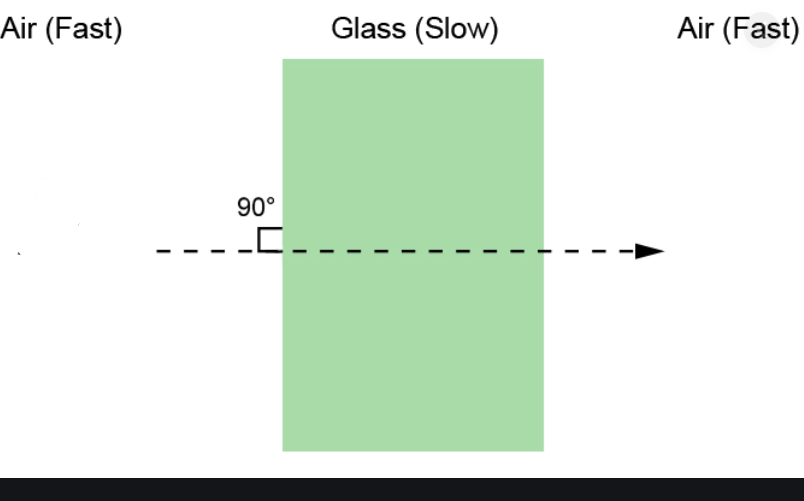
The line 90 degress through the refracting or reflecting surface is called?
Medium
Normal
Incidence
Reflection

Light refracts when:
It changes speed
It changes from a particle to a wave
Its density changes
It encounters a solid object


Waves refract as they pass from one medium into another.
Which best describes a beam of light moving from a less dense medium into a more dense medium?
Speed decreases. Wavelength decreases.
Frequency remains constant.
Speed decreases. Wavelength increases.
Frequency increases.
Speed decreases. Wavelength decreases.
Frequency increases.
Speed decreases. Wavelength increases.
Frequency decreases.
Waves refract as they pass from one medium into another.
Which best describes a beam of light moving from a denser medium into a less dense medium?
Speed increases. Wavelength increases.
Frequency remains constant.
Speed increases. Wavelength increases.
Frequency increases.
Speed increases. Wavelength decreases.
Frequency increases.
Speed increases. Wavelength increases.
Frequency decreases.

