
 Worksheets
Astronomy Week 3 Review
Total questions: 15
Worksheet time: 18mins

When a bicycle is stopped, it stays stopped. When a bicycle is in motion, it stays moving. This is an example of ______________________________.
Newton's 1st Law of Motion
Newton's 2nd Law of Motion
Newton's 3rd Law of Motion

Sound waves are which type of wave?
Longitudinal Wave
Transverse Wave
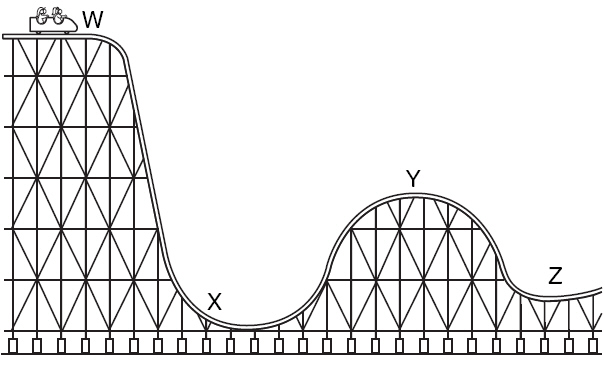
At which point is kinetic energy greatest?
W
X
Y
Z

How much larger is the Sun than the Earth?
The Sun is smaller than the Earth.
The Sun is approximately 110 times bigger than the Earth.
They are the same size.
The Sun is approximately 20 times bigger than Earth.

The Sun looks small in the sky because...
It is small compared to Earth
It is 1 Astronomical Unit (93 million miles) away.
It is not very bright.
Earth's moon reflects the light away from Earth.

How do you make a scale model? Select all that apply.
If it is large objects like the solar system, reduce all objects by a common factor (dividing by a number).
Scale models do not require reducing (dividing by a number) or enlarging (multiplying by a number).
My seventh grade math teacher taught me this. I know I should select this answer because they will be very upset if they know I forgot.
If it is small objects like a cell, enlarge all objects by a common factor (multiplying by a number).

Using the picture, why does Earth's Moon have different phases?
Earth's moon follows the Sun around the Earth.
Earth's moon moves around the Earth.
Earth's moon moves around the Sun.

Solar eclipses can only occur when it is a ___ moon.
Full Moon
New Moon
Quarter Moon
Gibbous Moon

What type of eclipse is this an example of?
Lunar Eclipse
Solar Eclipse
An ____________ is the inner, darker part of a shadow.
penumbra
umbra

When the Sun, Earth, and moon align, it is called a ___.
Lunar Eclipse
Solar Eclipse

When a lunar eclipse happens, we see...
The moon is covered by Earth's shadow and can turn red.
The sun is covered by the moon and it gets darker.
Nothing! Everything looks the same as always.
It happens during the day so you can't see anything.
Lunar eclipses can only occur when it is a ___ moon.
Full Moon
New Moon
Quarter Moon
Gibbous Moon

Why do we see lunar eclipses more often than solar eclipses?
Lunar eclipses are NOT more common than solar eclipses.
The Earth is 4 times larger than the moon and easily casts a shadow.
The umbra (shadow) is very large so a lot of people on Earth can see it.
The moon's orbit around Earth is short, so it aligns with the Earth and Sun often.

In your own words, explain how a LUNAR eclipse happens.

