wayground logo

Free Printable Worksheets

NEW

Font size

S
M
L
XL
Worksheets

The Blood System

Total questions: 19

Worksheet time: 14mins

Name
Class
Date
1.
What part of blood is responsible for carrying oxygen and carbon dioxide to body cells?
a)
Red Blood Cells
b)
White Blood Cells
c)
Platelets
d)
Plasma
2.
What part of blood is responsible for carrying wastes, nutrients, and minerals?
a)
Red Blood Cells
b)
White Blood Cells
c)
Platelets
d)
Plasma
3.
What do the arteries do?
a)
pumps blood to the heart
b)
pumps blood to and from the heart
c)
carry's blood away from the heart 
d)
a muscle 
4.
What is the function of the heart?
a)
To pump blood around the body
b)
To remove oxygen from the blood
c)
To allow blood to flow through it 
d)
To breath
5.
The main function of the circulatory system is 
a)
To give the body structure and support
b)
Excrete waste
c)
transport blood, nutrients, and gases throughout the body
d)
to transport messages from the body to the brain
6.

Oxygen rich blood leaves the heart through the

a)

left ventricle

b)

left atrium

c)

right ventricle

d)

right atrium

7.

Capillaries join together

a)

the heart and arteries

b)

veins and the heart

c)

arteries and veins

d)

heart and valves

8.

Veins have special ________________ to stop blood from flowing backward.

a)

gravity

b)

valves

c)

arteries

d)

ventricles

9.
Your blood is made up of which of the following...
a)
plasma, red blood cells, blue blood cells
b)
white and red blood cells
c)
plasma and platelets
d)
plasma, red blood cells, white blood cells, and platelets
10.

What would happen if your arteries cannot deliver blood?

a)

your tissues would not get the oxygen they need

b)

the skin would be extra hairy

c)

the heart would not work

d)

you would immediately fall asleep

11.
What is the largest artery in the human body called?
a)
Superior Vena Cava
b)
Aorta
c)
Inferior Vena Cava
d)
Pulmonary Artery
12.

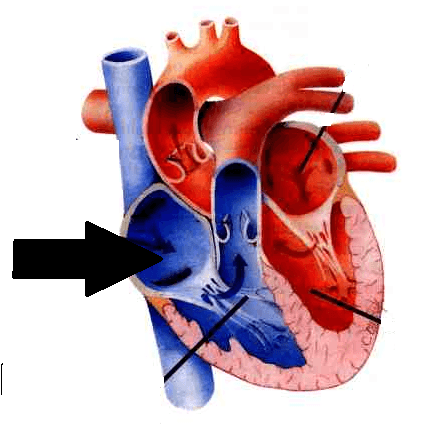
Identify the location of the heart where the bold arrow is pointing

a)

Left atrium

b)

Right atrium

c)

Left ventricle

d)

Right ventricle

13.

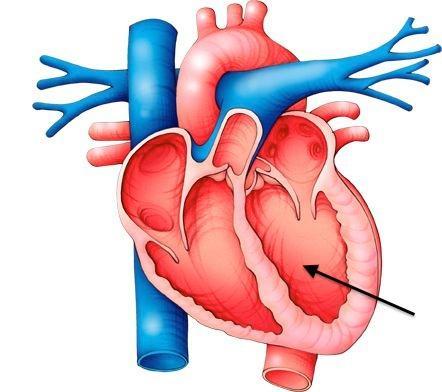
Identify the location of the heart where the arrow is pointing

a)

Left atrium

b)

Right atrium

c)

Left ventricle

d)

Right ventricle

14.
What is pulmonary circulation?
a)
Blood travelling to and from the lungs
b)
Blood travelling to and from the body
c)
A blood clot in the lungs
d)
The vessel that brings blood to the lungs
15.

The blood in the vena cava is...

a)

oxygenated, returning to the heart

b)

deoxygenated, returning to the heart

c)

oxygenated, leaving the heart

d)

deoxygenated, leaving the heart

16.

Identify 8

a)

Left Atrium

b)

Pulmonary Arteries

c)

Pulmonary Veins

d)

Left Ventricle

17.
When the ventricles contract, the bicuspid (mitral) valve prevents blood from flowing from the ________.
a)
right ventricle to right atrium
b)
left ventricle to left atrium
c)
left atrium to the right atrium
d)
right atrium to the left atrium
18.
Which one of the following represents the correct path for the transmission of an impulse in the intrinsic conduction system of the heart?
a)
AV node, Bundle of His, SA node, Purkinje fibers, bundle branches
b)
SA node, AV node, Bundle of His, bundle branches, Purkinje fibers
c)
SA node, Bundle of His, AV node, Purkinje fibers, bundle branches
d)
SA node, Bundle of His, bundle branches, Purkinje fibers, AV node
19.
The heart sounds "lub" and "dup" result from ________. 
a)
opening of the heart valves
b)
firing of the nodes of the intrinsic conduction system
c)
blood rushing through the chambers
d)
closure of heart valves