

wayground logo

Free Printable Worksheets

NEW

Font size

S
M
L
XL
Worksheets

Sophie Revision Quiz

Total questions: 31

Worksheet time: 1hrs 5mins
Name
Class
Date
1.
Pollination can occur between flowers of the same plant. 
a)
True 
b)
False 
2.
Pollination can occur between flowers of the different plants of the same species. 
a)
True 
b)
False 
3.
I have large petals and are usually brightly coloured. How am I pollinated?
a)
By animals
b)
By birds 
c)
By insects 
d)
All of the above
4.
I am a flower that produces nectar. What is the function of the nectar?
a)
To provide food for the flower
b)
To attract pollinators
c)
To attract animals to disperse the fruits
d)
To produce perfumes for Man
5.
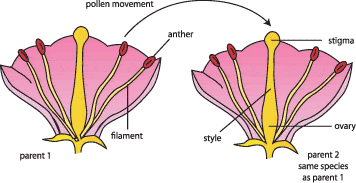
Pollination is the process by which the pollen grains are transferred from the ________ to the _________. 
a)
anther... ovary
b)
anther ... stigma
c)
stigma ... ovary 
d)
stigma ... filament
6.
Which of the following is/are types of pollination?
A) wind pollination 
B) Insect pollination 
C) explosive pollination  
a)
B only
b)
A and B only
c)
All of the above
7.
Wind-pollinated flowers usually have ______ and ________ petals. 
a)
big ... bright 
b)
small .... bright 
c)
big ... dull 
d)
small ... dull
8.
Male reproductive parts of a plant....
a)
Petals and ovary
b)
Ovary and ovule
c)
Anther and filament
d)
Stigma and style
9.
In which part of the flower is pollen found?
a)
Filament
b)
Anther
c)
Ovary
d)
Xylem
10.
What is the female part of the plant called?
a)
Stigma
b)
Pistil
c)
Stamen
d)
Style
11.
How does pollen reach the ovule?
a)
Stigma --> Style
b)
Style --> stigma
c)
Ovary --> stigma
d)
Ovary --> style
12.
Fertilization is....
a)
Egg and Sperm cells join
b)
Sperm Cells
c)
Egg Cells
d)
Pollination
13.
After fertilization the ovule will....
a)
Be carried away by a pollinator
b)
Be blown away by the wind
c)
Will grow into a new plant
d)
Develop into a fruit that contains seeds
14.

What is the name of flower part #2 ?

a)

stigma

b)

style

c)

anther

d)

sepal

15.
What is B?
a)
pancreas
b)
mouth
c)
gullet
d)
rectum
16.
Tube that carries swallowed food to the stomach
a)
esophagus
b)
liver
c)
pancreas
d)
rectum
17.
Breaking food down with the use of enzymes is known as:
a)
Chemical Digestion
b)
Physical Digestion
18.
The muscular organ in the body where chemical and mechanical digestion take place.
a)
pancreas
b)
liver
c)
stomach
d)
esophagus
19.
A fluid in the mouth that helps digest food.
a)
pepsin
b)
pepsi
c)
saliva
d)
salty
20.
A substance such as a fat, a protein, or a carbohydrate that a living thing needs to survive.
a)
saliva
b)
carrots
c)
nutrients
d)
minerals
21.

Most fish have _________________ to protect their bodies.

a)

hair

b)

scales

c)

feathers

d)

skin

22.

Which of the following is an example of a vertebrate animal?

a)

fly

b)

worm

c)

bird

d)

starfish

23.

Invertebrates do NOT have a

a)

brain.

b)

heart.

c)

stomach.

d)

backbone.

24.

Asia keeps seeing a small animal in her backyard. She observed the animal has a backbone, four legs and a long tail, and its body is covered with scales. What is the classification for this animal?

a)

bird

b)

mammal

c)

reptile

d)

amphibian

25.

Which group of vertebrates possesses gills, two sets of paired fins, and is generally adapted to living in water?

a)

fish

b)

reptiles

c)

mammals

d)

amphibians

26.

Animals that are warm blooded, have body hair, and produce milk for their young are grouped into which of the following classes?

a)

amphibians

b)

mammal

c)

birds

d)

reptiles

27.

What type of animal is a whale?

a)

amphibian

b)

fish

c)

mammal

d)

reptile

28.

A snake has an internal skeleton, cannot breathe under water, and relies on outside sources of heat to keep its body temperature constant. A snake is which type of animal?

a)

bird

b)

fish

c)

reptile

d)

amphibian

29.

Which vertebrate organism can breathe through its skin?

a)

clam

b)

frog

c)

spider

d)

pangolin

30.

Tulips and oak tree are both plants that look different. However, they both belong to the classification of plants that make

a)

leaves

b)

pine cones

c)

flowers

d)

seeds

31.

Ms. Daley takes her class on a field trip to a pond. The class sees a bald eagle and a salamander near the pond. How are these two animals alike?

a)

They both have offspring that is very different from the adults.

b)

They both lay eggs.

c)

They both are warm-blooded.

d)

They both are able to breathe through their skin.
