
 Worksheets
Waves Test Review
Total questions: 55
Worksheet time: 1hrs 12mins
Sound waves travel as ________ waves.
Transverse
Longitudinal
Surface
Sound waves travel by causing particles to move close together and apart (like a slinky), called ________.
Rarefaction
Surface wave
Compression
Which of these is not a property of a sound wave?
Elasticity
Loudness
Pitch
The _______ of a wave increases with increased energy.
Wave length
Amplitude
High frequency sounds have _______ pitch
HIgh
Low
The difference between a mechanical wave (like sound) and an electromagnetic wave (like light) is that
mechanical waves can move through a medium and a vacuum (space)
mechanical waves can move through a vacuum (space) only
mechanical waves can move through a medium only

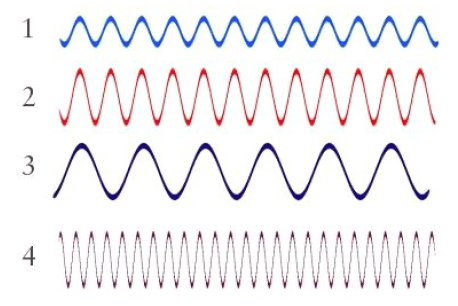


The range of electromagnetic waves placed in certain order is called the:
electromagnetic spectrum
electromagnetic wavelength
electromagnetic frequency
electromagnetic field
Electromagnetic waves can transfer energy without a(n):
medium
electromagnetic field
magnetic field
electric field
The matter through which sound waves travel is a _________________.
wavelength
frequency
amplitude
medium
____________ is how high or low a sound is.
pitch
volume
amplitude
wavelength
______________ is how loud or soft a sound is.
pitch
wavelength
volume
frequency
Which of the following can sound NOT travel through?
solids
empty space
liquids
gases
If a wave has a high frequency it will also have a high _______________.
volume
amplitude
pitch
crest
If a wave has a low frequency, it will also have a low ________________.
trough
pitch
amplitude
volume
If a wave has a high amplitude, it will also have a loud _____________.
pitch
amplitude
frequency
volume
A wave with a low amplitude will have a softer _______________.
volume
pitch
frequency
amplitude

Which of these provides the best explanation for why the pencil appears broken?
The pencil absorbs the light rays that hit it.
Water reflects light rays away from the pencil.
Light rays are bent by the water in the glass.
The surface of the water reflects the light rays.
Caleb is sitting near the window on a sunny day. When he closes the curtain, the room becomes darker. What property of the curtain allows it to make the room darker?
The curtain absorbs light.
The curtain is brightly colored.
The curtain folds easily.
The curtain is rectangular shape.
Which of the following is the best example of an object absorbing light?
A black sweater in the sun.
A clean window in the sun.
A curved mirror in the sun.
A long shadow in the sun.
Which of the following is demonstrated when light bounces off of mirrors or shiny surfaces?
Scattering
Refraction
Absorption
Reflection
Which of the following types of electromagnetic radiation has the shortest wavelengths?
Infrared
Ultraviolet
Visible light
Radio waves
Our eyes perceive colors because of differences in which of the following properties of light?
Intensity
Wavelength
Angle
Source
Adrian is observing a piece of white paper. His eye perceives the paper to be white because his eye is receiving what kind of light?
Light in all the colors of the visible spectrum.
Light mostly at the ultraviolet end of the spectrum.
Light mostly at the infrared end of the spectrum.
Light the paper produces when heated by the Sun.
Sunlight is a mixture of electromagnetic waves, ranging from infrared to ultraviolet. Which of the following types of electromagnetic radiation has the longest wavelengths?
Infrared
Ultraviolet
Visible light
Radio waves
A combination of all the wavelengths with in the visible light portion of the electromagnetic spectrum will result in which of the following colors?
White
Red
Violet
Blue

What type of wave is light?
electromagnetic
mechanical

Why does a banana look yellow?
it reflects yellow wavelengths of light and absorbs most other wavelengths
it absorbs yellow wavelengths of light and reflects most other wavelengths

Which electromagnetic wave is most harmful?
radio
gamma
ultraviolet
microwave

Electromagnetic waves can travel through
space
a medium
both

When you see the color black...
All colors are reflecting
All colors are absorbed
The color blacl is reflecting
the color black is absorbed
Why does an apple look red?
because it absorbs red light and reflects white light
because it absorbs red light waves and reflects the others
because it absorbs all colors of light
because it reflects red light waves and absorbs the others



