Wayground logo

Free Printable Worksheets

Font size

S
M
L
XL
Worksheets

Population Ecology AP BIO Review

Total questions: 40

Worksheet time: 40mins

Name
Class
Date
1.
An individual belonging to a specific species
a)
Biotic
b)
Community
c)
Organism
d)
Reptile
2.
All of the living and nonliving things in an area that interact with each other are called a/an ______.
a)
community
b)
habitat
c)
population
d)
ecosystem
3.
An area where an organism finds food, shelter and water in a specific arrangement
a)
niche
b)
biosphere
c)
biome
d)
habitat
4.
The living part of an ecosystem
a)
Biotic
b)
Abiotic
c)
Mother Earth
d)
Flowers
5.
The non-living part of an ecosystem
a)
Ocean
b)
Lava Flow
c)
Birds
d)
Abiotic
6.
The study of how living things interact with one another and with their environment.
a)
Biology
b)
Lithology
c)
Ecology
d)
Farmacology
7.
Organisms that look similar and can produce fertile offspring
a)
Species
b)
Fish
c)
Community
d)
Trees
8.
Two or more members of a particular species living and interacting in the same area
a)
Community
b)
Population
c)
Organisms
d)
Biosphere
9.
Different populations living and interacting with each other in the same area
a)
Biome
b)
Ecosystem
c)
Community
d)
Niche
10.

In 1976, the dominant finch on Daphne Major in the Galapagos Islands was the medium ground finch, with a population of 1,200. In 1977, a drought struck the island negatively affecting most of the vegetation. As a result, the population of medium ground finch dropped to 180 due to starvation. In 1983, however, a large amount of rainfall fell on the island creating optimal conditions for vegetation. The medium ground finch population increased to 1,100. What type of factor affected medium ground finch populations in 1977 and 1983?

a)

Density independent

b)

Logistic

c)

Density dependent

d)

Biotic

11.

In 1976, the dominant finch on Daphne Major in the Galapagos Islands was the medium ground finch, with a population of 1,200. In 1977, a drought struck the island negatively affecting most of the vegetation. As a result, the population of medium ground finch dropped to 180 due to starvation. In 1983, however, a large amount of rainfall fell on the island creating optimal conditions for vegetation. The medium ground finch population increased to 1,100. After the rainfall of 1983, what type of population growth did the medium ground finch experience?

a)

Logistic

b)

Quantitative

c)

Exponential

d)

Abiotic

12.
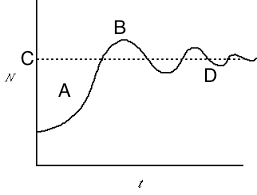
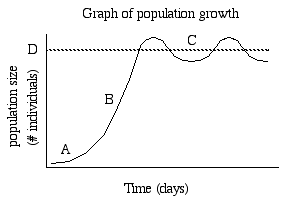
Which letter shows the the exponential growth of a population?
a)
A
b)
B
c)
C
d)
D
13.
Which point on the graph represents carrying capacity?
a)
A
b)
B
c)
C
d)
D
14.
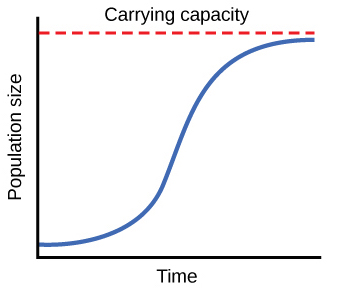
Refer to a population of 500 that experiences 55 births and 5 deaths during a one year period.
If the population maintains the current growth pattern, a plot of its growth would resemble which of the following?
a)
exponential growth
b)
fluctuating growth
c)
K-selected growth
d)
logistic growth
15.
__________ growth shows growth of a population under environmental constraints (carrying capacity-K) that sets a maximum population size 
a)
logistic
b)
exponential
c)
niche
d)
uniform
16.
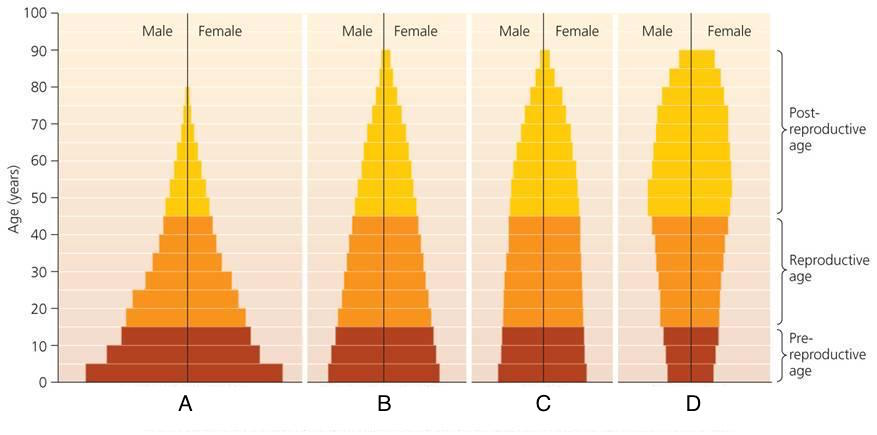
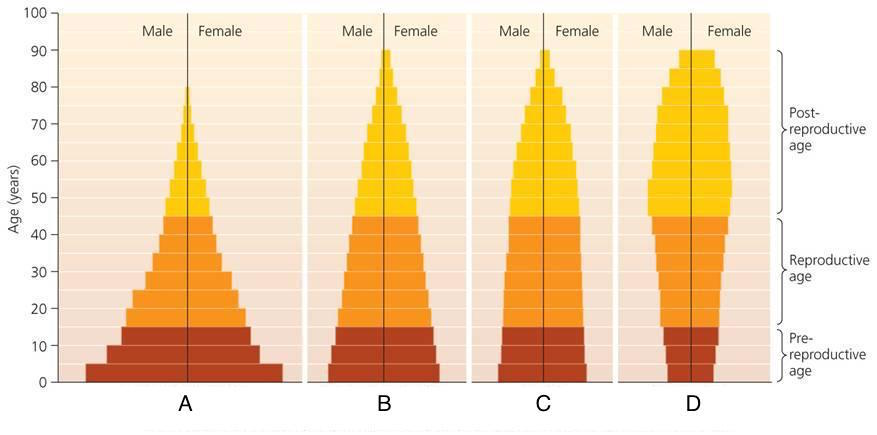
Which of these populations is experiencing the fastest growth?
a)
A
b)
B
c)
C
d)
D
17.
Which of these populations is experiencing the effect of severe limiting factors.
a)
A
b)
B
c)
C
d)
D
18.
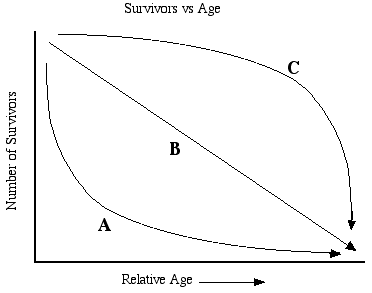
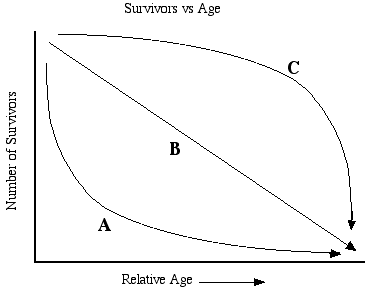
Refer to the diagram of the survivorship curve.
Which best describes an organism that fertilizes externally?
a)
A
b)
B
c)
C
d)
this is not a survivorship curve
19.
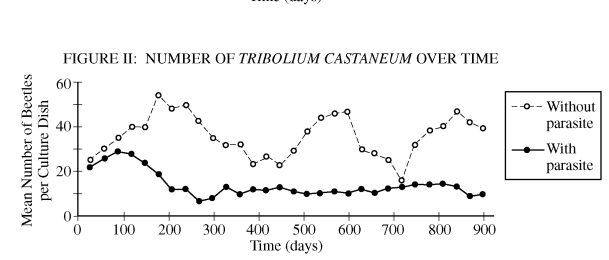
Which of the following correctly describes the interactions between T. castaneum and the parasite.
a)
The parasite decreases the population density of beetles in each culture dish.
b)
The parasite increases the population density of beetles in each culture dish.
c)
The parasite has no effect on the population density of the beetles.
20.
Refer to the diagram of the survivorship curve.
Which curve best describes an organism that invests a lot of energy in parenting?
a)
A
b)
B
c)
C
d)
this is not a survivorship curve
21.
Interpret the graph to correctly complete the following statement.  When the lynx population increases _ 
a)
the hare population increases.
b)
the hare population decreases
c)
the hare population stays the same.
22.
To measure population density, you must divide the number of individuals living in a defined space by the
a)
area of the space
b)
birth and death rates
c)
carrying capacity
d)
height of the space
23.
Nesting birds often space themselves evenly from other nests. This pattern is called
a)
clumped dispersion.
b)
uniform dispersion.
c)
random dispersion
d)
scatter dispersion
24.
Which of the following will increase the size of a population?
a)
emigration and births
b)
immigration and deaths
c)
immigration and births
d)
emigration and deaths
25.
Which of the following is a density-dependent limiting factor?
a)
human activities 
b)
unusual weather
c)
competition
d)
natural disaster
26.
Which of the following is a density-independent limiting factor?
a)
natural disaster
b)
predation
c)
disease
d)
parasitism
27.
The way in which individuals of a population are spread out is called
a)
population density
b)
survivorship
c)
population dispersion
d)
logistic curve
28.
The movement of a single caribou into a herd is an example of
a)
population
b)
immigration
c)
emigration
d)
predation
29.
What pattern of growth will a population with limited resources show?
a)
density-dependent
b)
exponential 
c)
logistic
d)
logical 
30.
Diseases may spread more rapidly when an area is crowded, so disease is considered to be a
a)
type I survivorship curve
b)
population crasher
c)
density-dependent limiting factor
d)
population enhancer
31.
Exponential growth occurs when a population....
a)
exceeds the habitat’s carrying capacity.
b)
is competing with another species.
c)
grows increasingly faster.
d)
breeds with another species.
32.
Which kind of dispersion is #1?
a)
clumped
b)
random
c)
uniform
33.
What will happen to the population when the death rate is larger than the birth rate?
a)
grow
b)
shrink
c)
stay the same
d)
None of these
34.
What will happen to the population when the birth rate is larger than the death rate?
a)
grow
b)
shrink
c)
stay the same
35.
When a population grows past the ecosystem's carrying capacity, what happens to the population?
a)
Continues to grow
b)
The population starts to die off to return to carrying capcity
c)
The population will go extinct due to lack of resources
d)
The population grows then finds a new carrying capacity
36.
An example of indirect competition for resources is _______________________.
a)
limiting resource
b)
population density
c)
territory
d)
biotic factors
37.
Food, water, sunlight, shelter, and space are resources that are often __________.
a)
limiting factors
b)
wet
c)
messy
d)
found in rocks
38.
The unique ways an organism survives, obtains food and shelter, and avoids danger is known as _________.
a)
habitat
b)
carrying capacity
c)
biotic potential
d)
niche
39.

The Florida Panther is a large cat that is native to the southern parts of Florida. Recently, the panther's main food source, rabbits, have been infected with a deadly disease that only affects rabbits. How would this most likely affect the population of panthers in the coming years?

a)

The panther population will decrease since they won't have access to as much food

b)

The panther population will not be affected because they will adapt to eating other food

c)

The panther population will increase because they will produce more offspring to make up the difference

d)

The panther population will decrease because they will contract the disease.

40.

Sea turtles are marine reptiles. They rely on an external heat source, which makes them ectotherms. They are commonly found in waters off the Mid-Atlantic and Northeast United States during the summer and early fall. Typically, they begin to migrate south to warmer water by late October. However, some sea turtles strand along our shores when water temperatures drop rapidly or unexpectedly. This is called “cold stunning.” Cold stunning is similar to hypothermia in humans. Initial symptoms include a decreased heart rate, decreased circulation, and lethargy, followed by shock, pneumonia and possibly death.


Based from this passage, why do sea turtles migrate?

a)

Sea turtles migrate because their food source is more abundant in the south during the fall.

b)

Sea turtles migrate because predators become more abundant in the Mid-Atlantic and Northeast of the U.S. during the summer and early fall.

c)

Sea turtles migrate because humans are fishing more often in the areas where they are commonly found during summer and fall.

d)

Sea turtles migrate because they depend on external sources of heat to help maintain their body temperature.