
 Worksheets
TECTONICS RECAP
Total questions: 26
Worksheet time: 50mins

What is the correct order (starting from the surface) of Earth’s layers?
crust, outer core, inner core, mantle
mantle, outer core, inner core, crust
crust, mantle, outer core, inner core
outer core, inner core, crust, mantle
A German scientist Alfred Wegener was the first to hypothesize that ...........
Continents were never joined together
The sea floor is spreading
The continents are moving
The Earth's magnetic pole flips
The movement of the tectonic plates is caused by
the rotation of the Earth.
convection currents in the Asthenosphere and mantle
the gravity of the iron-nickel core.
the Moho discontinuity.
There are three types of plate boundaries. Which choice is NOT a type of plate boundary?
Destructive (convergent)
thrust (Propel)
Constructive (divergent)
Conservative (transform)
What evidence was NOT used by Wegener as proof of continental drift?
land features
erosion
climate
fossils

What is a plate boundary where both plates move away from each other?
Constructive (divergent)
plate
Destructive (convergent)
Conservative (transform)
Any trace of an ancient organism that has been preserved in rock is called a
landform
continent
fossil
landmass
According to Wegener's theory of continental drift,
Earth's surface is made up of seven major landmasses
the continents do not drift
Earth is slowly cooling and shrinking
the continents were once joined together in a single landmass and have slowly moved.
What is the process that continually adds new crust to the ocean floor along both sides of the mid-ocean ridge?
subduction
continental drift
convergent
sea floor spreading
What is a plate boundary where two plates move toward each other?
Conservative (transform)
Destructive (convergent)
Constructive (divergent)
What is a plate boundary where two plates slip past each other moving in opposite directions?
Conservative (transform)
Destructive (convergent)
Constructive (divergent)
Most geologists think that the movement of Earth's plates is caused by
conduction
earthquakes
convection currents in the mantle
Earth's magnetic field
What are the places of Earth's crust that carry the continents and oceans?
sea floor spreading
continental drift
plates
faults
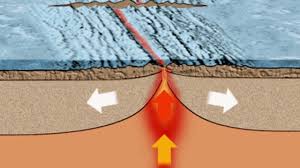
In sea-floor spreading, molten material rises from the mantle and erupts
along the edges of all the continents.
along mid-ocean ridges.
in deep-ocean trenches.
at the north and south poles.

The process by which the ocean floor sinks beneath a deep-ocean trench and back into the mantle is known as _______
convection.
continental drift.
subduction.
conduction.

Most geologists think that the movement of Earth’s plates is caused by _______
convection.
continental drift.
subduction.
conduction.
The geological theory of _______ states that pieces of Earth’s lithosphere are in constant, slow motion.
subduction
plate tectonics
deep-ocean trenches
sea-floor spreading

A place where two plates slip past each other, moving in opposite directions, is known as a _______
Conservative (Transform) boundary
Constructive (divergent) boundary.
Destructive (convergent) boundary.
Scientists think that convection currents flow in Earth’s
continents.
mantle.
lithosphere.
inner core.

The place where two plates come together is known as a _______
Conservative (transform) boundary.
Constructive (divergent) boundary.
Destructive (convergent) boundary.

What are formed at collision zones / boundaries?
Fold Mountains
Oceans Trenches
Tsunamis
A scale used for measuring the magnitude of an earthquake is known as the ______________
Ritter Scale
Seismic Scale
Richter Scale
Wegner Scale
What is a plate boundary where two plates move away from each other?
Conservative (transform)
Destructive (convergent)
Constructive (divergent)

