
NEW
Font size
 Worksheets
Kinetics and Equilibrium
Total questions: 40
Worksheet time: 42mins

Why does a higher concentration increase the rate of reaction?
it increases the amount of reactants
it lowers the activation energy
it increases the energy of particle collisions
it increases the frequency of particle collisions

Which statement correctly describes an endothermic chemical reaction?
The products have lower potential energy than the reactants, and the ΔH is positive
The products have lower potential energy than the reactants, and the ΔH is negative
The products have higher potential energy than the reactants, and the ΔH is positive
The products have higher potential energy than the reactants, and the ΔH is negative
Which balanced equation represents an endothermic reaction?
N2(g) + 3H2(g) --> 2NH3(g)
N2(g) + O2(g) --> 2NO(g)
CH4(g) + 2O2(g) --> CO2(g) + 2H2O(l)
C(s) + O2(g) --> CO2(g)
Which statement about a system at equilibrium is true?
The forward reaction rate stops and the reverse reaction rate continues
The forward reaction rate is greater than the reverse reaction rate.
The forward reaction rate is less than the reverse reaction rate
The forward reaction rate is equal to the reverse reaction rate.

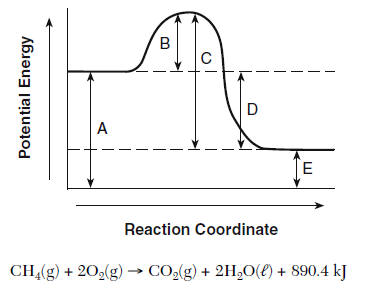
The potential energy diagram below represents a reaction.
Which arrow represents the activation energy of the forward reaction
A
B
C
D
Which statement best explains the role of a catalyst in a chemical reaction?
A catalyst changes the kinds of products produced
A catalyst provides an alternate reaction pathway that requires less activation energy
A catalyst limits the amount of reactants used
A catalyst is added as an additional reactant and is consumed but not regenerated
Which sample has the lowest entropy?
1 mole of KNO3(l)
1 mole of KNO3(s)
1 mole of KNO3(aq)
1 mole of KNO3(g)

Given the balanced equation
Which statement best describes this proces
It is endothermic and entropy decreases
It is endothermic and entropy increases
It is exothermic and entropy decreases
It is exothermic and entropy increases
Systems in nature tend to undergo changes toward
lower energy and lower entropy
lower energy and higher entropy
higher energy and lower entropy
higher energy and higher entropy
Given the equation representing a reaction at equilibrium:
N2(g) + 3H2(g) --> 2NH3(g) + energy
Which change causes the equilibrium to shift to the right?
decreasing the concentration of H2(g)
decreasing the pressure
increasing the concentration of N2(g)
increasing the temperature
N2(g) + O2(g) ↔ 2NO(g)
As the concentration of N2(g) increases, the concentration of O2(g) will
For the reaction SO2 + O2 <−> SO3
If the equilibrium shifts to the left, the concentration of SO3 will ___________.
Increase
Decrease
Stay the same
For the reaction SO2 + O2 <−> SO3
If the concentration of SO2 is increased, the equilibrium position of the reaction will shift ___________.
To the left
To the right
To the left and right
Neither left nor right
2SO2(g) + O2(g) <--> 2SO3(g) +HEAT
Which change causes the equilibrium to shift to the right?
Given the equation representing a system at equilibrium:
N2(g) + 3H2(g) <--> 2NH3 (g) + ENERGY
Which changes occur when the temperature of this system is decreased?
The concentration of H2(g) increases and the concentration of N2(g) increases.
The concentration of H2(g) decreases and the concentration of N2(g) increases.
The concentration of H2(g), N2(g), and NH3(g) decreases.
The concentration of H2(g) and N2(g) decreases and the concentration of NH3(g) increases.
N2O4(g) <--> 2NO2(g)
Which statement describes this system at equilibrium?
The following graph shows two different reaction pathways for the same overall reaction at the same temperature. Which pathway is faster and why?
Red, because the activation energy is larger
Blue, because the activation energy is lower
both reaction progress at the same rate
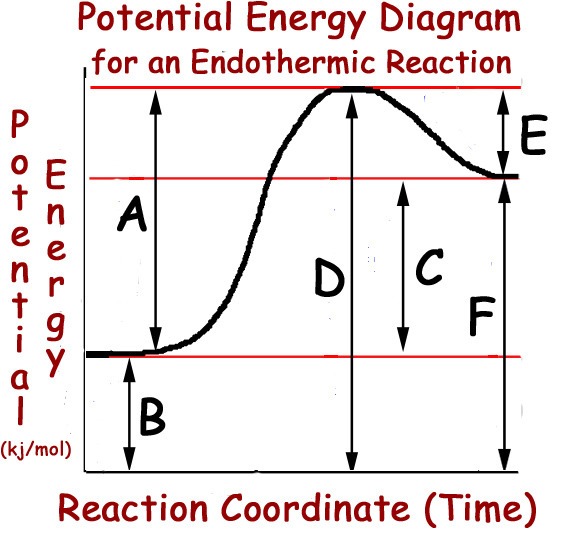
What letter represents the potential energy of the reactants?
A
B
C
D
What letter represents the potential energy of the products?
A
F
D
E
What letter represents the potential energy of the activated complex?
B
D
F
E
What letter represents the heat of the reaction (ΔH)?
A
B
C
D
What letter represents the activation energy of the forward reaction?
A
B
C
D
What letter represents the activation energy of the reverse reaction?
E
F
A
D
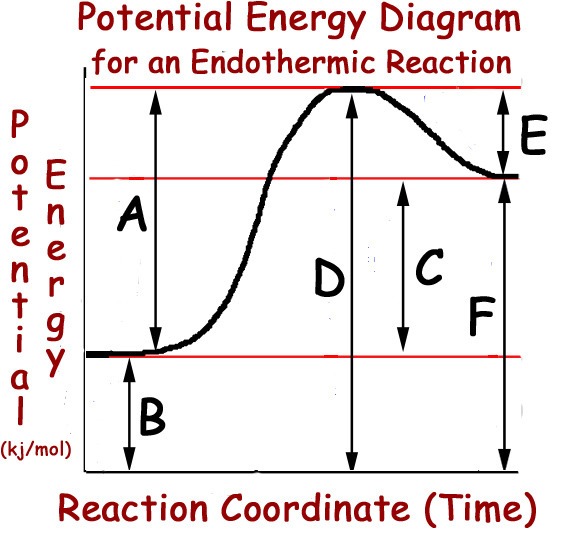
Is this reaction endothermic or exothermic?
endothermic
exothermic
Which sample has the highest entropy?
1 mole of KNO3(l)
1 mole of KNO3(s)
1 mole of KNO3(aq)
1 mole of KNO3(g)
Given the equation representing a reaction at equilibrium:
N2(g) + 3H2(g) --> 2NH3(g) + energy
Which change causes the equilibrium to shift to the left?
decreasing the concentration of H2(g)
decreasing the pressure
increasing the concentration of N2(g)
decreasing the temperature
Which list of the phases of H2O is arranged in order of decreasing entropy?
ice, steam, and liquid water
ice, liquid water, and steam
steam, liquid water, and ice
steam, ice, and liquid water
Which one of these types of compounds tend to have a faster rate of reaction?
Ionic Compounds
Covalent Compounds
Polar Covalent Compounds
Freebie Question..select Answer Choice 1 for free points!
Free points
No, I want to get a bad grade

