Wayground logo

Free Printable Worksheets

Font size

S
M
L
XL
Worksheets

STAAR REVIEW- DISTANCE LEARNING

Total questions: 60

Worksheet time: 51mins

Name
Class
Date
1.

Which table represents a land feature or geologic process that occurs at each type of boundary pictured? (8.9B)

a)
b)
c)
d)
2.
Which position is the Northern Hemisphere experiencing Fall?
a)
A
b)
B
c)
C
d)
D
3.

The teacher draws a model of the moon phases to show to his class. He expects students to label the model on their own correctly. A student is having trouble labeling position 4. Which moon phase would be shown at position 4?

a)
b)
c)
d)
4.

A student is using an HR Diagram to find out more about star classifications. The student decides to compare stars from Area M and Area P. Which of these observations made by the student is not correct?

a)

Area M has some stars brighter than area P, but on average, area P has brighter stars than area M.

b)

Area M is cooler, on average, than area P. This is because they are closest to the cool side of the HR Diagram.

c)

Area P has some stars brighter than area M, but on average, area M has brighter stars than area P.

d)

Area M has larger stars than those in area P. This is because they have a higher luminosity and mass.

5.

The photograph shows a rift valley in Kenya, Africa. Which statement describes the geologic process that is most likely responsible for the formation of this rift valley?

a)

It is are along a transform plate boundary that is no longer active, so erosion is creating deep valleys.

b)

It is along a transform plate boundary in which plates are currently moving side by side, causing earthquakes and rifts.

c)

It is along a plate boundary in which plates are currently converging, cause an uplift in one side of the crust and steep slopes.

d)

It is along a plate boundary in which plates diverged in the past, creating a deep rift in the crust.

6.
Which category is our Sun located in?
a)
White Dwarfs
b)
Supergiants
c)
Main Sequence
d)
Giants
7.
How many producers are in this food web?
a)
1
b)
2
c)
3
d)
4
8.
What type of geological feature will form at a convergent boundary in the ocean?
a)
mid ocean ridge
b)
volcanic Islands
c)
fault
d)
mountains
9.
The organelle inside a plant cell that converts sunlight into energy.
a)
Chloroplast
b)
Photosynthesis
c)
Parasite
d)
Cell Wall
10.
Organisms who make their own energy by taking in light or chemicals.
a)
Heterotroph
b)
Phototropism
c)
Autotroph
d)
Heterotroph
11.
Which of the following is a predator-prey relationship in this food web?
a)
Jackal-Goat
b)
Rabbit-Green Plant
c)
Mouse-Owl
d)
Jackal-Lion
12.
Balanced forces would describe objects that_____
a)
move at a constant speed
b)
change speed
c)
travel at a slower speed
d)
change direction
13.
For an investigation a student pours a blue solution into a beaker.  The student then places a shiny, silver-colored strip of zinc into the solution.  The strip of zinc had a dark, solid form on it and small solid pieces broke off of it and settled to the bottom of the beaker.  The student inferred that a chemical reaction occurred.  What evidence supports this?
a)
A dark solid formed on the zinc.
b)
The zinc metal remained silver and shiny
c)
The solution turned blue when the zinc was added
d)
None of these
14.
How many elements are in C6H12O6?
a)
1
b)
2
c)
3
d)
4
15.
What best describes the energy conversion that occurs when you turn on a flashlight?
a)
electrical to thermal to light
b)
chemical to electrical to light
c)
nuclear to electrical to thermal
d)
kinetic to light to thermal
16.
(6.8A) At which of these positions does the ball have both the greatest kinetic energy and the least potential energy?
a)
Position 1
b)
Position 2
c)
Position 3
d)
Position 4
17.
55 mph north is an example of....
a)
speed
b)
velocity
c)
direction
d)
force
18.
(6.8C) A student walks 2 km in 30 minutes. What is the student's average speed in km/h?
a)
4 km/h
b)
2 km/h
c)
15 km/h
d)
60 km/h
19.
The diagram below shows a hot air balloon rising. Propane gas tanks are seen at the bottom of the balloon.  What energy transformations occur when propane gas is used to lift the balloon? 
a)
Mechanical to light to chemical
b)
Chemical to mechanical to thermal 
c)
Thermal to chemical to light
d)
Chemical to thermal to mechanical 
20.

Himilayan Mountains

a)

converging plates

b)

earthquake in subduction zone

c)

diverging plates

d)

transformational

21.
How many hydrogen atoms are in this chemical formula: 
a)
4 hydrogen atoms
b)
1 hydrogen atom
c)
2 hydrogen atoms
d)
3 hydrogen atoms
22.

Element or compound?

a)

Element

b)

Compound

23.
Which of these is the electron?
a)
A
b)
B
c)
C
d)
D
24.
Calcium is most like which of the following?
a)
Barium
b)
Potassium
c)
Cesium
d)
Nitrogen
25.
Elements which are shiny, conduct electricity and heat are called...
a)
metal
b)
nonmetal
c)
metalloid
d)
nonexistent
26.
How many valence electrons does iodine (I) have?
a)
6
b)
16
c)
7
d)
17
27.
What is the name of the group that never reacts? They are stable with a full outermost ring!!!
a)
noble gases
b)
transition
c)
halogens
d)
borons
28.

What determines the reactivity of an atom?

a)

The protons

b)

The neutrons

c)

The electrons

d)

The valence electrons

29.
If these teams are pulling with the same amount of force what will happen?
a)
The boy in blue will win.
b)
They will not move at all indicating a balanced force
c)
The boy in red will win.
d)
They will not move at all indicating an unbalanced force
30.
What is the net force?
a)
400 N Up
b)
400 N Down
c)
- 400 N Down
d)
800 N Down
31.
Football A has a greater mass than football B.  Which football will have greater acceleration when both are thrown with the same force in the same direction?
a)
Football A
b)
Football B
c)
They will have the same acceleration
d)
Mass has no effect on acceleration
32.
You hit a wall with a stick.  The equal but opposite reaction is _____
a)
the wall pushes against you
b)
the stick pushes against you
c)
you push against the stick
d)
the wall pushes against the stick
33.
How does Newton's first law of motion apply to a ball rolling across the gym?
a)
The ball will stop halfway across the gym.
b)
The ball will continue to roll until an unbalanced force is applied.
c)
The ball will start bouncing until it hits the wall.
d)
The ball will roll in a zigzag pattern.
34.
How does Newton's first law of motion apply when a person is not wearing a seatbelt and a car comes to a sudden stop?
a)
The passengers will continue to move forward due to inertia.
b)
The passengers will move backward into the seat.
c)
The passenger will lean to the left or right.
d)
The passenger will not be affected by the sudden stop. 
35.
If a force of 50 N is applied to each of the three objects, which one will have the least acceleration. 
a)
Object X because it has the greatest mass. 
b)
Object Y because it has the least volume.
c)
Object Z because it has the least mass.
d)
Object Z because it has the greatest volume. 
36.

What goes with REACTIVITY or SIMILAR PROPERTIES?

a)

proton

b)

neutron

c)

valence electron-electrons in outer shell

37.

What group is LEAST reactive?

a)

Group 2

b)

Group 3

c)

Group 4

d)

Group 18 because it has 8 valence electrons

38.

Malleable and ductile describe

a)

metal

b)

metalloid

c)

nonmetal

39.
An atom has 10 protons and a mass of 18. It has __ neutrons
a)
10
b)
18
c)
28
d)
8
40.
What element is represented in this Bohr Model? 
a)
Carbon
b)
Hydrogen
c)
Aluminum
d)
Lithium
41.
Which element has the most protons?
a)
Ca
b)
N
c)
H
d)
C
42.

An element has a mass number of 31 and an atomic number of 15. How many total particles are inside the nucleus and outside the nucleus?

a)

15, 15

b)

15, 31

c)

31, 15

d)

16,15

43.

How many protons, neutrons, and electrons are found in a stable element of Osmium-191?

a)

76 P, 76 N, 76 E

b)

76 P, 191 N, 76 E

c)

115 P, 76 N, 115 E

d)

76 P, 115 N, 76 E

44.

Which activity would BEST demonstrate the Law of Action/Reaction?

a)

A car traveling down the road.

b)

A rocket launching to space.

c)

A soccer ball sitting on the ground.

d)

A lady pushing a grocery cart.

45.

Mary is riding in a car when the driver suddenly slams on the brakes. Mary is jerked forward out of her seat. This is an example of which law of motion?

a)

2nd Law

b)

1st Law

c)

3rd Law

46.

Billy pushes his little brother on a sled through the snow. He then tries to push his father on the the same sled. He noticed that it was much harder to push his father. Which law is this an example of?

a)

1st Law

b)

2nd Law

c)

3rd Law

47.

What is the force on a 1000 kg elevator that is falling freely at 9.8 m/sec2

a)

102.04 n

b)

9,800 n

c)

980 n

d)

103 n

48.
What is happening at E?
a)
Stationary
b)
Accelerating
c)
Fast steady speed; moving away from the starting position
d)
Steady speed; returning to start position
49.
According to the graph how far does the person travel in the first 5 seconds?
a)
2 m
b)
10 m
c)
0 m
d)
5 m
50.
How many times does this object STOP moving?
a)
None
b)
Once
c)
Twice
d)
Three times
51.

What is the total number of protons, neutrons, and electrons in a cadmium, Cd, atom.

a)

48

b)

112

c)

160

d)

208

52.

Which students responses are correct?

a)

Student 1

b)

Student 2

c)

Student 3

d)

Student 4

53.

Which substances have the same number of carbon atoms?

a)

Substances 1 and 2

b)

Substances 2, 3, and 4

c)

Substances 2 and 3 only

d)

Substances 1 and 3

e)

Substances 1 and 4

54.

Which element meets this criteria: shiny, solid at room temperature, and has 2 valence electrons?

a)

Li

b)

Sr

c)

Kr

d)

P

55.

Which two elements on the periodic table are in the same period?

a)

Na and Si

b)

Cl and Br

c)

Sc and Y

d)

Kr and Ar

56.

Which of the following is NOT an example of a physical change?

a)

crumpled paper

b)

pencil sharpening

c)

shrunken clothing

d)

mixing two clear liquids and they start glowing green
57.
What is the advantage of having different shaped beaks?
a)
To look different from other species.
b)
To be able to eat the food readily available in the environment.
c)
To protect itself against predators.
d)
To protect itself against prey.
58.
The purpose of selective breeding is to 
a)
Get bigger animals
b)
get smaller animals
c)
create animals with desirable traits
d)
create animals with bad traits
59.
How much energy is available to be passed on to the next trophic level in an ecosystem?
a)
100%
b)
10%
c)
50%
d)
75%
60.
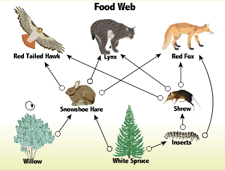
What may happen if the snowshoe hare was removed from the food web pictured?
a)
The insects in the habitat would increase.
b)
The shrew population would decrease due to being only hawk food source.
c)
The willow tree population would decrease.
d)
Foxes would dies due to no food source.