
 Worksheets
Mix & Flow Exam Review
Total questions: 63
Worksheet time: 16hrs 45mins
A homogeneous mixture is the same thing as...
a solution
a heterogeneous mixture
a compound
an element
A type of mixture that forms when one substance dissolves in another is known as a
heterogeneous mixture
solution
solute
solvent

Which substance is least soluble at 0 ºC?
KI
KNO3
KClO3
Ce2(SO4)3

How many grams are soluble in 100 g of water at 100 ºC?
300 grams
250 grams
100 grams
50 grams

Which solute is most likely a gas?
NH3
NaNO3
KCl
NaCl

When 40 grams of NaCl is dissolved in 100 grams of water at 90 ºC, the solution can be correctly described as:
supersaturated
saturated
unsaturated


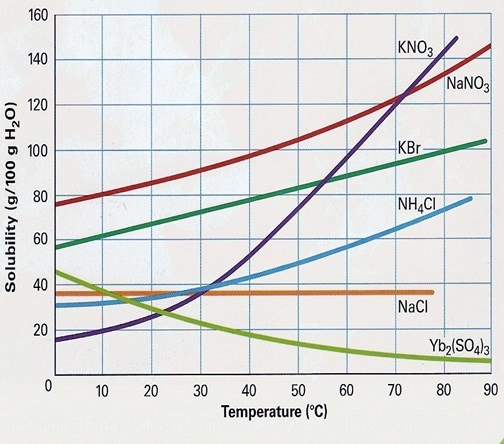
Identify how many grams of KNO3 is required to make a saturated solution at 40'C.
50 g
45 g
55 g
33 g

If I dissolve carbon dioxide in water, what is the solvent?
Carbon Dioxide
There is no solvent
Oxygen
Water
If I dissolve salt in water, what is the solvent?
salt
water
salt & water
none of the above
If I dissolve sugar in water, what is the solution?
water
sugar
sugary water
none of the above
Define the term soluble.
Can dissolve in water
Cannot dissolve in water
Partially dissolves in water
Define the term insoluble.
Can dissolve in water.
Cannot dissolve in water.
Partially dissolves in water.
Is water the only solvent that can dissolve solutes?
Yes
No

You can make a solute dissolve more quickly in a solvent by
adding more solute.
adding ice.
heating the solvent.
removing some solvent.
Which of the following would NOT increase the rate at which a sugar cube dissolves?
Reducing the amount of solvent
Crushing the sugar cube
Stirring the solution
Heating the solvent
What is viscosity?
Viscosity is a measure of a fluid's ability to boil.
Viscosity is a measure of a fluid's colour intensity.
Viscosity is a measure of a fluid's resistance to flow.
The more viscous a fluid is, the slower it will flow.
True
False
Low viscosity can be described as...
Liquids that flow quickly
Liquids that flow slowly
High viscosity can be described as...
a liquid that flows slowly
a liquid that flows quickly
What are factors that make one fluid flow faster than another?
particle size and shape
attraction of particles
temperature
freezing rate
particle colour and texture
Fluids made of (a) particles have a (b) viscosity, so they can easily move past each other.
Particles of the same substance that are attracted to one another is called:
adhesion
cohesion
adhesive
The (a) of a liquid will (b) when its temperature (c) .
Place the following in order, from the one with the lowest viscosity to the one with the highest viscosity:

Rubbing alcohol

Olive oil

Shampoo

Molasses

Mayonnaise
Peanut butter is an example of a...
High viscosity liquid
Low viscosity liquid
Isnt a liquid at all! Don't be silly.
Water is an example of a...
Low viscosity liquid
High viscosity liquid
Which viscosity can be described as "thick"?
Low viscosity
High viscosity
Which viscosity can be described as "thin"?
Low viscosity
High viscosity
do packed particles make an object more dense or less dense?
less dense
more dense
all of the above
half and half
which is the least dense?
gas
water
ketchup
lamp oil
which of these has the heaviest density?
water
helium
ketchup
cookie
What two types of measurements make up DENSITY?
Mass and Volume
Temperature and Mass
Grams and Centimeters
Volume and Weight
Give the units for volume
cm
kg
cm3
cm2
State the units for mass
cm
ml
kg
s
The density of a material is the SAME no matter what the size or shape of the material
True
False
What is used to find the volume of an irregular shaped object?
Graduated cylinder
Scale
Test tube
Oil
Which state of matter has a definite volume but no definite shape?
Solid
Liquid
Gas
Plasma
A cube measures 3.0 cm on each side
(hint: V = L X W X H)
and has a mass of 25 g.
Water has a density of 1g/cm3
Will the cube float or sink?
Float
Sink
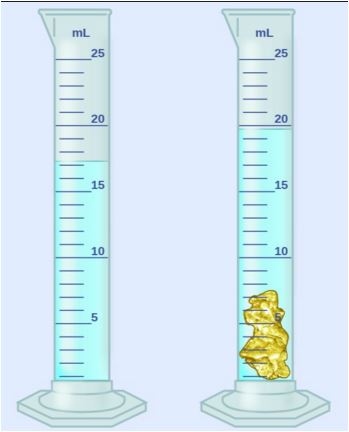


10.0 ml
15.0 ml
20.0 ml
25.0 ml


The amount of matter in an object is ____.
mass
volume
density
buoyancy
How much space an object take up is its _______________.
volume
mass
density
buoyancy
This is what happens to an object when the buoyant force is stronger than the gravitational force.
(a)
How do you get a chunk of dense metal to float instead of sink
Nothing, you cannot change the shape
add a less dense metal to the original metal
Increase the volume of the metal by flattening its shape
compress the metal

The upward force exerted by a fluid is called the...
buoyant force
density force
fluidity force
normal force

