wayground logo

Free Printable Worksheets

Font size

S
M
L
XL
Worksheets

Final Exam Review - Chemistry '26

Total questions: 55

Worksheet time: 3625secs

Name
Class
Date
1.

a substance that is the building block of all matter (made of one kind of atom).

a)

element

b)

atom

c)

compound

d)

mixture

2.

matter made of two or more elements (chemically bonded/cannot be separated by physical means)

a)

compound

b)

atom

c)

element

d)

mass

3.

What is the atomic mass of Neon?

a)

10

b)

20.18

c)

10.18

d)

20.2

4.
How many protons are in Beryllium?
a)
4
b)
9
c)
5
d)
2
5.
How many neutrons are in a Gold atom?
a)
79
b)
196
c)
118
d)
275
6.

What is at the center of every atom?

a)

An electron

b)

A compound

c)

A molecule

d)

A nucleus

7.
Which two particles make up the nucleus of an atom?
a)
Protons and Electrons
b)
Protons and Neutrons
c)
Molecules and Compounds
d)
Neutrons and Electrons
8.
What is the role of an electron in an atom?
a)
Electrons live inside the nucleus and carry a neutral charge.
b)
Electrons circle the nucleus and have a positive charge.
c)
Electrons circle the nucleus and have a negative charge.
d)
Electrons live inside the nucleus and have a negative charge.
9.
In an atom, what is the number of protons equal to?
a)
The number of electrons.
b)
The number of neutrons.
c)
The number of molecules.
d)
The number of nuclei.
10.

What is a compound?

a)

The center of an atom that is formed by neutrons, protons, and electrons.

b)

A tiny particle that makes up all matter.

c)

A molecule that is formed from two or more different types atoms.

d)

A molecules that is formed from the same type of atoms.

11.
A proton is a _____ charged particle.
a)
Negatively
b)
Positively
12.
An electron is a _____ charged particle.
a)
Positively
b)
Negatively
13.
What is an atomic number?
a)
The sum of protons and neutrons in an atom.
b)
The sum of protons and electrons in an atom.
c)
The number of protons in an atom of a specific element.
d)
The number of neutrons in a specific element.
14.

The number of neutrons equals...

a)

atomic number - mass number

b)

Protons - neutrons

c)

Electrons - protons

d)

mass number - atomic number

15.
What charge does a neutron have?
a)
positive
b)
negative
c)
no charge
16.
Where are protons located in the atom?
a)
orbitals
b)
nucleus
c)
rings
d)
positive
17.
The number of protons plus neutrons.
a)
Mass number
b)
Mass Weight
c)
Atomic number
d)
Atomic weight
18.
Where are neutrons located in the atom?
a)
shells/orbitals
b)
rings
c)
center
d)
nucleus
19.
all matter is made of what 
a)
energy 
b)
atoms 
c)
electrons 
d)
compounds 
20.

What is Jimmy?

a)

Electron

b)

Proton

c)

Atomic

d)

Neutron

21.

USE THE PERIODIC TABLE

How many valence electrons does carbon have?

a)

4

b)

12

c)

6

d)

14

22.

USE THE PERIODIC TABLE

How many valence electrons does sodium have?

a)

1

b)

2

c)

3

d)

4

23.
a)
7
b)
8
c)
9
d)
10
24.
a)
2
b)
3
c)
5
25.

Identify the element in Period 5 that has 1 valence electron?

(Use the Peroidic Table from Class)

a)
Rb
b)

Mo

c)
Ag
d)
Sb
26.

What element in Period 4 has 5 valence electrons?

(Use the Peroidic Table from class)

a)
Zr
b)
As
c)
V
d)
Sb
27.

Valence electrons are electrons in the shell

a)

furthest from the nucleus

b)

closest to the nucleus

c)

having the lowest energy level

d)

that has the fastest electrons

28.

Which of the following is false about covalent bonds?

a)

Forms by sharing electrons

b)

Forms between 2 nonmetals

c)

Represented by a line between atoms

d)

Forms by transferring electrons

29.

Which list of elements contains a metal, a metalloid, and a nonmetal?

a)

Ag, Si, I2

b)

Ge, As, Ne

c)

K, Cu, Br2

d)

S, Cl2 , Ar

30.

Elements that have atoms with stable valence electron configurations in the ground state are

a)

Group 1

b)

Group 2

c)

Group 17

d)

Group 18

31.

What are the elements in group 18 (the far right) of the periodic table called?

a)

Alkali metals

b)

Alkaline earth metals

c)

Halogens

d)

Noble gases

32.

What are the elements in group 17 of the periodic table called?

a)

Alkali metals

b)

Alkaline earth metals

c)

Halogens

d)

Noble gases

33.

What are the elements found along the "staircase" called? They have properties of both metals and non-metals.

a)

Metalloids

b)

Non-metals

c)

Transition metals

d)

Metals

34.
Atoms are most stable when their outer shell is complete.
a)
true
b)
false
35.
Covalent bonds actually "share" electrons?
a)
true
b)
false
36.
How are covalent bonds formed?
a)
Sharing of electrons
b)
Transfer of electrons
37.
How are ionic bonds formed?
a)
Transfer of electrons
b)
Sharing of electrons
38.

Why do elements bond?

a)

To be friends

b)

To create a new element

c)

To become stable

d)

To become unstable

39.

Opposite charges _______________.

a)

avoid

b)

attract

c)

push

d)

repel

40.
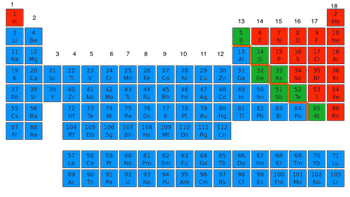
Where are metals located on the periodic table?
a)
Blue
b)
Green
c)
Red
41.
Where are the nonmetals located on the periodic table? 
a)
Blue
b)
Red
c)
Green
42.
Where are the metalloids located on the periodic table?
a)
Blue
b)
Red
c)
Green
43.
Is this equation balanced?
a)
yes
b)
no
c)
Not enough information
d)
Left side is balanced
44.
Which side of a chemical equation is the product side?
a)
Left (before the yields sign)
b)
Right (after the yields sign)
45.
What is a coefficient?
a)
The small number on the right of the chemical symbol.
b)
The large number to the left of a formula.
46.

Balance this equation

_Zn+_HCl-->_ZnCl2 +_H2

** Write out on scrap paper**

a)

1,1,2,1

b)

1,1,1,2

c)

1,2,1,1

d)

2,1,1,1

47.

Balance this equation.

_Mg + _Cl2 --> _MgCl2

** Write out on scrap paper**

a)

1, 2,1

b)

1,1,1

c)

2,1,1

d)

1,1,2

48.

Balance this equation

_N2 + _H2 --> _NH3

** Write out on scrap paper**

a)

1,2,3

b)

1,3,2

c)

1,1,2

d)

2,1,1

49.

How many atoms of aluminum are on each side of the following equation:

4Al + 3O2 --> 2Al2 O3

** Write out on scrap paper**

a)

2

b)

6

c)

1

d)

4

50.
The blue numbers in the image below represent ________
a)
Charges
b)
coefficients
c)
subscripts
d)
none of the answers are correct
51.
At the end of chemical reactions, what is the total mass of the reactants compared to the total mass of the products?
a)
the product is doubled
b)
the product is half the mass of the reactants
c)
the mass is the same
d)
the mass changes depending on the reaction
52.

Is this equation balanced or unbalanced?

N2 + H2 = NH4

** Write out on scrap paper**

a)

Balanced

b)

Unbalanced

53.
What does the Law of Conservation of Mass state?
a)
Matter cannot be gained or lost in a chemical reaction.
b)
Matter can only be lost in a chemical reaction.
c)
Matter can only be gained in a chemical reaction.
d)
Matter can be gained and lost in a chemical reaction. 
54.

Which statement is true about the interactions between hydrogen (H) and nitrogen (N)?

a)

1 atom and 10 electrons

b)

1 molecule and 10 electrons

c)

1 molecule and 10 atoms

d)

4 molecules and 10 atoms

55.

When Ryan poured vinegar on baking soda, which of the following was a sign that a chemical change occurred?

a)

nothing happened

b)

it fizzed and produced gas

c)

it glowed

d)

its color became darker