
 Worksheets
Electricity YR 7 KS 3
Total questions: 54
Worksheet time: 42mins
Which of these circuits will not allow the lightbulb to light up


What is a series circuit?
True
false
A path with more than one way for electrons to travel
A path with only one way.
Resistors make the electrons flow faster.
agree
disagree

a unit that measures the flow of a current is called ______
ampere
volt
watt
ohm
a unit that measures the force of a current is called ______
ampere
volt
watt
ohm
In a series circuit...
the current is the same everywhere.
the current is split between components.
the voltage is the same everywhere.
the voltage is split between components.
Ammeters should always be connected in (a) .
In a series circuit, if one component breaks the others will remain on.
True
False
In a circuit, electrons flow from
negative to positive
positive yo negative

Look at the circuit. Branch 2 is open, which statement is correct?
Only the bulb in branch 2 will not work.
All bulbs in other branches will not work.
The first branch with two bulbs will still work, others will not.

If the current flowing through the cell is 2A, what is the ammeter reading?
5A
1A
6A
2A

zig zag
Resistor
Ammeter

This is the symbol for a...
Fixed Resistor
Variable Resistor
Light Dependent Resistor
Fuse
How many paths does a series circuit have?
4
3
2
1
The voltage stays the same in a series circuit.
True
False
Adding more loads to a parallel circuit will increase the currentt.
True
False.

Which of the circuits in the diagram are series circuits?
A
B
C
D

Which of the circuits in the diagram are parallel circuits?
A
B
C
D

Which of the circuits in the diagram will have lightbulbs that are lit?
A
B
C
D
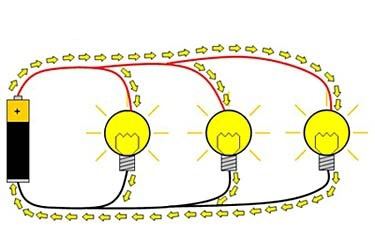
What type of circuit is shown in the picture?
Series Circuit
Broken Circuit
Parallel Circuit
Open Circuit
Opposite charges
attract
repel
become neutral
do nothing
Mr. Anady rubbed two balloons against his wool sweater for 30 seconds each. What will happen when the balloons are brought near each other?
The balloons will repel each other.
The balloons will attract each other.
The balloons will become positively (+) charged.
The balloons will pop.
The accumulation of excess electric charge on an object is called
Static electricity
Electric discharge
Resistance
Current electricity
What can happen when you touch a metal doorknob after rubbing your shoes on the carpet?
The doorknob sends a burst of electric current into your body
Millions of electrons go from your finger into the doorknob
Our negatively charged body becomes positively charged
Our finger becomes negatively charged
If two charges repel each other, the two charges must be?
Positive & Positive
Positive & Neutral
Negative & Negative
Positive and Negative
An object becomes charged when the atoms in the object gain or lose?
Electrons
Protons
Neutrons
All of the above
If a substance has a higher number of electrons than protons on its surface, what type of charge does it have?
A positive charge.
A negative charge.
A neutral charge.
No charge at all.
An object becomes negatively charged by
losing protons
gaining electrons
losing electrons
gaining protons
An object becomes positively charged by
losing protons
gaining electrons
losing electrons
gaining protons
Electricity flows well through conductors. A good example of a conductor is ___________________.
Rubber
Wool
Metal
Glass
Materials that allow electrical charges to flow easily through them are called __________.
Currents
Insulators
Conductors
Semiconductors
A positively-charged and a negatively-charged object will...
Attract
Repel
Do nothing
The accumulation of excess electric charge on an object is called
Static Electricity
Electric Discharge
Resistance
Current Electricity
If an object has the same number of positive and negative charges, its electrical charge is...
Positive
Negative
Neutral or no charge
Opposite
Static charges build up when
Protons move within an object
The nucleus moves within an object
Neutrons move within an object
Electrons move within an object

