
 Worksheets
Demand for Labour
Total questions: 20
Worksheet time: 15mins

The demand for labour in this industry has declined from Q2 to Q1. This could be because: (one correct answer)
The price of capital has declined.
The demand for the product that labour produced has declined.
The wage rate increased.
Labour productivity has increased.

A shift from D1 to D2 could happen because (two correct answers)
the price of capital has increased.
the price of capital has fallen.
demand for product labour produces has increased.
demand for product labour produces has fallen.
the global economy has entered a recession.
The demand for labour is a 'derived demand', meaning that ...
the demand for labour is dependent on the supply of the inputs in the production process
the demand for labour is completely independent of the demand for the product
the demand for labour is dependent upon the demand for whatever the labour produces
the demand for labour is greater than the demand for the product that the labour makes
If the demand for McDonald's hamburgers rose, which of the following diagrams would display the likely impact on the demand for McDonald's workers
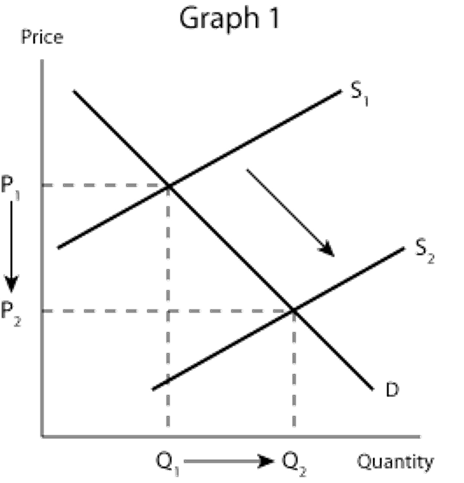
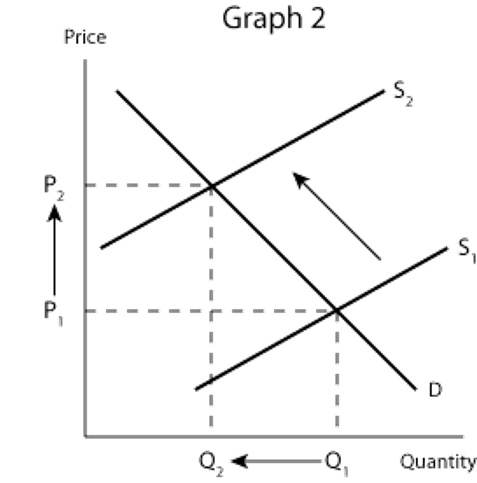
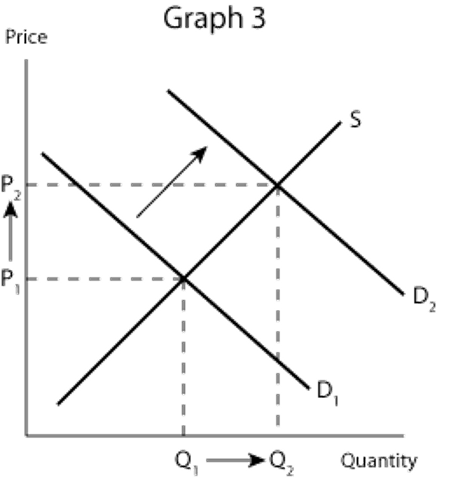
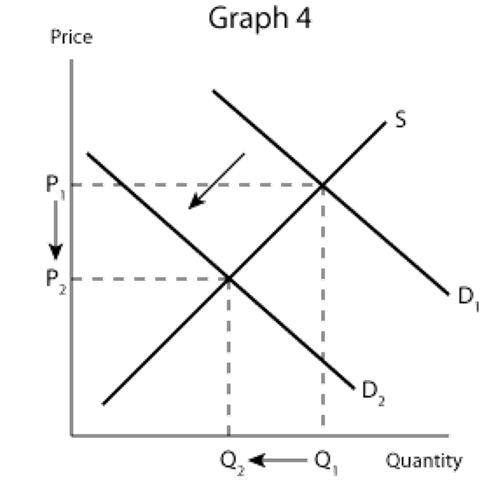
Several factors affect the demand for labour, including all of the following EXCEPT:
The age distribution of the labour market
Availability of substitutes
Productivity of labour
Other employment costs
Demand that arises because there is demand for another good is called ...
Price elastic demand
Excess demand
Demand deficient
Derived demand
Of the four parts of the business cycle, in which part are we most likely to see a rapid increase in business activity, demand and prices very high, and unemployment very low?
Trough
Recovery
Boom
Downturn
How many factors of production are variable in the long run?
0
1
4
5
Which law states that marginal output will start to decline if more and more units of one variable factor off production are combined with a given quantity of fixed factors?
(a)
The number of extra units produced by an additional worker is known as what (abbreviated to three letters)?
(a)
How would you describe the shape of the MRP curve?
Downward sloping
Upward sloping
Initially upward, then downward sloping
Steep
MRP of the first worker is £20, the second £40, the third £35, the fourth £25 and the fifth, £20.
If the wage rate is £30, how many workers will the firm hire?
1
2
3
4
5
Which of the following would shift the Demand for Labour curve left?
Lower wage rates
Decrease in price of a competitors product
Increased training for workers
Decrease in the price of capital substitutes
A decrease in the price of the final good
A firm's Demand for Labour curve is likely to be more elastic, when?
(a)
How have you found the economics course @home so far?
1 out of 5
2 out of 5
3 out of 5
4 out of 5
5 out of 5
A firm is more likely to have an elastic demand for labour curve for which type of worker?
A hairdresser
A doctor
An assembly line worker
What % of workers in the UK hotel and food industries are currently on furlough?
25%
50%
70%
80%
What is the estimated cost of COVID-19 to the UK tourism industry in 2020?
£2bn
£8bn
£15bn
£25m
Why are the most beautiful areas in the UK likely to experience the highest job losses?
Demand for tourism workers in Cornwall is derived from what?
The population of Cornwall
The wage rate of workers in the hospitality sector
The demand for tourist visits to Cornwall
The supply of workers

