
 Worksheets
1.4 Enzymes
Total questions: 25
Worksheet time: 20mins
Name
Class
Date
1.
What is a substance called if it speeds up a chemical reaction?
a)
reusable
b)
catalyst
c)
specific
d)
fragile
2.
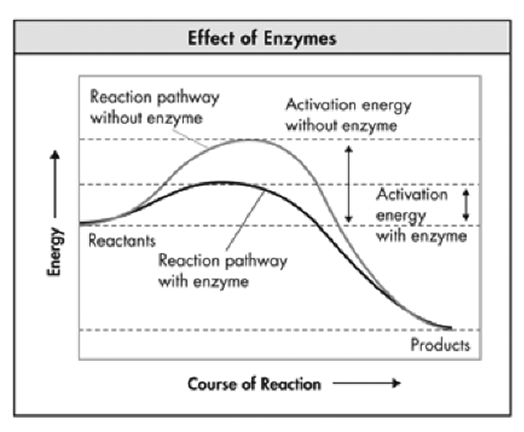
The graph shows how enzymes affect reactions in cells. Which statement best summarizes the information shown in the graph?
a)
Enzymes increase the energy of the reactants.
b)
Enzymes decrease the energy level of the products.
c)
Enzyme decrease the activation energy of the reaction.
d)
Enzymes reverse the direction of the reaction.
3.
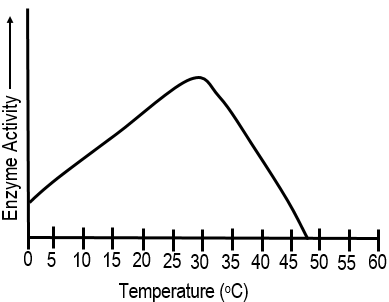
Based on the graph, what is the optimal temperature for this enzyme?
a)
15oC
b)
40oC
c)
30oC
d)
35oC
4.
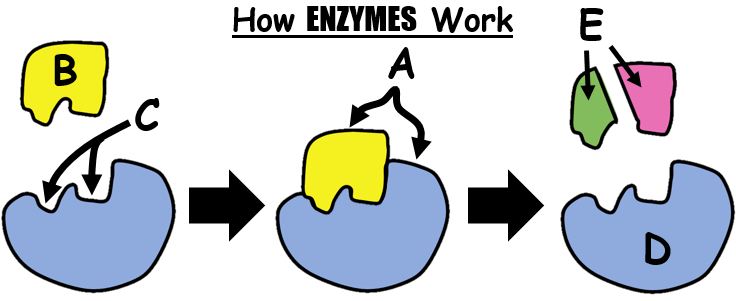
In the diagram, what is letter A?
a)
product
b)
substrate
c)
enzyme-substrate complex
d)
active site
5.
Enzymes are...
a)
nucleic acids
b)
proteins
c)
lipids
d)
carbohydrates
6.
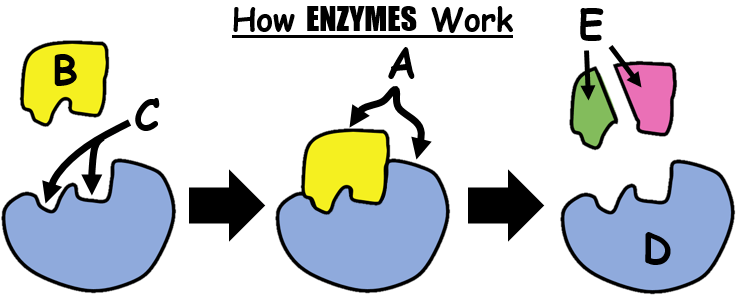
Letter D...
a)
active site
b)
enzyme
c)
substrate
d)
products
7.
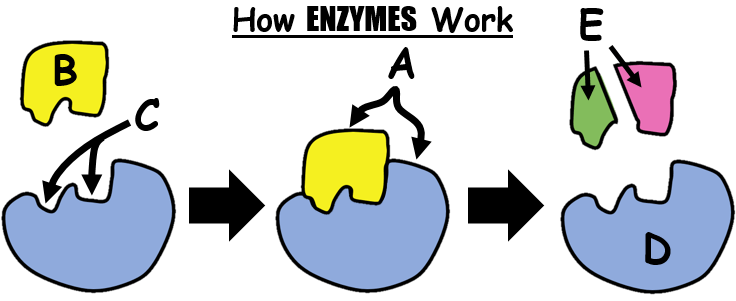
Letter B...
a)
active site
b)
enzyme
c)
substrate
d)
products
8.
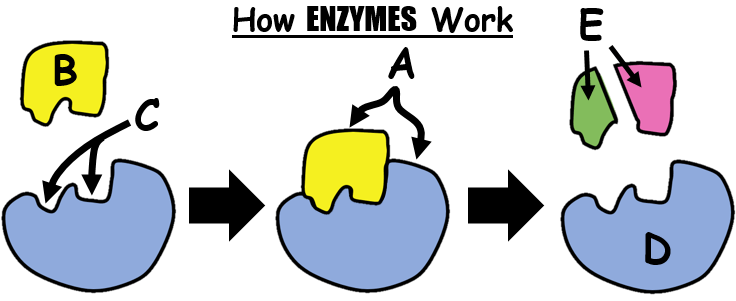
Letter C...
a)
active site
b)
enzymes
c)
substrate
d)
products
9.
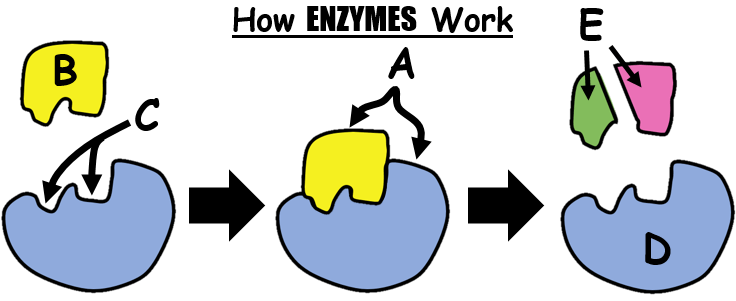
Letter E...
a)
active site
b)
enzyme
c)
substrate
d)
products
10.
With what 3 letters do enzymes typically end?
a)
-ose
b)
-ase
c)
-ese
d)
-tic
11.
Any substance that is acted upon by an enzyme is called a(n)?
a)
Coenzyme
b)
Substrate
c)
Vitamin
d)
Polypeptide
12.

Which of the following conclusions can be drawn from this graph?
a)
The optimum pH of the enzyme is 6.6.
b)
The optimum pH of the enzyme is 5.8
c)
The enzyme’s activity increases as pH increases 5.0 to 9.0
d)
The enzyme’s activity is greater around pH of 8.0 .
13.
What happens when enzymes are heated to a high temperature?
a)
The enzymes die.
b)
The shapes of the enzyme are altered.
c)
The enzymes' amino acid sequence changes.
d)
The enzymes remain the same
14.
Every enzyme has a optimal temperature and pH. True or False?
a)
True
b)
False
15.
Enzymes are composed of which of the following monomers?
a)
amino acids
b)
carbohydrates
c)
nucleotides
d)
monosaccharides
16.
Each enzyme only has 1 substrate that will fit its active site. What is this called?
a)
reusablility
b)
denaturation
c)
specificity
d)
fragility
17.
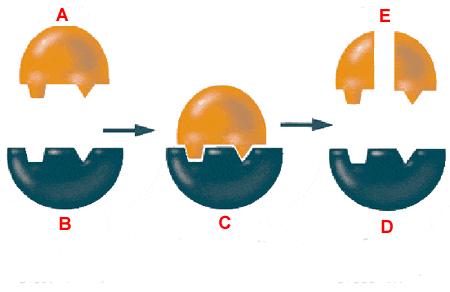
This reaction shows a(n) ____________ reaction
a)
Catabolic
b)
Anabolic
c)
Dehydration Synthesis
d)
Halogenation
18.
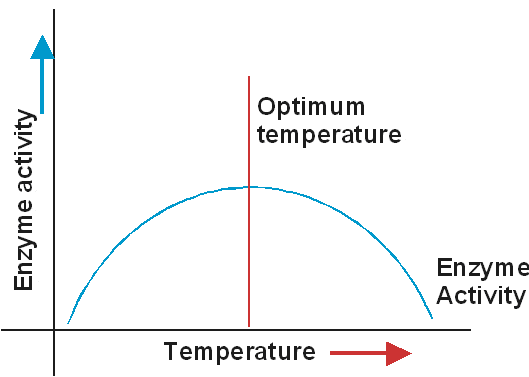
At high temperatures enzyme activity declines because of:
a)
Denaturation
b)
Decreased Kinetic Motion
c)
Increased H-Bonding
d)
Dissociation of Ionic Compounds
19.
At low temperatures enzyme activity declines because of:
a)
Denaturation
b)
Decreased Kinetic Motion
c)
Increased H-Bonding
d)
Dissociation of Ionic Compounds
20.
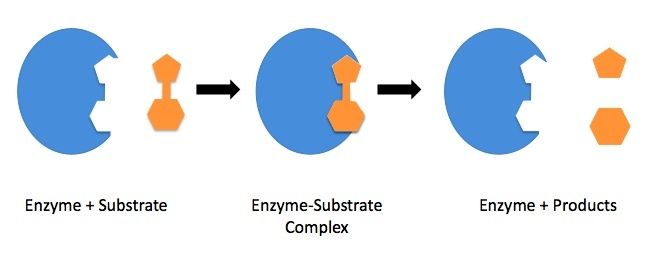
A receptor site that a molecule can bind to that changes the shape of the active site is called a(n):
a)
Allosteric Site
b)
Active Site
c)
DiSulphide Bridge
d)
MHC Receptor
21.
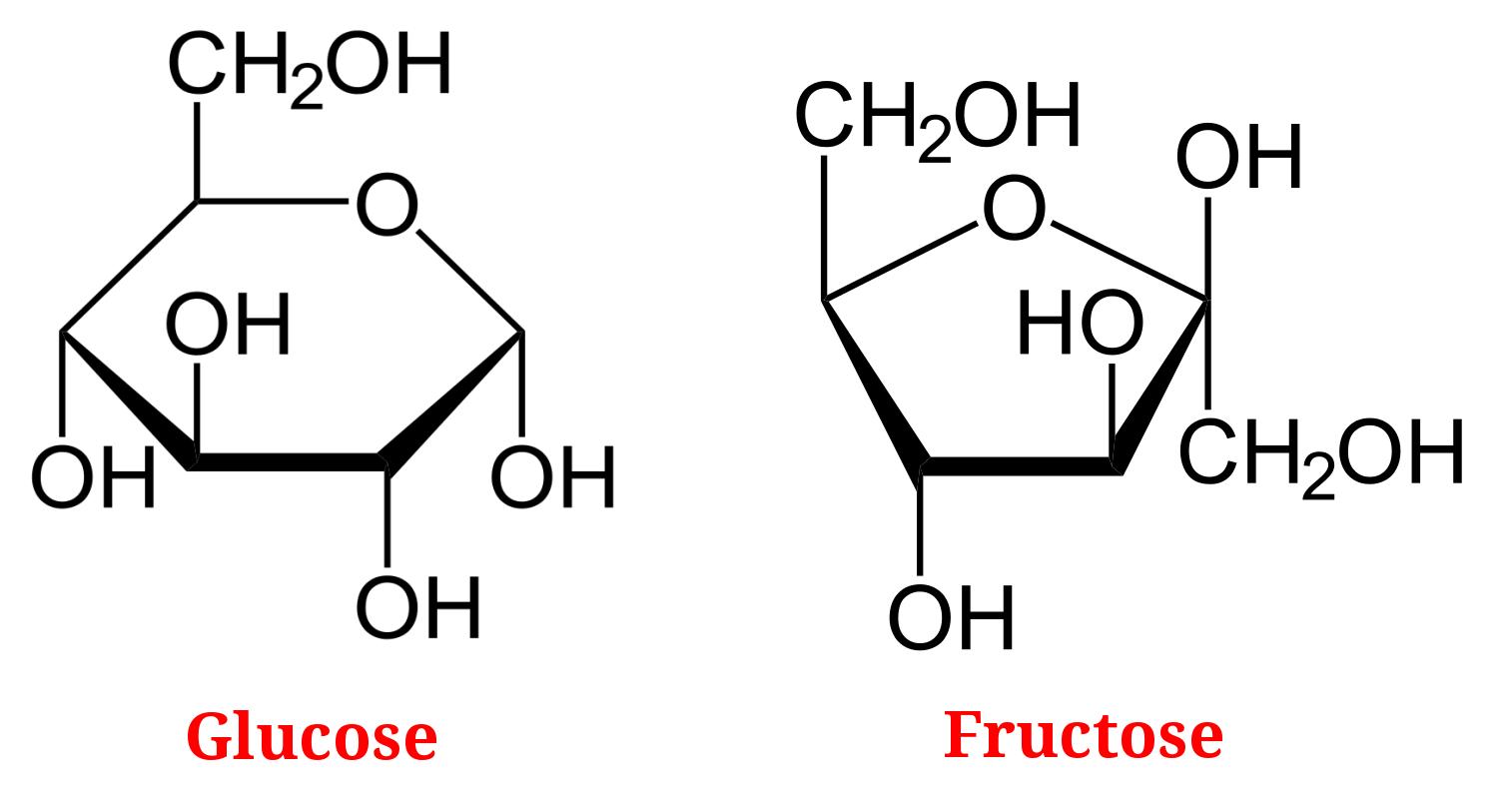
An enzyme that changes glucose into fructose would be a(n):
a)
Isomerase
b)
Lyase
c)
Oxidoreductase
d)
Transferase
22.
A competitive inhibitor bind to which part of an enzyme?
a)
Active site
b)
Allosteric site
c)
Astatine site
d)
Alanine site
23.

What type of inhibition is shown by line A on the graph?
a)
Competitive
b)
Non-competitive
c)
Allosteric
d)
Hydrolytic
24.

What type of inhibition is shown by line B on the graph?
a)
Competitive
b)
Non-competitive
c)
Integral
d)
Hydrolytic
25.
Name the device used to measure very small concentrations of specific chemicals in a solution e.g. in blood or urine.
a)
Blood pressure monitor
b)
Biosensor
c)
Dialysis
d)
Sectrometer
100 %

