wayground logo

Free Printable Worksheets

Font size

S
M
L
XL
Worksheets

refraction of light science year 4

Total questions: 40

Worksheet time: 1hrs 20mins

Name
Class
Date
1.
How does light behave as it enters these mediums?
a)
continue its path as straight line.
b)
bends toward the normal
c)
bends away from the normal
d)
reflects
2.
Light bending as it passes from one medium (object) to another is...
a)
Refraction
b)
Reflection
3.
What is this image showing?
a)
Reflection
b)
Refraction
c)
The law of reflection
d)
Concave Mirror
4.
Why does the lower part of the child appear so much different in size from the upper part?
a)
The light rays that travel through water and then into air are refracted.
b)
The light rays that travel through water and then into air are enlarged.
c)
The light rays that travel through air and then into water are reflected.
d)
The light rays that travel through air and then into water are reduced.
5.

Refraction is when light__________.

a)

Is bounced by an object or material.

b)

Changes speed as it travels in different materials which causes bending.

c)

When light speeds up to over 300,000 km/s

6.

Light emerging from water to air will bend ______ due to the change of speed as it crosses the boundary.

a)

toward the normal

b)

away from the normal

c)

along the normal

7.

Light travels through air, water, glass and many other materials. What path does it travel to get from one place to another?

a)

sideways

b)

back and forth

c)

straight

d)

up and down

8.
Light changes speed as it travels through various mediums.  What are examples of mediums that light can travel through.
a)
snow and ice
b)
air and water
c)
cloth and wood
d)
glass and wood
9.
The pictures shows what a student observed when he looked through a hand lens at a penny.
What happens to light passing through a hand lens that makes the image of the penny appear larger? The light is-
a)
absorbed
b)
reflected
c)
refracted
d)
stopped
10.
This shows the phenomenon known as....
a)
reflection
b)
refraction
c)
mirrors
d)
focal point
11.

The bending of light is called...

a)

a rainbow

b)

refraction

c)

reflection

d)

absorption

12.

Light travels in a _________ line.

a)

wavy

b)

curved

c)

straight

d)

low

13.

What does the picture show about light?

a)

reflection

b)

absorption

c)

refraction

d)

light

14.

Refraction is

a)

the bending of light as it passes into new medium and changes speed

b)

the bending of light around or through a barrier and changes speed

c)

when light bounces off a boundary and changes speed

d)

the bending of light as it crosses a boundary into a new medium with the same speed

15.

As light leaves air and enters water or glass it....

a)

gets faster and bends towards the normal

b)

gets faster and bends away from the normal

c)

gets slower and bends towards the normal

d)

gets slower and bends away from the normal

16.

This picture illustrates ...

a)

light refracts away from the normal when leaving water and entering air

b)

light refracts towards the normal when leaving water and entering air

c)

light does not refract when leaving water and entering air

d)

light continues to travel in a straight line across the boundary between water and air

17.

Light passes into a glass block. Which is the angle of refraction?

a)

A

b)

B

c)

C

d)

D

18.

The diagram below shows a ray of monochromatic light incident on a boundary between air and glass. Which of the letters represent the path after it strikes the glass?

a)

A

b)

B

c)

C

d)

D

19.
According to Willebord Snell, light passing from air to glass will cause the light to
a)
maintain its original speed 
b)
accelerate while it is in glass
c)
increase its speed
d)
reduce its speed
20.
Why does the lower part of the child appear so much different in size from the upper part?
a)
The light rays that travel through water and then into air are refracted.
b)
The light rays that travel through water and then into air are enlarged.
c)
The light rays that travel through air and then into water are reflected.
d)
The light rays that travel through air and then into water are reduced.
21.

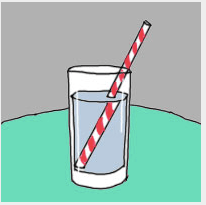
Why does the straw appear to be bent?

a)

light is reflected

b)

light is absorbed

c)

light is turned

d)

light is refracted

22.

What do we call a material that light can travel through?

a)

air

b)

water

c)

medium

d)

pathway

23.
a)
Reflection
b)
Refraction
24.
a)
Reflection
b)
Refraction
25.
a)
Reflection
b)
Refraction
26.

When does the light is refracted?

a)

When light travels in a straight line

b)

When light is bounced

c)

When light travels in two different mediums

d)

When light cannot pass through an opaque object

27.

Diagram shows the condition of a spoon in a glass of water.

What can be observed about the spoon?

a)

The spoon looks bent.

b)

The water is clearer.

c)

The water level rises.

d)

Light is refracted.

28.

What is the conclusion from your observation in this picture?

a)

Light travels in a straight line

b)

Light can be refracted

c)

Light can be reflected

d)

Light can pass through a transparent material

29.

Which of the following shows the principle of light refraction? Tick the correct answers.

a)

A

b)

B

c)

D

d)

E

e)

F

30.
What does it mean to refract?
a)
to bend something, almost always light
b)
clear or easy to see through
c)
a polished surface which reflects an image
d)
allowing light but not detail to pass through
31.
the bending of light when it passes though a medium, such as water or a prism
a)
reflection
b)
refraction
c)
absorbtion
d)
medium
32.
What causes light to appear refracted?
a)
temperature
b)
speed
c)
weather
d)
climate
33.
According to Willebord Snell, light passing from air to glass will cause the light to
a)
maintain its original speed 
b)
accelerate while it is in glass
c)
increase its speed
d)
reduce its speed
34.
What is this called?
a)
refraction
b)
reflection
c)
reconstroction
d)
retraction
35.
Swimming pools and the ocean look shallower than they really are due to:
a)
reflection 
b)
dispersion
c)
refraction
d)
total internal reflection
36.
A student placed a pencil in a cup of water.  The pencil appears broken because light-
a)
always travels in a straight line
b)
bends when it passes through water
c)
makes the water in the glass evaporate
d)
reflects the pencil on the water's surface
37.

This image is an example of …………..

a)

Reflection phenomenon

b)

Diffusion phenomenon

c)

Refraction phenomenon

38.

Light travels at a speed of 300,000 km/s in outer space but can slow in different materials like glass or water.

a)

True

b)

False

39.

The pencil appears broken because light?

a)

refracted

b)

reflected

40.

Swimming pools and the ocean look shallower than they really are due to?

a)

refraction

b)

reflection