
 Worksheets
PRODUCT STRATEGY
Total questions: 50
Worksheet time: 25mins
The term _________ is mostly used as a need-satisfying entity.
Place
Product
Promotion
Price
The total product personality is mostly enhanced through the _____________ features.
Branding
Labelling
Packaging
Associated
_____________ is the basic element of the product.
Core product
Branded product
Specific product
Differentiated product
_____________ provides written information about the product.
Branding
Package
Label
Logo
_________ increases aesthetics and sales appeal.
Package
Label
Logo
Brand mark
A ___________ is defined as a name, term, symbol, design or a combination of them which is intended to identify the goods and services of one seller and to differentiate them from those of competitors.
Brand name
Brand mark
Trade mark
Brand
People buy ___________ and not the physical object.
Brand
Services
Product
Ideas
Four marketing decisions needed for the effective marketing of a product is called ....
(answer can me more than 1)
marketing mix
4Ps
Marketing affectiveness
marketing elasticity
Goods and services produced to satisfy customer needs and wants (?)
product
brand
marketing mix
none of these options
An identity or symbol that distinguish a product from competitors' product (?)
brand
brand image
product
product elasticity
Which of the following are the costs of new product development?
no guarantee it would be a success
expensive market research
large capital expenditure might occur
competitive advantage
Which of the following are benefits of new product development?
increase potential sales
it might help the business to survive when the market has changed
more finance would be needed
dis-economies of scale
General impression of a produce held by consumers (?)
brand image
brand
product
customer loyalty
Which of the following are the roles of packaging?
protection to the product
provide information about the product
help consumers recognise the product
to keep the product fresh
- sales are low
- product might be making a lost
- huge advertising cost
These are characteristics of which stage in the Product Life Cycle?
Growth
Introduction
Maturity
Saturation
- Sales stop growing
- most profitable stage
- threat of declining might occur
This stage is called ..... in the Product Life Cycle.
Introduction
Saturation
Growth
Maturity
- sales are going down
- product has not been generating profit
- product needs to be pulled out from the market
This stage is called .... in the Product Life Cycle.
Decline
Growth
Saturation
Introduction
Which of following is/are in decline stage?
Blackberry
Nokia
Kodak
iPhone
- Product is becoming better known
- Sales are increasing
- Product starts to earn profit
This stage is called ... in the Product Life Cycle
Growth
Introduction
Saturation
Maturity
Which of the following is the correct order of the stages in the Product Life Cycle?
Development, Introduction, Growth, Maturity, Saturation, Decline
Introduction, Development, Growth, Maturity, Saturation, Decline
Development, Introduction, Growth, Saturation, Maturity, Decline
Introduction, Development, Maturity, Growth, Saturation, Decline
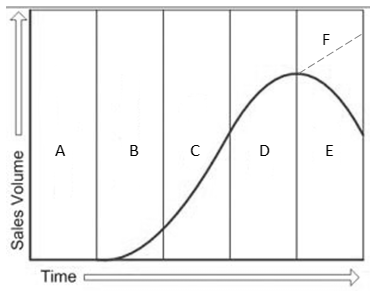
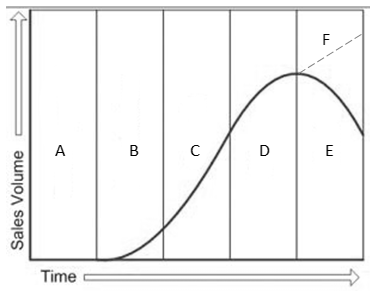
What is happening at point F of the Product Life Cycle?
Growth
Maturity
Extension Strategy
Introduction
Which of the following phase involve selecting the best idea and dropping poor ideas?
Idea generation
Business Analysis
Market strategy development
Idea screening
Which of the following phases are in the product life cycle?
Product development
Introduction
Growth
Product replacement
Maturity is the period where
Profits are nonexistent in this stage because of the heavy expenses of product introduction.
rapid market acceptance and increasing profits.
Profits level off or decline because of increased marketing outlays to defend the product against competition.
sales fall off and profits drop.
Which customers are often buy during the introduction of new product?
Laggards
Middle majority
Early adopters
Innovators
Declining is the period where
Profits are nonexistent in this stage because of the heavy expenses of product introduction.
rapid market acceptance and increasing profits.
Profits level off or decline because of increased marketing outlays to defend the product against competition.
sales fall off and profits drop.
Which customers are often buy during the declining stage of new product?
Laggards
Middle majority
Early adopters
Innovators
Business analysis includes
review of the sales
review of the costs
profit projections
Which of the following stages involve transforming a product concept into a physical product to offer workable market offering?
Business analysis
Product development
Marketing strategy development
Concept development and testing
Game Freak wish to introduce a new product into the market. First, they need to
screen ideas
brainstorm ideas
conduct business analysis
develop marketing strategy
The ideas generation can come from
employees
customers
competitors
government
Involves cultural trends and observing customer behaviors.
introducing the product
evaluating acceptance
testing the product
generating ideas
Eliminating possibilities until one or two ideas are selected for development.
generating ideas
screening ideas
introducing the product
evaluating customer acceptance
A prototype is made and tested.
testing the product
evaluating customer acceptance
screening ideas
generating ideas
Evaluates proposed product in terms of size of market, potential sales, costs, profit potential, technology, the competition, and the level of risk involved.
screening ideas
testing the product
business proposal
introducing the product
Companies make plans relating to production, packaging, labeling, branding, promotion, and distribution.
Testing the product
developing the product
evaluating customer acceptance
generating ideas
This stage is also called "commercialization". New products are advertised to introduce benefits to consumers.
Developing the product
Testing the product
Developing a proposal
Introducing the product
A model of a new product.
protagonist
prototype
proton
production
Packaging does not show the name of the product.
True
False
Packaging helps move the product.
True
False

