
NEW
Font size
 Worksheets
Circular Motion
Total questions: 10
Worksheet time: 10mins
A particle of mass 0.01 kg moves in a horizontal circle of diameter 1 m with an angular velocity of 3π
rad s-1.
What is the magnitude of the force responsible for this motion?
0.03 π
0.09 π
0.03 π2
0.09 π2
A particle of mass 0.01 kg moves in a horizontal circle of diameter 1 m with an angular velocity of 3π
rad s-1.
What is the direction of the force responsible for this motion?
away from the centre of the circle
towards the centre of the circle
along a tangent to the edge of the circle
in a circle
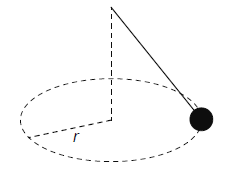
The mass at the end of a pendulum is made to move in a horizontal circle of radius r at constant speed. The magnitude of the net force on the mass is F.
What is the direction of F during half a revolution?
towards the centre of the circle
away from the centre of the circle
along a tangent to the circle
in a circle
The mass at the end of a pendulum is made to move in a horizontal circle of radius r at constant speed. The magnitude of the net force on the mass is F.
What is the work done by F during half a revolution?
0
πrF
(πrF)2
2πrF
An object of mass m at the end of a string of length r moves in a vertical circle at a constant angular speed ω.
What is the tension in the string when the object is at the bottom of the circle?
m(ω2r + g)
m(ω2r –g)
mg(ω2r + 1)
mg(ω2r +-1)
An object of mass m moves in a horizontal circle of radius r with a constant speed v. What is the rate at which work is done by the centripetal force?
rmv3
2πrmv3
4πrmv3
zero
An object rotates in a horizontal circle when acted on by a centripetal force F. What is the centripetal force acting on the object when the radius of the circle doubles and the kinetic energy of the object halves?
4F
2F
F
2F
The maximum speed with which a car can take a circular turn of radius R is v. The maximum speed with which the same car, under the same conditions, can take a circular turn of radius 2R is
2v
v√2
4v
2v√2
A satellite X of mass m orbits the Earth with a period T. What will be the orbital period of satellite Y of mass 2m occupying the same orbit as X?
2T
T
T2
2T

Two particles, X and Y, are attached to the surface of a horizontally mounted turntable.
The turntable rotates uniformly about a vertical axis. The magnitude of the linear velocity of X is v and the magnitude of its acceleration is a. Which of the following correctly compares the magnitude of the velocity of Y and the magnitude of the acceleration of Y with v and a respectively?
Y velocity = v
Y acceleration < a
Y velocity > v
Y acceleration < a
Y velocity = v
Y acceleration > a
Y velocity > v
Y acceleration > a

