
 Worksheets
Energy System Interplay 2
Total questions: 39
Worksheet time: 1hrs 18mins
Lactate Inflection Point can occur when an athlete
exercises at submaximal intensity.
fails to improve their lactate tolerance.
depletes their muscle and liver glycogen stores.
exceeds their VO2 maximum.
With regard to ATP production, the:
ATP-PC energy system has the highest yield and slowest rate.
Anaerobic Glycolysis energy system has the lowest yield and highest rate.
Aerobic Glycolysis has the highest yield and lowest rate.
Aerobic Lipolysis has the highest yield and lowest rate.
Which of the following is a situation when anaerobic glycolysis would NOT be the dominant source of energy?
In a 400 metre race
In the red blood cells
When a marathon runner approaches the finish line
Anaerobic Glycolysis would be dominant in all of the situations above
Which of the following correctly outlines a change that would occur at the commencement of exercise?
Decreased Lactic Acid
Increased Inorganic Phosphates (Pi)
Increased PC stores
None of the above
Which of the following fuels takes the longest to deplete?
Intramuscular ATP
Phosphocreatine (PC)
Glycogen
Water
A Centre player for Netball spends 34% of the time working at maximal effort and 66% of the time resting (work to rest ration is 1:2). The Dominant Energy System during work time for the Centre Player is
The ATP-PC System
The Anaerobic Glycolysis System
The Aerobic Energy System
Both the ATP-PC System and the Anaerobic Glycolysis System
During a 5km run what is the most likely cause of fatigue?
Depletion of PC
Accumulation of metabolic by-products such as hydrogen ions
Depletion of glycogen
None of the above
The Lactate Inflection Point, or LIP, is:
The point at which lactate production exceeds removal
The point beyond which lactate production exceeds removal
The point after lactate production exceeds removal
The accumulation of lactate in the blood
Our body uses 3 energy systems to produce ATP—aerobic, anaerobic glycolysis, and ATP-CP. These 3 energy systems are able to generate ATP at different rates as well as different yields. Which of the following statements is true in regards to the rate and yield of ATP production?
The ATP-PC system has the fastest rate of ATP production, as well as the largest yield relative to the other energy systems.
Fat metabolised by the aerobic energy system has the slowest rate of ATP production, but can produce the largest yield relative to the anaerobic energy systems
Anaerobic glycolysis produces more ATP from a glucose molecule than aerobic glycolysis.
Anaerobic glycolysis has a faster rate of ATP production than the ATP-PC system
A 100-metre runner completes a race in less than 10 seconds. What is the most likely cause of fatigue for this runner?
depletion of intramuscular glycogen stores
accumulation of hydrogen ions
depletion of creatine phosphate stores
dehydration
Aerobic glycolysis is the most efficient energy system in generating ATP for muscle activity. The net gain of ATP molecules produced due to the breakdown of glycogen is:
26 - 28
34 - 36
36 - 38
46 - 48
The by-products of the aerobic energy system include
lactic acid, water and energy for ATP resynthesis.
lactic acid, water and carbon dioxide
carbon dioxide, water and energy for ATP resynthesis.
carbon dioxide, water and lactic acid.
The most likely cause of fatigue for a 1500 m runner is
dehydration.
glycogen depletion.
metabolic by-product accumulation
elevated body temperature.
Which of the following are examples of FOOD fuels that, when broken down, can provide energy for ATP resynthesis?
carbohydrates, creatine phosphate and fats
creatine phosphate, adenosine diphosphate and carbohydrates
protein, carbohydrates and fats
creatine phosphate, fats and protein
Nutrition can be used to help speed up recovery post-exercise. Ingestion of both carbohydrate (CHO) and protein is important to allow
fast triglyceride and electrolyte restoration.
fast protein restoration and slow CHO restoration.
fast CHO and protein restoration simultaneously.
fast CHO restoration and slow protein restoration.
During a passive recovery, the main objective of the athlete is to
eliminate waste products such as hydrogen ions from the body
restore ATP and CP to pre-exercise levels.
break down lactic acid into pyruvate and hydrogen ions.
restore blood glucose to an optimal level.
Out of the following activities performed at maximal intensity, select the one with the highest percentage contribution of energy from the ATP–PC system.
100-metre sprint
long jump
50-metre swim
discus throw
Hypoglycaemia, often referred to as “hitting the wall”, is responsible for a decrease in performance and it occurs when
muscle glycogen stores deplete.
liver glycogen stores deplete.
blood glucose levels deplete.
protein becomes the major fuel supplier.
By-products of the ATP-PC system include
ADP, inorganic phosphate, creatine
AMP, inorganic phosphate, H+ accumulation.
ADP, lactic acid, water
ATP, heat, creatine phosphate.
The most likely cause of fatigue in an athlete competing in a 200m athletics event on a very hot 40 degree Celsius day would be
neural transmitter tiredness.
depletion of muscle glycogen.
decreased muscle pH levels.
dehydration.
The rate of ATP production and the amount of ATP produced by each of the three energy systems is different. Which of the following is true for the aerobic energy system?
Fast rate, high yield
Slow rate, low yield
Fast rate, low yield
Slow rate, high yield
Which of the following metabolic by-products is NOT believed to be implicated in causing muscular fatigue?
Inorganic phosphate (Pi)
Lactate
Hydrogen ions (H+)
Adenosine diphosphate (ADP)
Recovery after exercise can take the form of either a passive recovery or an active recovery. Which of the following would be best aided by an athlete undertaking a passive recovery?
Replenishment of muscle glycogen stores.
Replenishment of liver glycogen stores
Removal of accumulated hydrogen ions from muscle tissue.
Replenishment of muscle phosphocreatine stores
Which of the following statements is INCORRECT in relation to fats and their role in the body?
Meat products, dairy products and many processed foods are rich sources of fats
Fats are predominately utilised while at rest and during low-intensity activity such as walking.
The aerobic metabolism of a given amount of fats requires less oxygen than the aerobic metabolism of a similar amount of glycogen.
Fat is transported in the blood in the form of FFA.
In which of the following athletic running events at the 2012 London Olympics would the competitors be expected to use a relatively even contribution from the anaerobic and aerobic energy sources?
1500 metres
100 metres
10,000 metres
400 metres
Where does the krebs cycle occur?
sarcoplasm
mitochondria
muscles
lactate
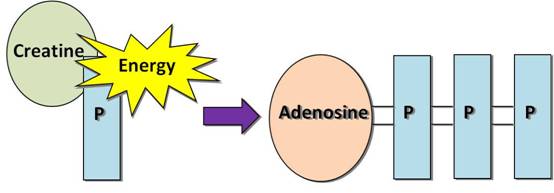
ATP breaks down to release energy for muscle contraction. It then turns into:
Adenosine Monophosphate
Adenosine Triphosphate
Adenine
Adenosine Diphosphate
The anaerobic glycolysis system of providing energy:
(Cambridge Checkpoints 2019).
uses only carbohydrates
is associated with submaximal exercise.
produces relatively few ATP molecules.
is activated two minutes after the onset of maximal exercise.
Carboyhydrates require
less oxygen than fats to break down.
more time than proteins to break down.
more oxygen than proteins to break down.
more time than fats to break down.
Energy System interplay refers to:
All three energy systems working together.
One energy system providing more energy than the other two systems at any point in time.
Three energy systems working together and one kicking in as the others drop off.
The PC system providing most energy first, then the anaerobic glycolysis system and then the aerobic energy system.
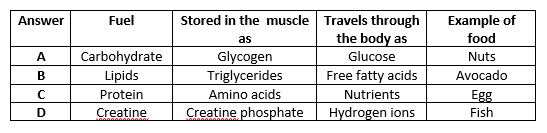
Which one of the above shows the correct information about the fuels used in ATP production.
A
B
C
D
The aerobic system provides ATP during recovery. Which food fuel would be the main contributor to ATP production during extended rest periods?
Lipids
Protein
Creatine
Carbohydrates
Fats are the primary fuel source of energy at: (VCAA 2016 Exam)
60% of VO2 max.
70% of VO2 max.
80% of VO2 max.
90% of VO2 max.
The ATP-PC system is utilised during what exercise intensity?
Sub-maximal intensity (<85% MHR)
High Intensity (85% MHR)
High Intensity (95% MHR)
At rest
The anaerobic glycolysis system achieves peak power during which time frame?
2-4 seconds
5-15 seconds
15-60 seconds
over 75 seconds
An elite 3000m runner would predominantly use which energy system during a race?
ATP-PC Energy System
Anaerobic Glycolysis Energy System
Aerobic Energy System

Which would be the dominant energy system in this physical activity?
ATP-PC System
Anaerobic Glycolysis System
Aerobic System
ATP system
Which of the following does NOT occur when working at or above the lactate inflection point (LIP)?
Ventilation rate increases
Pain levels increase
Blood lactate levels decrease
Fatigue sets in

