wayground logo

Free Printable Worksheets

NEW

Font size

S
M
L
XL
Worksheets

Movement of the Earth

Total questions: 30

Worksheet time: 44mins

Name
Class
Date
1.

Without the tilt of Earth's axis, we would not have ________

a)

Day and night

b)

Years

c)

Seasons

d)

The moon

2.

What season is the Northern Hemisphere having?

a)

Fall

b)

Winter

c)

Spring

d)

Summer

3.

What season is the Northern Hemisphere having?

a)

Fall

b)

Winter

c)

Spring

d)

Summer

4.

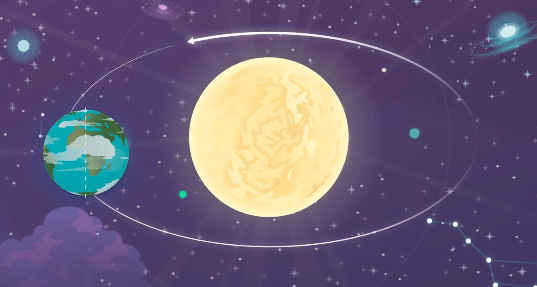
___________ is the path an object takes around another object in space.

a)

Rotate

b)

Revolve`

c)

Axis

d)

Orbit

5.
Which season is taking place in the Southern Hemisphere in Position 1?
a)
Winter
b)
Spring
c)
Summer
d)
Fall
6.
Which season is taking place in the Northern Hemisphere in Position 1?
a)
Winter
b)
Spring
c)
Summer
d)
Fall
7.
Which season is taking place in the Northern Hemisphere in Position 3?
a)
Winter
b)
Spring
c)
Summer
d)
Fall
8.
The hemisphere where you live 
a)
equator
b)
southern
c)
northern
d)
eastern
9.
What causes more heat,  indirect sunlight or direct sunlight?
a)
indirect
b)
direct
10.
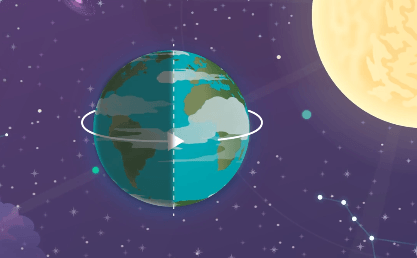
Day and night is caused by the _____________ of earth on its axis.
a)
revolution
b)
orbit
c)
rotation
d)
apparent motion
11.
About how long does it take the Earth to make one REVOLUTION around the Sun?
a)
12 hours
b)
24 hours
c)
365 days
d)
29.5 days
12.
How long does it take for Earth to rotate on its axis one time?
a)
24 hours
b)
24.25 hours
c)
365 days
d)
365.25 days
13.

It take the earth _________ to complete one rotation.

a)

a day

b)

a month

14.

The earth rotation results in producing:

a)

seasons

b)

day and night

15.

The earth is the __________ planet in the solar system

a)

first

b)

second

c)

third

d)

forth

16.

As the distance between planet and the sun increases the year length

a)

increases

b)

decreases

c)

all planets have the same year length

d)

non of the above

17.

The earth is tilted on its _____

a)

line

b)

equator

c)

axis

d)

core

18.
The right side of this illustration represents...
a)
...night.
b)
...winter.
c)
...summer.
d)
...fall.
19.
The Earth is rotating on its axis, creating _____
a)
the 12 months
b)
the years
c)
the seasons
d)
day and night
20.
How long does it take for the Earth to make one full orbit around the Sun?
a)
one day
b)
one week
c)
one month
d)
one year
21.
What is the name of the imaginary line running through the North Pole to the South Pole?
a)
orbit
b)
axis
c)
equator
d)
latitude
22.
This is the largest planet in the solar system.
a)
Saturn
b)
Jupiter
c)
Uranus
d)
Venus
23.
This is the smallest planet in the solar system
a)
Mercury
b)
Venus
c)
Earth
d)
Mars
24.
This gas giant has a large storm in its atmosphere known as The Red Spot
a)
Jupiter
b)
Saturn
c)
Uranus
d)
Neptune
25.
Which planet has the biggest rings?
a)
Jupiter
b)
Saturn
c)
Uranus
d)
Neptune
26.
What force keeps the planets orbiting the sun?
a)
Gravity
b)
Magnetism
c)
Electricity
d)
Friction
27.
They are small and have rocky bodies. 
a)
this describes the inner planets 
b)
this describes the outer planets 
28.

Which galaxy do we live in?

a)

Andromeda

b)

ESO 146-IG 005

c)

Milky Way

d)

Seque 2

29.
What kind of galaxy is this?
a)
Ring
b)
Irregular
c)
Spiral
d)
Elliptical 
30.

A Group of stars, and or star systems, held together by gravity is known as:

a)

Universe

b)

Galaxy

c)

Solar System

d)

Planet