wayground logo

Free Printable Worksheets

NEW

Font size

S
M
L
XL
Worksheets

PHY: Electrostatics

Total questions: 25

Worksheet time: 30mins

Name
Class
Date
1.
During a physics lab, a plastic strip was rubbed with cotton and became positively charged. The correct explanation for why the plastic strip becomes positively charged is that ...
a)
the plastic strip acquired extra protons from the cotton.
b)
the plastic strip acquired extra protons from the charging process 
c)
protons were created as the result of the charging process
d)
the plastic strip lost electrons to the cotton during the charging process 
2.
Insulators are different than conductors in that insulators ____.
a)
do not contain electrons or protons 
b)
 do not contain any charge
c)
have a weaker affinity for electrons 
d)
do not allow charge to freely move 
3.
A glass rod becomes positively charged when it is rubbed with silk. This net positive charge accumulates because the glass rod
a)
gains electrons
b)
loses electrons
c)
gains protons
d)
loses protons
4.
 A balloon is rubbed against a student's hair and then touched to a wall. The balloon sticks to the wall due to
a)
magnetic forces between the particles of the balloon and the particles of the wall
b)
electrostatic forces between the particles of the balloon and the particles of the wall
c)
magnetic forces between the particles of the wall
d)
electrostatic forces between the particles of the balloon
5.
When a plastic rod is rubbed with wool, the wool acquires a positive charge because
a)
protons are transferred from the wool to the rod
b)
protons are transferred from the rod to the wool
c)
electrons are transferred from the rod to the wool
d)
electrons are transferred from the wool to the rod
6.
Two electrically neutral metal spheres, A and B, on insulating stands are placed in contact with each other. A negatively charged rod is brought near, but does not touch the spheres, as shown in the diagram below. How are the spheres now charged?
a)
A is positive and B is positive.
b)
A is negative and B is positive.
c)
A is positive and B is negative.
d)
A is negative and B is negative.
7.
Two like charges
a)
 neutralize each other.
b)
repel each other. 
c)
must be neutrons. 
d)
attract each other.
8.
The charge of an electron is 
a)
positive. 
b)
negative. 
c)
Electrons have no charge
9.
An atom loses an electron.  What type of charge does it have now?
a)
positive
b)
negative
10.
What direction are the electric field lines around an electron?
a)
towards the charge
b)
away from the charge
11.
What does it mean when the electric field lines are close together?
a)
the field is positive
b)
the field is negative
c)
The field is strong
d)
the field is weak
12.
Charged objects are not attracted to neutral objects
a)
True
b)
False
13.
When a balloon is rubbed on clothes it acquires a charge by ___________
a)
Induction
b)
reduction
c)
friction 
d)
concuction
14.
Where do electrons go when you rub a balloon on your hair?
a)
Onto the balloon
b)
Into your hair
c)
Nowhere
15.

What direction are the electric field lines around a proton?

a)

towards the charge

b)

away from the charge

16.
Which of the following is not a good conductor of electricity?
a)
copper
b)
silver
c)
Glass
d)
aluminum
17.
The law of conservation of charge states that...
a)
all atoms have more protons than electrons
b)
only protons can be rubbed off of an atom
c)
charge cannot be created or destroyed
d)
charge cannot be transferred 
18.
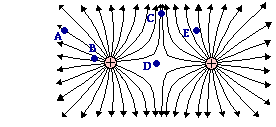
Which of the following labeled points is in the region with the strongest force of electric charge
a)
A
b)
B
c)
C
d)
D
19.

When a charged object contacts another object (one is usually a conductor), there is a transfer of electrons. How do you determine which object acquires the transferred electrons?

a)

Always transfer from the bigger to the smaller object, to make it even

b)

Transfer is based on the initial charge of the two objects

c)

Transfer is based on how much electron affinity that each object has

d)

Always transfer from the more negative to the more positive object
20.

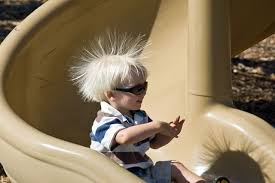
Why does the child's hair stick up?

a)

The boy is grounded since he's at the bottom of the slide

b)

He gained a charge from the slide, and since he's not grounded, his hairs have the same charge so they repel one another

c)

He gained a charge from the slide, and since he's not grounded, his hairs have opposite charges so they repel one another

d)

When hair is neutral, some have a positive side and some have negative side, so they will attract to each other, making it stand up

21.
When a plastic rod is rubbed with wool, the wool acquires a positive charge because
a)
protons are transferred from the wool to the rod
b)
protons are transferred from the rod to the wool
c)
electrons are transferred from the rod to the wool
d)
electrons are transferred from the wool to the rod
22.
If two balloons have the same charge, what will happen if you place them close to each other?
a)
Nothing
b)
They will be attracted
c)
They will pop
d)
They will push each other away.
23.

When a silver atom looses an electron, its net charge (in coulombs) is

a)

+1

b)

-1

c)

+1,6 x 10⁻¹⁹

d)

-1,6 x 10⁻¹⁹

24.
When you charge a balloon by rubbing it on your hair this is an example of what method of charging?
a)
Friction
b)
Conduction
c)
Grounding
d)
Induction
25.

which is the field for opposite charges

a)
b)
c)
d)