Wayground logo

Free Printable Worksheets

Font size

S
M
L
XL
Worksheets

Quiz: Acad. Modern Atomic Theory

Total questions: 44

Worksheet time: 54mins

Name
Class
Date
1.

Subatomic particles with a negative charge

a)

Electrons

b)

Neutrons

c)

Protons

d)

Quarks

2.

What is not a field that makes up an electromagnetic wave?

a)

electric

b)

magnetic

c)

digitial

d)

none of the above

3.

What electromagnetic wave . has . the shortest wavelengths and the highest frequencies?

a)

Gamma Rays

b)

Ultraviolet Rays

c)

Radio Waves

d)

X Rays

4.

What happens to wavelength as the frequency of a wave increases?

a)

increase

b)

stays the same

c)

decreases

d)

becomes faster

5.

The human eye is only capable of seeing which electromagnetic wave?

a)

Infrared Light

b)

Ultraviolet Light

c)

Visible Light

d)

All of the above

6.

What electromagnetic wave has the longest wavelengths and lowest frequencies?

a)

Microwaves

b)

Ultraviolet Rays

c)

Infrared Waves

d)

Radio Waves

7.

The color blue has more energy than the color red.

a)

True

b)

False

8.

To calculate the frequency of an electromagnetic wave, you need to know the speed of the wave and its

a)

wavelength.

b)

intensity.

c)

refraction.

d)

amplitude.

9.

Light acts like

a)

a wave.

b)

a particle.

c)

Both a wave and a particle

d)

neither a wave nor a particle.

10.

Light in the form of a particle that has discrete amount of energy is called a

a)

Charm

b)

Photon

c)

Exciton

d)

Muon

11.

Electrons that have not been excited are said to be at:

a)

high level

b)

base line

c)

set state

d)

ground state

12.

There may be a maximum of ____ p orbitals at a given energy level.

a)

2

b)

6

c)

3

d)

8

13.

This shape is that of a...

a)

s orbital

b)

d orbital

c)

p orbital

d)

f orbital

14.

This is a ____ orbital

a)

s

b)

d

c)

p

d)

f

15.

Which of the following is NOT a possible pair of quantum numbers?

a)

2p

b)

2d

c)

4p

d)

4f

16.

What is the electron configuration for F?

a)

1s2 2s2 3p5

b)

1s2 2s2 3d5

c)

1s2 2s2 2p5

d)

1s2 2p5

17.

What does the 1 in "1s" stand for?

a)

energy level

b)

s orbitals

c)

p orbitals

d)

the number of electrons

18.

What element has the electron configuration 1s2 2s2 2p6 3s2 3p5?

a)

Chlorine

b)

Argon

c)

Fluorine

d)

Sulfur

e)

Bromine

19.

How many electrons are in 1s2 2s2 2p4?

a)

5

b)

6

c)

8

d)

13

20.
What was wrong with Bohr's model of the atom?
a)
He said the atom had a dense, positive center.
b)
He said the atom was made of positive matter surrounding  negative particles.
c)
He said atoms cannot be subdivided, created or destroyed.
d)
He said e- follow specific paths.
21.
According to classical mechanics, which law(s)  apply or applies to the behavior of macroscopic particles?
a)
Newton's three laws
b)
the differential wave equation
c)

Dalton's law of multiple proportions

d)
Kepler's Law
22.
Schrodinger's cat experiment tested
a)
the probability of quantum tunneling
b)
Bohr's atomic model
c)
whether a quantum system could exist in multiple states
d)
radioactive decay in Plutonium
23.
All of the following statements about Schrodinger's cat are true EXCEPT
a)
it was conducted in 1935
b)
the cat is sealed inside of a box
c)
the cat  is both alive and dead
d)
there is a 50 percent chance a vial of poison is released inside the box
24.
Which physicist proposed the uncertainty principle in 1927?
a)
Niels Bohr
b)
Albert Einstein
c)
Arnold Schrodinger
d)
Werner Heisenberg
25.
Which two characteristics are variables in Heisenberg's uncertainty principle?
a)
wavelength and distance
b)
position and momentum
c)
charge and displacement
d)
atomic radius and frequency
26.
The Gold Foil experiment was done by __________.
a)
Chadwick
b)
Bohr
c)
Rutherford
d)
Thomson
27.
Which is the electron configuration for an oxygen atom?
a)
1s22s22p63s23p64s2
b)
1s22s22p4
c)
1s22s22p6
d)
1s22s22p63s23p6
28.
What is the maximum number of electrons that an orbital can have?
a)
1 electron
b)
2 electrons
c)
3 electrons
d)
4 electrons
29.
How many electrons can the d sublevel hold?
a)
8
b)
10
c)
2
d)
4
30.
What is this element? 
1s22s22p63s23p6
4s23d104p6
a)
Argon
b)
Krypton
c)
Selenium
d)
Bromide
31.
How many electrons can the first energy level hold?
a)
1
b)
2
c)
8
d)
0
32.
Which element is pictured?
a)
neon
b)
fluorine
c)
magnesium
d)
argon
33.

Electron arrangement that uses arrows

a)

Electron configuration

b)

Shorthand configuration

c)

Lewis dot structure

d)

Orbital notation

34.
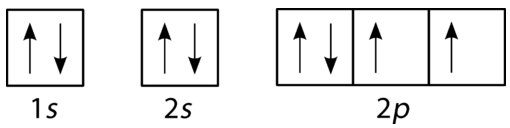
This orbital diagram represents:  
a)
C
b)
B
c)
N
d)
O
35.
This orbital diagram represents:  
a)
C
b)
B
c)
N
d)
O
36.
What is incorrect about this orbital diagram?
a)
Both arrows in the 2p box should be pointing up
b)
There is nothing incorrect with this diagram
c)
In the there should only be 1 orbital in the first 2p box and one in the 2nd 2p box
d)
All the arrows should be pointing up.
37.

Who's rule is incorrect with this orbital diagram?

a)

Schrodinger

b)

Pauli

c)

Hund

d)

DeBroglie

38.
 The diagram above represents two electrons with 
a)
a. opposite spins.
b)
 b. the same spin.
c)
c. different energies.
d)
d. different energy levels.
39.
Which is associated with more energy? 
a)
2p
b)
2s
c)
3p
d)
1s
40.
An electron occupies the lowest energy orbital that can receive it.
a)
Hund’s rule
b)
Pauli exclusion principle
c)
Bohr model of the atom
d)
Aufbau principle
41.
All orbitals of equal energy are occupied by one electron before any single orbital is occupied by a second electron.
a)
Aufbau principle
b)
Pauli exclusion principle
c)
Hund’s rule
d)
Core Notation
42.
No two electrons in the same atom can have the same four quantum numbers.
a)
Aufbau principle
b)
Pauli exclusion principle
c)
Hund’s rule
d)
Noble gas notation
43.

Which guideline, Hund’s rule or the Pauli exclusion principle, is violated in the following orbital diagrams?

a)

Hund's

b)

Aufbau's

c)

Pauli's Exclusion

44.

What does it mean to be "quantized"?

a)

The electron's mass is very small.

b)

The electron is actually a wave.

c)

The position & speed of the electron cannot be known at the same time.

d)

The electron is limited to certain positions in the atom because of specific, fixed energy levels.