wayground logo

Free Printable Worksheets

Font size

S
M
L
XL
Worksheets

EA6: Homework week 5.17 II

Total questions: 55

Worksheet time: 1hrs 5mins

Name
Class
Date
1.

Stored energy is ...

a)

Potential Energy

b)

Kinetic Energy

2.

Energy in motion is ...

a)

Potential Energy

b)

Kinetic Energy

3.

This car is moving fast. This is ...

a)

Potential Energy

b)

Kinetic Energy

4.

This apple hanging from a tree is an example of ...

a)

Potential Energy

b)

Kinetic Energy

5.

This turbine is spinning. This is an example of ...

a)

Kinetic Energy

b)

Potential Energy

6.

What energy transformation occurs in the chameleon as it quickly launches its tongue to catch an insect?

a)

Radiant --> Chemical

b)

Thermal --> Chemical

c)

Chemical --> Mechanical

d)

Mechanical --> Chemical

7.

What energy transformation occurs as as an elephant walks through the savanna?

a)

Thermal --> Chemical + Mechanical

b)

Mechanical --> Chemical + Thermal

c)

Radiant --> Chemical + Mechanical

d)

Chemical --> Mechanical + Thermal

8.
Kinetic energy is energy due to...
a)
interactions between objects or particles
b)
motion
c)
elasticity
d)
mass
9.

Based on this table which country seems the WORST, like you would NOT want to live there?

a)

Country A

b)

Country D

c)

Country E

d)

Country B

10.
Which Continent is home to 36% of the wild cats?
a)
Asia
b)
Africa
c)
North America
d)
South America
11.
What percentage does a whole circle graph represent?
a)
360%
b)
90%
c)
50%
d)
100%
12.
Which Continent has the smallest % of wild cats?
a)
Asia
b)
Europe
c)
North America
d)
South America
13.
Which Continent is home to 36% of the wild cats?
a)
Asia
b)
Africa
c)
North America
d)
South America
14.
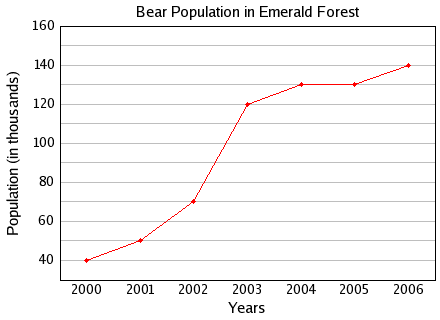
Between which two years did the bear population remain constant?
a)
2004 and 2005
b)
2001 and 2002
c)
2005 and 2006
d)
2000 and 2001
15.

The total energy of all the particles in a substance is called

a)

temperature

b)

thermal energy

c)

degrees

d)

mass

16.

Heat transfer occurs

a)

in many directions

b)

both from warm objects to colder ones and from cold objects to warmer ones

c)

only from warm objects to colder ones

d)

only from cold objects to warmer ones

17.
What happens to particles as they heat up?
a)
They slow down
b)
Nothing
c)
They don't move
d)
They speed up
18.
What happens to particles as they cool down?
a)
They slow down
b)
Nothing
c)
They don't move
d)
They speed up
19.
As you touch a hot stove the heat transfers -
a)
from your hand to the stove
b)
from the stove to your hand
c)
It doesn't transfer
20.
The amount of thermal energy is express in______
a)
Joules
b)
Calorie
21.
Conduction can only occur between two objects when –
a)
one object is less dense than the other.
b)
both objects are in physical contact with each other.
c)
one of the objects is made of a metal.
d)
both objects are exactly the same temperature.
22.
In the situation illustrated, how will heat energy move? Heat energy will be transferred from –
a)
the water to the hot plate by convection.
b)
the water to the hot plate by conduction.
c)
the hot plate to the water by convection.
d)
the hot plate to the water by conduction.
23.
The role an organism plays in its ecosystem
a)
niche
b)
behavior
c)
structure
d)
function
24.

An animal that is hunted as food

a)

prey

b)

predator

c)

decomposer

d)

producer

25.

An organism that hunts and feeds on another organism is a ______________________.

a)

prey

b)

producer

c)

predator

d)

decomposer

26.
How many mountain bikes were sold?
a)
22
b)
28
c)
16
d)
6
27.
The goal of every species on earth is...
a)
to survive and reproduce 
b)
divide and conquer 
c)
survive and conquer 
d)
reproduce and die 
28.
What are the 4 things that living things need to survive
a)
air, food, protection, love
b)
food, water, space, air
c)
love, protection, air, space
d)
protection, water, meat, plants
29.
What is a producer? 
a)
Organism that creates their own food.
b)
Organism that eat other organisms for energy
c)
Organism that eat other dead organisms
30.
What is a consumer? 
a)
Organism that creates their own food.
b)
Organism that eat other organisms for energy
c)
Organism that eat other dead organisms
31.
What is a decomposer? 
a)
Organism that creates their own food.
b)
Organism that eat other organisms for energy
c)
Organism that eat other dead organisms
32.
What do Omnivores eat? 
a)
Plants ONLY 
b)
Animals ONLY
c)
Plants AND Animals
33.
What do Herbivores eat? 
a)
Plants ONLY 
b)
Animals ONLY
c)
Plants AND Animals
34.
What do Carnivores eat? 
a)
Plants ONLY 
b)
Animals ONLY
c)
Plants AND Animals
35.
Who does the owl get energy from? 
a)
Grass
b)
Grasshopper
c)
Mouse
d)
Ow
36.
Who is the producer in this food chain? 
a)
Grass
b)
Grasshopper
c)
Mouse
d)
Ow
37.
Who does the grasshopper get energy from? 
a)
Grass
b)
Grasshopper
c)
Mouse
d)
Ow
38.

Producers are:

a)

animals

b)

rocks

c)

plants

39.

Plants are called producers because they can produce their own:

a)

music

b)

food

c)

air

40.

Animals that eat only plants are called:

a)

herbivores

b)

omnivores

c)

carnivores

41.

A food chain is:

a)

an animal that eats only plants.

b)

a diagram that shows how energy moves from one organism to another. (Grass>Mouse>Owl)

c)

An animal that is hunted and eaten by another animal.

42.

A system of many food chains that interact with each other:

a)

predator

b)

consumer

c)

food web

43.

An animal that hunts and eats other animals:

a)

producer

b)

plants

c)

predator

44.

A living thing that needs to eat other living things for food:

a)

consumer

b)

producer

c)

desk chair

45.

A living thing:

a)

organism

b)

rock

c)

weather

46.

An animal that is hunted and eaten by another animal:

a)

predator

b)

prey

c)

scavenger

47.

An example of a herbivore:

a)

cow

b)

lion

c)

wolf

48.

An example of a carnivore:

a)

giraffe

b)

eagle

c)

cow

49.

An example of a producer:

a)

apple tree

b)

cat

c)

dog

50.

An example of a consumer:

a)

grass

b)

roses

c)

dog

51.

An example of a predator:

a)

shark

b)

mouse

c)

rabbit

52.

An example of prey:

a)

lion

b)

mouse

c)

shark

53.
What is the study of the interactions among organisms and  between organisms and their environments called?
a)
Biology
b)
Ecology
c)
Astronomy
d)
Biosphere
54.
Which of these is an example of an autotroph?
a)
Sunflower
b)
Krill
c)
Leopard
d)
Hummingbird
55.
Energy increases as you move up the food pyramid (from bottom to top).
a)
True 
b)
False