
 Worksheets
Evidence of Evolution [9.2]
Total questions: 20
Worksheet time: 20mins
Which of these structures are homologous?
the wings of a bat and the wings of a moth
the hip bones of snakes
the lungs of a land mammal and the gills of a marine animal
the three long bones in a human arm and the three long bones in a cat's front leg

Which conclusion can best be drawn from the diagram?
The four animals have similar dietary needs.
The four animals have the same number of chromosomes.
The four animals may have evolved from a common ancestor.
The four animals may have evolved during a different period of time.
The bones in the wings of a bird, the flipper of a whale, and the arm of a human are
analogous structures
abiotic factors
biotic factors
homologous structures
What is the primary evidence to show changes in species over long periods of time?
fossil record
the movement of continents
the genetic records of prehistory and modern species
the discovery of living organisms based on an element other than carbon
Fossils of an extinct species of giant armadillo were found to be similar to a smaller species of armadillo presently inhabiting the same region. This similarity could be best explained on the basis of
modern forms have evolved from earlier forms
inheritance of acquired traits
use and disuse
the heterotroph hypothesis

The presence of feathers on some dinosaur fossils suggests that
dinosaurs were flying reptiles
modern reptiles lost their feathers
all winged animals share common ancestry
birds evolved from dinosaurs
Genome maps provide the DNA sequences of chromosomes. Some scientists have compared the genome maps of a hedgehog and a sloth. What do these genome maps allow the scientists to determine?
The color patterns of the offspring of each species
How much the size ranges of the two species differ
The methods of protein synthesis that each species uses
How closely related the two species are to each other.
Two nucleotide sequences found in two different species are almost exactly the same. This suggests that these species
are evolving into the same species
contain identical DNA
may have similar evolutionary histories
have the same number of mutations

The vestigial hindlimb bones of a whale are considered to be evidence of
common ancestry with land mammals
common ancestry with snakes
mutations generating new traits
intelligent design
What conclusion can you draw from the fact that many modern whale species have pelvic and leg bones?
The ancestors of whales may have been land mammals
Whales could walk if they wanted to
Whales are preparing to evolve into land animals
Someday whales will be able to walk and will have legs
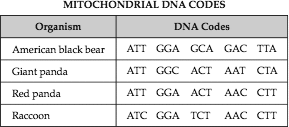
What conclusions can be made based on this table shown?
the American black bear and the giant panda are most closely related
the giant panda and the red panda are most closely related
the red panda and the racoon are the most closely related
the giant panda and the racoon are most closely related

Which of the following can be determined by observing the embryos shown in the diagram


Which structure suggests evidence of common ancestry with the bat?
Bird wings because they both fly
Moth wings because they're both wings
Whale fins because they both flap
Human hands because they have similar bones

Archaeopteryx lithographica is an example of a transitional fossil because
It was the intended transition between reptiles and birds
it has features of both dinosaurs and birds
it was adapted to both run and fly
it doesn't match the timeline of evolution we had predicted


A researcher in the Amazon jungle recently found an unknown species of fern. She compared it to four known fern species that grow in the same area. Her results are shown in the table. The unknown species is most similar to which known species?
species 1
species 2
species 3
species 4

The table shows the number of differences between the amino acid sequence in the hemoglobin molecules of several different species compared with the amino acid sequence in human hemoglobin. Using this data, which organism is most related to humans?
Responses
frog
gorilla
horse
pig

