wayground logo

Free Printable Worksheets

NEW

Font size

S
M
L
XL
Worksheets

Nuclear Chemistry Review For Exam

Total questions: 35

Worksheet time: 47mins

Name
Class
Date
1.

The half life of Thorium-234 is 24 days. What fraction of the element remains after 96 days. Use scrap paper if necessary.

a)

1/2

b)

1/4

c)

1/8

d)

1/16

2.

The technetium-99 isotope has a half-life of 6.0 hours. If 100.0 mg were injected into a patient how much remains after 18 hours? Use scrap paper if necessary.

a)

33.0 mg

b)

12.5 mg

c)

.33 mg

d)

15.8 mg

3.

Cobalt-60 is a beta emitter with a half-life of 5.3 years.

How many half-lives did the sample go through at the end of 21.2 years? Use scrap paper if necessary.

a)

2

b)

3

c)

4

d)

5

4.

Barium-122 has a half-life of 2 minutes. A fresh sample weighing 80 g was obtained. If it takes 10 minutes to set up an experiment using barium-122, how much barium-122 will be left when the experiment begins? Use scrap paper if necessary.

a)

0.25g

b)

2.5g

c)

25g

d)

80g

5.

Which type of radioactive decay gives off energy only (no particles)?

a)

alpha

b)

beta

c)

gamma

6.

In order of most to least penetrating radiation we have

a)

Alpha , Beta, Gamma

b)

Beta , Gamma , Alpha

c)

Gamma, Beta, Alpha

d)

Gamma, Alpha, Beta

7.
What sort of shield will block gamma rays?
a)
skin
b)
paper
c)
aluminum
d)
thick lead
8.
What happens to the atomic number during alpha decay?
a)
The atomic number decreases by 4
b)
The atomic number increases by 1
c)
The atomic number decreases by 2.
d)
The atomic number stays the same.
9.
What process is modeled with this equation?
a)
alpha decay
b)
beta decay
c)
fission
d)
fusion
10.
Balance the following equation:
146C --> 0-1e + ________
a)
145B
b)
146C
c)
147N
d)
42He
11.
What type of reaction is this?
a)
alpha
b)
beta
c)
gamma
d)
quiet
12.
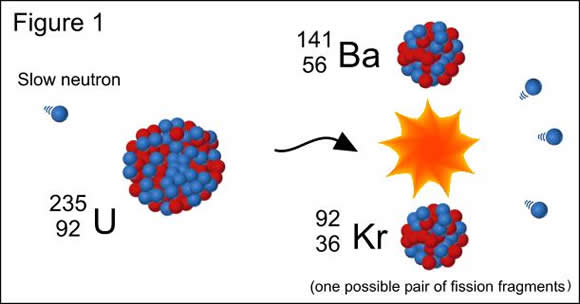
Which nuclear process is shown in the picture?
a)
fission
b)
fusion
c)
alpha decay
d)
beta decay
13.
What is one problem with using nuclear fission as an energy source?
a)
finding radioactive elements that have longer half-lives
b)
finding ways of storing radioactive wastes
c)
finding compounds to cool heated water
d)
finding non-radioactive elements for reactors
14.
What is not true about fission reactions at power plants?
a)
They are exothermic
b)
They produce a lot of energy
c)
They are uncontrolled and fast
d)
They are slow and controlled
15.
Which nuclear power plant has not had a meltdown
a)
Three Mile Island (US)
b)
Chernobyl (Ukraine)
c)
Taishan (China)
d)
Fukushima (Japan)
16.
During fission, some of the nuclear mass is converted into
a)
energy
b)
heavier nuclei
c)
critical mass
d)
protons
17.
Which produces more energy--nuclear fission or nuclear fusion?
a)
Fusion
b)
Fission
c)
They produce the same amount
d)
It depends on the elements used
18.

Determine the type of reaction above.

a)

Alpha Decay

b)

Beta Capture

c)

Beta Emission

d)

Positron Emission

19.

What is the missing isotope that will balance the following nuclear equation? Use scrap paper if necessary.

94Be + 11H → _____ + 42He

a)

105B

b)

105Ne

c)

63Li

d)

63C

20.
In a nuclear reactor what slows down neutrons?
a)
Control Rods
b)
Moderator
c)
Sheilding
d)
The brakes
21.
In fission neutron is often used to start the reaction and it is also a product of the reaction. This is called a ____
a)
neutron emission
b)
nuclear fusion
c)
domino effect
d)
chain reaction
22.

What is the product in the following nuclear reaction? Use scrap paper if necessary.

11H + 31H → ____

a)

41H

b)

42Be

c)

42He

d)

21H

23.
Which of the following is a disadvantage of nuclear energy as a power source?
a)
Nuclear energy produces less energy than the burning coal
b)
Nuclear energy produces air pollution
c)
Nuclear waste must be safely stored
d)
The fuel source is very limited
24.
An electron that is emitted during radioactive decay is a
a)
neutron
b)
gamma ray
c)
alpha particle
d)
beta particle
25.
What is meant by the statement that 15P32 has a half life of 14 days
a)
It takes 7 days to go down to 50% radioactivity each time
b)
It takes 14 days to go down to 50% radioactivity each time
c)
After 14 days it starts to become less radioactive
d)
It takes 14 days to go up by 50% radioactivity each time
26.
In a nuclear reactor what absorbs fast moving neutrons?
a)
generator
b)
moderator
c)
control rods
d)
sheilding
27.
What turns the turbines in a nuclear power plant?
a)
uranium
b)
plutonium
c)
heat
d)
steam
28.
a)

A

b)

B

c)

C

d)

D

29.
a)

A

b)

B

c)

C

d)

D

30.
a)

A

b)

B

c)

C

d)

D

31.
a)

A

b)

B

c)

C

d)

D

32.
a)

A

b)

B

c)

C

d)

D

33.

What happens when the number of protons in an atom changes?

a)

It becomes a new isotope

b)

Usually nothing happens, unless the atom is radioactive

c)

The atomic nucleus explodes

d)

It becomes a completely different atom, with different properties

34.

The graphic image shown refers to the...........

a)

Line of Solidarity

b)

Graph of Balance

c)

Band of Stability

d)

Neutron Probability

35.

All of the elements in this group above #92 undergo radioactive decay and are never found in nature.....

a)

Polonium Group

b)

Transuranium Group

c)

Plutonium Group

d)

Transmutation Group