
 Worksheets
Isolation, Expansion, Imperialism...OH MY!
Total questions: 31
Worksheet time: 17mins
What was referred to as "Seward's Folly?"
Annexation of Hawaii
Purchase of Alaska
Making Cuba a protectorate
Signing of the Treaty of Kawanaga
An addition to the Monroe Doctrine that states the U.S. may use force to keep stability in Latin America:
Monroe Doctrine
Roosevelt Corollary
Dollar Diplomacy
Isolationism
What territories did the U.S. gain as a result of the Spanish-American War?
Midway and Samoa
Panama and Colombia
Guam, Puerto Rico, & the Philippines
Japan and China
Why did the U.S. annex Hawaii?
Economic value of sugarcane
Discovery of Gold
Access to a canal to connect the region
Cure yellow fever
Americans dreamed of expanding territory, seeking land and better opportunities:
Colonialism
Annexation
Isolationism
Imperialism
The Platt Amendment...
Gave the U.S. the right to intervene in Puerto Rico's business at any time it wanted.
Gave the U.S. the right to intervene in the Philippine Island's business any time it wanted.
Gave the U.S. the right to intervene in Hawaii's business any time it wanted.
Gave the U.S. the right to intervene in Cuba's business any time it wanted.
This person believed that the strength of a nation lies in the power of their Navy...
Theodore Roosevelt
Woodrow Wilson
William H. Seward
Alfred Thayer Mahan
John Hay proposed the/an _____ in opposition to the European spheres of influence.
Open Door Policy
Platt Amendment
Teller Amendment
Big Stick Policy
Which of the following best summarizes Dollar Diplomacy?
The U.S. had a moral duty to help nations in need
The U.S. should invest in foreign nations to help stimpulate trade
The U.S. should spread democracy to the backwards nations of Latin America
The U.S. needed to remove itself for poor investments in foreign nations
The Roosevelt Corollary to the Monroe Doctrine established the U.S.’s right to ___.
Build the Panama Canal
Annex Hawaii
Attack the Spanish
Intervene in Latin America
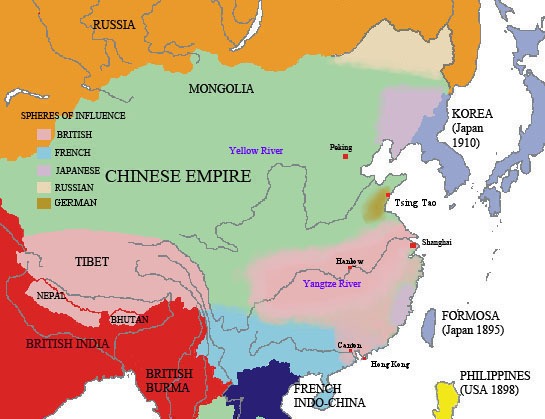
What term is used for the various regions in which foreigners controlled their own affairs in China in the 19th and 20th centuries?
Spheres of influence
Open Door Policy
Dollar Diploimacy
Big Stick Policy
Which of the following was NOT a motivation for U.S. imperialism?
Need for raw materials to support industry
Anglo-Saxonism (cultural superiority)
Desire to attract new immigrants
Increase American political and military reputation
Expansionists such as Roosevelt and Alfred Mahan urged the U.S. to...
Extend its influence into Africa
Acquire overseas territories, especially in the Pacific
Negotiate economic programs with Asian nation
Seek better trade relations with Latin America
American (public) support for Cuban rebels was fueled by...
Sugar investments
Interests in American immigration
Yellow Journalism
Fear of a Spanish colony close to its borders
Why did the de Lome letter anger Americans?
Outlined European desire to build an American empire
Identified the plan to blow up the U.S.S. Maine
Mocked and ridiculed the President and his administration
Identified a plot to threaten American interests in Latin America
The Teller Amendment stated that..
The U.S. had no interest in annexing Cuba
The U.S. would pay war reparations
The U.S. would assume control of and annex Cuba
The U.S. would acquire the lease from France to build a canal
The Platt Amendment added what to the Cuban constitution?
Limitations on Cuban treaties made with other countries
Called for a withdrawal of U.S. troops
The sale of San Juan hill to the U.S. for $20 mill.
Outlined the creation of a democratic gov't for Cuba
How did the Filipinos react to becoming a U.S. territory?
Rebelled against the U.S. troops unsuccessfully
Welcomed the opportunity to access more American products
Called for more U.S. involvement and protection
Integrated their culture after the U.S. cultural superiority
What was the justification for imposing imperialism on the Philippines?
Industrial expansion
Dollar Diplomacy
Moral Diplomacy
Ethnocentrism
The Anti-Imperialist league considered the ___ to be criminal aggression due to the subjugation of its people.
War for Panama independence
Declaration of war on Spain
Occupation of the Philippines
Purchase of Alaska
What contributed to the outbreak of the Boxer Rebellion?
Poor treatment towards foreigners
Outbreak of the Russo-Japanese War
Chinese anger at foreign involvement in China
Anglo Saxon influence on Chinese culture
How did Roosevelt's use of the "speak softly and carry a big stick" reflect his foreign policy?
Ordered troops to invade foreign nations
Used business interests to promote influence
Used a soft spoken personality to gain nations' trust
Used negotiations backed up by a threat of military force
Why did the U.S. support and recognize Panama's independence?
To build a canal that facilitate trade between the oceans
To stabilize the Latin American economies
To improve Latin American relations with the U.S.
In order to gain control and annex the nation
President Wilson sent General John J. Pershing to Mexico to ...
Capture Pancho Villa
Prevent diseases (yellow fever & malaria)
Seize the rebel city of Veracruz
Defeat and capture San Juan Hill
What did Wilson's foreign policy revolve around?
Building democracy in foreign countries
Promoting American business interests
Increasing the acquisition to new markets
Ensure a military force could back up negotiations
What was the role of journalism during the Age of Imperialism?
Influencing and affecting public opinion
Increase the morality of the printed press
Pressure the wealthy to finance military operations
Provide detailed accounts of gov't actions to the people
How were Emilio Aguinaldo, the Boxers, and Pancho Villa similar?
Worked to promote the Anti-Imperialist league
Resisted U.S. imperialism in their nations
Resisted their countries becoming U.S. territories
Worked to promote Anglo Saxonism in their nations
Anti-imperialists were concerned that imperialism would weaken...
The foundations that built the U.S.
The religious beliefs of Americans
The ability to enforce immigration policies
The growth of industry that advance their nation
Which of the following nations was NOT a stepping stone towards the larger prize in China?
Puerto Rico
Midway islands
Hawaii
Philippines
Expansionists, like Alfred Thayer Mahan, urged America to...
Acquire overseas territories
Extend influence in the Middle East
Negotiate cultural exchanges within Africa
Build trade relations with Latin America

