wayground logo

Free Printable Worksheets

Font size

S
M
L
XL
Worksheets

Ecology

Total questions: 32

Worksheet time: 24mins

Name
Class
Date
1.
How do producers obtain energy?
a)
They conduct photosynthesis.
b)
They consume plants.
c)
They consume primary consumers.
d)
They consume secondary consumers.
2.
How do consumers get their energy? 
a)
laying in the sun
b)
eating other organisms 
c)
providing food for other organisms
d)
surviving in an ecosystem 
3.
Which organism do the owl and the weasel compete for in the food web?
a)
Hawk
b)
Spider
c)
Grasshopper
d)
Shrew
4.
What might happen if you remove a primary consumer from the ecosystem?
a)
There would be more food for secondary consumers.
b)
The number of primary consumers would increase.
c)
The number of plants would increase.
d)
The number of secondary consumers would increase.
5.
Which of the following would be the most likely effect, if there were a sudden increase in the cricket population?
a)
There would be a decrease in the small bird population.
b)
There would be a decrease in the grass/flowers population.
c)
There would be a decrease in the mice population.
d)
There would be an increase in the grass/flowers population.
6.
Which of the following best describes the small bird in the food web above?
a)
primary and secondary consumer
b)
secondary and tertiary consumer
c)
primary consumer only
d)
secondary consumer only
7.
How many primary consumers are there in this food web?
a)
1
b)
2
c)
3
d)
4
8.
Which one is NOT an example of a decomposer?
a)
mushroom
b)
leaves
c)
mold
d)
worm
9.
Example of a decomposer
a)
fungus
b)
mouse
c)
plants
d)
frogs
10.
What is this called?
a)
Food Web
b)
Food Chain
c)
Abiotic Factors
11.
What is this called?
a)
Food Web
b)
Food Chain
c)
Abiotic Factors
12.
What's the role of consumers in a food chain?
a)
Use sunlight to make food 
b)
Eat other species and keep them from overpopulating
c)
Break down dead stuff
d)
Add nutrients to the soil
13.
True or False. In this Food Web Pyramid the consumers on each level only get about 10 percent of energy that the plants have stored.
a)
True
b)
False
14.
In this Food Web Pyramid what is the proper name for the organisms above the producer level at the bottom.
a)
herbivores
b)
consumers
c)
carnivores 
d)
omnivores
15.

This diagram shows how energy flows through an eco-system. What is the first source of energy in this pyramid?

a)

sharks and large birds

b)

algae, plankton and seagrass

c)

herbivorous fish, crustaceans and sea urchins

d)

seals and carnivorous fish

16.

Several owls live in a forest. The owls prey on mice. Hawks also prey on mice. Which might happen if several hawks move to the forest where the owls live?

a)

The number of owls will increase, and the number of hawks will decrease.

b)

The number of mice will increase, and the number of owls will decrease.

c)

The number of owls and hawks will increase.

d)

The number of owls and mice will decrease.

17.
What are plants called in a food chain?
a)
Producers
b)
Consumers
c)
Decomposers
d)
Scavengers
18.
What are animals called in a food chain?
a)
Producers
b)
Consumers
c)
Decomposers
d)
Plants
19.
What are the organisms that break down dead stuff?
a)
Producers
b)
Consumers
c)
Decomposers
d)
Organisms
20.
Where does the energy start in this food chain?
a)
Plant
b)
Sun
c)
Deer
d)
Wolf
21.
What is the role of a producer?
a)
Use sunlight to make food
b)
Gain energy from eating other organisms
c)
Keep other species from overpopulating
d)
Breaking down dead stuff 
22.
What is the role of decomposers in a food chain?
a)
Use sunlight to make food
b)
Eat other organisms to gain energy
c)
Make the food for the whole food chain
d)
Break down dead organisms and add nutrients to the soil
23.
Which of these organisms would receive energy from the snake?
a)
Plant
b)
Rabbit
c)
Mouse
d)
Hawk
24.
Which food chain is in the correct order?
a)
cat, grass, bird, snail
b)
bird, snail, grass, cat
c)
grass, snail, bird, cat
d)
grass, cat, bird, snail
25.

If a disease strikes the snakes the rabbits will

a)

increase

b)

decrease

c)

not be affected

26.

If a disease strikes the snakes the grass will

a)

increase

b)

decrease

c)

not be affected

27.
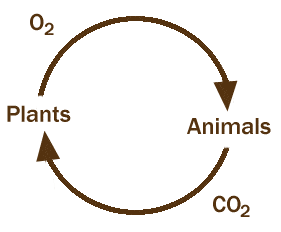
Which statement is true about the carbon dioxide-oxygen cycle?
a)
animals breathe in nitrogen and release oxygen which is used by plants
b)
animals breathe in oxygen and release carbon dioxide which is used by plants
c)
animals breathe in nitrogen and release carbon dioxide which is used by plants
d)
animals breathe in carbon dioxide and release oxygen which is used by plants
28.
If all the trees on Earth were destroyed, what would be the effect on humans?
a)
there would be a lack of food
b)
there would be a lack of oxygen
c)
there would be a lack of fresh water
d)
there would be a lack of carbon dioxide
29.
The class decided to have a terrarium.  The teacher says it is important to include both plants and animals.  Why is it necessary to include both plants and animals?
a)
plants provide food for the animals and animals provide water for the plants
b)
plants provide water for the animals and animals provide food for the plants
c)
plants provide carbon dioxide for the animals and animals provide oxygen for the plants
d)
plants provide oxygen for animals and the animals provide carbon dioxide for the plants
30.
Animals and plants use substances that cycle through the environment.  Which substance is needed by plants to survive and is released into the environment by animals?
a)
oxygen
b)
sugar
c)
salt
d)
carbon dioxide
31.
If the removal of many plants and trees increase in a forest, what effect could this have on the carbon dioxide and oxygen cycle?
a)
CO2 levels decrease
b)
CO2 levels increase
c)
Nitrogen levels decrease
d)
Oxygen levels increase
32.
If the Sun stop shinning, plants and animals would not survive because ___________________.
a)
Plants use the Sun's energy and oxygen to make glucose, which animals eat.
b)
Plants use the Sun's energy and CO2 to make glucose, and release O that animals breathe.
c)
Plants use the Sun's energy to make CO2 and release glucose.
d)
Plant use the Sun's energy to make water and release O that animals breathe in.